Endometriosis

Havin’ a Heat Wave!

hot flash noun. a sudden feeling of feverish heat, typically as a symptom of menopause.

Not every girl in her mid-thirties is as blessed as me. I get to take small, frequent vacations to my own, private, tropical resort every day. I can be sitting in a restaurant, standing at my bathroom sink, or even kneeling in church when – swoosh! – within moments I am transported to a hot, humid haven.

Two Sundays ago, I was sitting in a pew when a particularly sweltering climate change hit, and I looked around to see if anyone else in the nave had noticed the equatorial shift. Everyone sat perfectly still, snuggled comfortably in their cardigans and suit coats, while I sat there furiously fanning my sleeveless arms.

“I remember those days,” a woman in her fifties leaned over to whisper conspiratorially.

She was not the only one to have noticed my steamy situation. A cluster of women standing in the narthex after the service grinned at me and confided, “The night sweats are the worst!”

Even though most of these women are twenty-plus years my senior, they welcomed me – Lupron-induced-menopausal, little me – into their circle. I felt oddly special to be included in their conversation, like a youth at the kids’ table suddenly being invited to dine with the adults.

The most touching show of camaraderie, however, came later that night at our monthly Bible study.

“Here,” Gretchen smiled, handing me a canvas-covered fan painted with delicate folk art. “I used this during the worst of it.”

I fingered the wooden handle and raised the fan to test its canvas sail. My lips parted in sweet relief as the most delicious, refreshing breeze moved across my feverish cheeks.

“Isn’t it the best?” Gretchen exclaimed. “You can keep it.”

Yep. I am one, blessed girl. Bring on the hot flashes!

My Peach

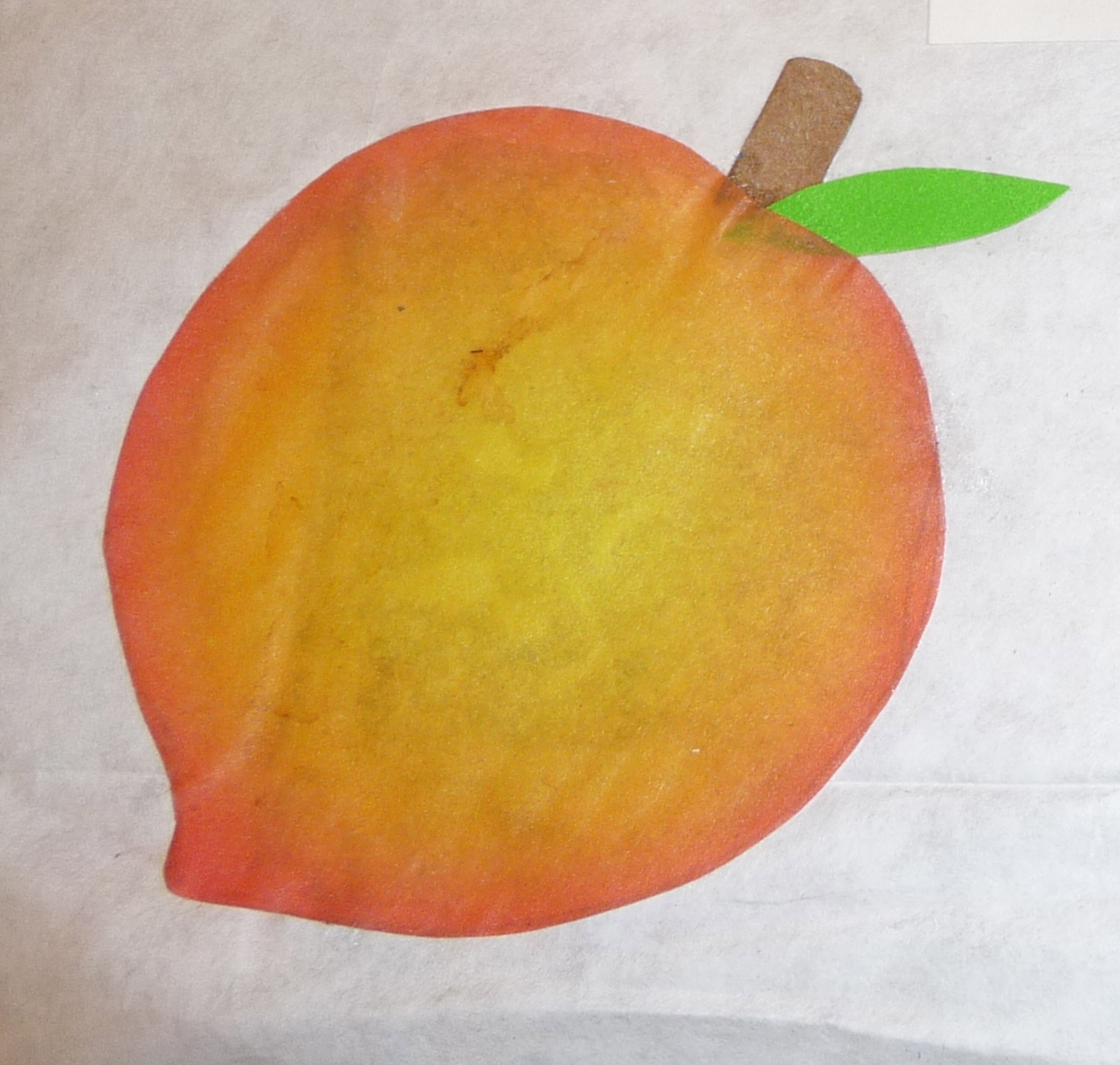
I had a peach growing inside of me. Not a little peach, but a ripe, juicy peach measuring at eight centimeters. Like any fruit in its prime, my peach needed to be harvested before it became hazardous to the rest of my orchard. Heaven forbid it should turn rancid, or – worse! – grow so big as to break off a limb!

“There is only one thing to do,” my orchard keeper said. “We need to schedule a peachectomy.”

Okay.

“And, who knows? Maybe, we’ll find some weeds to pull or some dead branches to trim. If not, we can at least test the soil’s acidity before next spring.”

“Peachy,” was all I could say.

However, I felt anything but. A peachectomy, you see, has never been on my bucket list, and I have always lived in hopes that my tree, fruitful or not, would never ever have to be axed or chainsaw massacred. Still, my orchard keeper is the best, so there was nothing left for me to do but to take her advice and to trust in the Lord of the Harvest.

Right around this time I received a package in the mail from a friend. It was wrapped in white paper, and next to my name on the top was a cut-out of an orange-yellow piece of fruit. I started laughing before I even opened the package, and I kept laughing as I pulled out an assortment of peachy-rific gifts: peaches and cream oatmeal, peach tea, peach lip gloss, you name it. “Here’s your ‘Life’s a Peach’ survival kit,” my friend wrote. “You weren’t trying to have surgery without one, right?”

Praise be to God, my peach was successfully harvested, pesky weeds were pulled, and my soil’s acidity was determined fine and dandy. I find myself daily offering up prayers of thanks to God for such a wise and talented orchard keeper and for such loving, thoughtful, hilarious friends who never let a sister in Christ feel alone in her suffering. (Thank you, Rebekah!) Life really is a peach.

Jump Squats

Everyone has a coping mechanism. Some bake brownies for personal consumption, others escape reality through episodes of Downton Abbey, and others still sew and stitch and glue and prune and create to their hearts’ content.

My coping mechanism? Training for the next big race.

So, you can imagine my feeling of panic when my doctor told me last August that I had to immediately cease all impact exercise. No road races. No triathlons. No nothing. That was six months ago, and I am still staring at four more weeks on the calendar before I can hit the pavement running again.

Sometimes, the temptation to despair is overwhelming. We already lose so much in our barrenness – our family line, our health, our societal pride, our Mother’s Day carnations – that the thought of losing one more thing, especially that thing which brings us the most temporal comfort, threatens to break us.

But losing it won’t break you. The things that we lose in this life are not the things that last, and they most certainly are not the things that save us from despair. Abandoning my sneakers has only reassured me of this truth: Neither death nor life nor things present nor things to come nor lost endorphins will separate me from the love of Christ. His gifts of forgiveness, life, and salvation do last, and they most certainly do save me from despair. They are even readily available to me today in His Word and in His Body and Blood, filling me with comfort when my coping mechanism can’t.

Still, I am really looking forward to doing jump squats again.

Surgery Survival Kit

Laparoscopies. Laparotomies. Myomectomies. Hysterectomies. Sometimes, surgeries come hand-in-hand with barrenness, so we decided to create a Surgery Survival Kit for all of you. Here is the best (and worst) of what we have learned from our own experiences under the knife:

1. Do whatever your doctor tells you to do, both pre and post-surgery. Ignore everything else on this list if your doctor does not approve. (Sincerely, your HRTB Hosts)

2. Um, don’t even try to get through this ordeal without a stash of dark chocolate on hand. (Katie)

3. See if you can get your post-surgery prescriptions at your pre-op appointment. It is nice to have those meds ordered, picked-up, ready to go, and waiting for you when you get home. (Katie)

4. While you’re at the pharmacy, go ahead and stock up on MiraLAX or some kind of stool softener. Constipation is a common side effect of pain killers. (Katie and Jen)

5. Following a laparoscopy, you are most likely going to have gas pain in your shoulders (No kidding!), and it can cause you more discomfort post surgery than your actual incisions. The gas is leftover carbon dioxide from all that was pumped into your abdomen during the procedure. It can take up to 48 hours for your body to reabsorb the gas, so I recommend stocking up on some Gas X (Jen swears by the strips!) and having a heating pad within reach. (Katie)

6. Buy some good pads. The hospital may send you home with a few, but buy ones you like.  Bleeding is common after whateverectomies, and the last thing you want to do on the way home from surgery is stop somewhere to buy pads. (Jen)

7. Make sure your pastor knows the date, time, and location of your surgery, so that he can be there to read Psalms to you and pray with you while you wait. Don’t be embarrassed to tell him. I promise you, it’s worth it. (Katie)

8. Wear low-rise, loose-fitting, comfy pants to your surgery, as well as slip-on shoes. Your incision(s) will thank you later. (Katie)

9. Leave a pillow in your car. Trust me, you want something in between you and the seatbelt on your way home from the hospital. (Rebecca and Katie)

10. Are you a singer? Make sure your anesthesiologist knows. You can tell him/her when he calls you the night before your surgery. It doesn’t hurt to remind your anesthesiologist to look out for your vocal folds during intubation. (Katie)

11. Pack a bag for the hospital. You may be going in with the intention of having outpatient surgery, but you never know – especially if it is a diagnostic surgery – whether or not it will turn into an overnight stay. Must-have items on your packing list: toothbrush, toothpaste, hairbrush, hair rubbers bands, pajamas, prescription meds, a good book, your glasses case, and someone to take you home. (Jen and Katie)

12. Invite someone to stay with you for a few days (or longer). It can be very difficult to manage on your own when you are on bed rest, doped up on pain meds, legally unable to drive, and on doctor’s orders not to lift anything over ten pounds. (Jen)

13. I remember seeing a cat scampering around the post-op room as I was coming to. If you see similar sights that just shouldn’t be there you are probably halucinating and need to close those eyes again to get more sleep. Or else you just chose the wrong hospital. I’m pretty sure my cat didn’t really exist. (Rebecca)

14. I found it incredibly helpful to have an audio book available to listen to after my last surgery. Since I had to spend the night, and since it’s very difficult to sleep with those stupid leg compression tights on and the accompanying LOUD compression machine, it was nice to be able to turn something on in the middle of the night when I was wide awake. It was also nice to have it post-surgery at home when I just didn’t feel like focusing on the pages of a book, or I was too tired to keep my eyes open and watch a movie but my body wouldn’t let me sleep. (Rebecca)

15. Bending straws are your friends, especially on those days when sitting up is difficult. (Jen)

16. Ginger Ale tastes so much better than water when you are groggy and nauseous from the anesthesia. Mom’s chicken and quinoa soup is also a must. And some salty crackers. And some watermelon. And some bing cherries. And…zzzzzzzzz. (Katie)

17. Everyone reacts to anesthesia differently, so be prepared for some side effects. Headaches are normal, though not fun. Have that heating pad ready! The pain medication doesn’t necessarily take those headaches away. (Rebecca)

18. Have a recliner or some kind of armchair available for sleeping in the first night at home. Another option is to have multiple pillows on hand to prop yourself up in bed. Be prepared to sleep on your back for awhile. It can be painful to turn onto your side. (Kristi, Rebecca, Jen, and Katie)

19. If your bed is high, consider getting some type of stool. It can be difficult getting in and out of bed when your abs are toast. (Jen)

20. Along the same lines, consider investing (around $50) in a raised toilet seat. Getting up and down from a low seat can be really painful and difficult for the first week or so, especially if you have had a myomectomy. (Jen)

21. Don’t be afraid if you feel some numbness above your incision. This can happen due to nerves being cut. It can take awhile to get some feeling back. Call your doctor if you are concerned. (Jen)

22. Start walking as soon as your doctor says it’s okay and you feel up to it. It helps get your digestive system moving again. (Jen)

23. Listen to your body as you recover. Sometimes at the beginning of the day you may feel great and make plans for a fuller day. But if your body gives out after a few hours, stop everything and rest. Don’t plan to bounce back immediately, no matter what you’ve heard from other people’s experiences. The last thing you want is a business trip scheduled for the week after surgery. So, be gentle with yourself. You’ve come through surgery, and the body is tender. It will take time to heal, so don’t push it. (Rebecca and Kristi)

24. Indulge in some light shopping. Every girl needs a new pair of sexy granny panties to cover up her incision. (Jen)

25. Be at peace in the knowledge that you are God’s own child, and He preserves and sustains your life. He perfectly loves you in Jesus. Whatever happens, it’s okay. (The Bible)

P.S. These suggestions are lovingly brought to you by Jen, Rebecca, Kristi, and Katie. Happy Healing!

Poked and Pampered

There is a certain amount of vulnerability a girl feels as she lies on a hospital bed under the fluorescent lights, her thin, cotton gown a little more breezy than she would prefer. Adrenaline surges through her veins every few minutes as pre-op nurses poke and prod and swipe and press and wrap and prepare and pamper. Each touch is gentle and every smile is sincere, but the nurses’ attempts to make a girl feel comfortable only serve to remind her of just how uncomfortable she is about to be.

And what they are going to do to her body.

And how long it is going to take for her flesh to heal.

And what the doctor is going to tell her afterwards.

The thought of it all steals the strength from her bones, the very breath from her lungs. But, then, the voice of her pastor, her faithful shepherd sitting bedside, cuts through the beeps and swishes of machines, through the white noise of her fear:

“For God alone, O my soul, wait in silence,
for my hope is from him.
He only is my rock and my salvation, my fortress; I shall not be shaken.
On God rests my salvation and my glory;
my mighty rock, my refuge is God.

Trust in him at all times, O people;
pour out your heart before him;
God is a refuge for us. Selah

Those of low estate are but a breath;
those of high estate are a delusion;
in the balances they go up;
they are together lighter than a breath.
Put no trust in extortion;
set no vain hopes on robbery;
if riches increase, set not your heart on them.

Once God has spoken;
twice have I heard this:
that power belongs to God…”*

And the girl is reminded that she does not have to be strong. She only needs to be His.

(*Psalm 62:5-11, ESV)