When I imagined the joy of announcing to my parents that they had become grandparents, I could not also imagine joy in explaining to them that their grandbabies were being kept in a clinic until further notice.
The very thought of such an exchange checked my ambition, for it drove home the point to me that children belong with their parents. To try explaining anything otherwise highlighted the absurdity of IVF.
Put another way, parents cannot parent children stored in a clinic, and grandparents cannot help raise grandchildren they never see nor touch. No-one in the family can live out their God-given vocations in IVF, for creating children apart from their parents stunts and disorders basic human vocations.
If your conscience is burdened because you used IVF, know that you are not alone in your regrets. The apostle Paul teaches us in his letter to the Romans that “none is righteous, no, not one” (Rom. 3:10). He also writes that “there is therefore now no condemnation for those who are in Christ Jesus” (Rom. 8:1). Please, talk to your pastor or a trusted Christian friend about your regrets, and put your faith in Jesus’ words from the cross about His work of salvation on our behalf: “It is finished” (John 19:30). Because of Christ’s mercy, we can live our lives looking backward in repentance yet forward in hope.
The apostle Paul writes these words in 1 Corinthians 12:26 — “And if one member suffers, all the members suffer with it; or if one member is honored, all the members rejoice with it.”
There is so much suffering in this world. We, the members of the body of Christ have suffered much. We have not suffered all, for Christ took that upon Himself for us. We should have suffered death, eternal death. God, in His mercy, sacrificed His own beloved Son, so that we might not suffer eternal death. God is gracious!
And now, dear friends, we can help carry the burden of suffering with our sisters in the faith. It’s sad to hear that a friend’s pregnancy has failed. Your sister in Christ tries to be strong, but it hurts so much. The birth mother chose to care for her child rather than place the little one in your dear friend’s arms. Your friend’s arms are heavy with sorrow but empty of children. Your friend’s children despise her as a parent. She questions where she went wrong.
What, as the Body of Christ, can we do? What can happen within the sisterhood of suffering? I have some ideas.
The sisterhood of suffering is one where you can…
NOT offer her false promises.
NOT tell her to simply “get over it.”
NOT dismiss her pain.
NOT ignore her tears.
NOT judge her sorrow.
NOT look the other way.
NOT leave her to drown in her despair.
The sisterhood of suffering is one where you can…
spend time with her.
hug her.
sit quietly beside her.
cry with her.
acknowledge her pain.
speak truthfully to her.
pray for her.
share God’s Word with her.
We are called to care for one another, and I’ve listed only a handful of ways we can do this. When one sister suffers, many suffer. We can only help bear the burden when we KNOW one another. Thus, we spend time together. We ask questions. We listen to one another. By the grace of God, He will help us share the suffering of a hurting sister. Can we take the hurt away? No, but perhaps we can be the hand of God to hug her. Perhaps we can be the voice who reminds her that God loves her and does not forsake her. Perhaps we can hand that pens a note of encouragement to her.
St. Paul exhorts us with these words from Romans 12:15 — “Rejoice with those who rejoice; weep with those who weep.”
Dear sisters, let us love one another in the sisterhood of suffering.
I could not fathom asking my children to spend their earliest days away from the warmth and safety of my womb’s embrace.
To be created in a petri dish means living in an environment that cannot sustain life. If I used IVF to create my children, then their first home would be in that unsustainable, dangerous environment. They would be far away from me, and I would be unable to protect, defend, or nurture them at their weakest and most vulnerable state. I would be unable to mother them.
It would be a hired clinician, not me, overseeing my children’s initial cell-division. This means that my children’s earliest caretaker in life would be a stranger tasked with grading them by sight alone for their viability, determining which of them should be transferred to my womb and allowed an attempt at implantation, and, if any remained behind in the petri dish, which of them should be frozen and stored at the clinic in liquid nitrogen.
Subjecting my children to such indignities and clinical abuses seemed the very opposite of parental love to me.
If your conscience is burdened because you used IVF, know that you are not alone in your regrets. The apostle Paul teaches us in his letter to the Romans that “none is righteous, no, not one” (Rom. 3:10). He also writes that “there is therefore now no condemnation for those who are in Christ Jesus” (Rom. 8:1). Please, talk to your pastor or a trusted Christian friend about your regrets, and put your faith in Jesus’ words from the cross about His work of salvation on our behalf: “It is finished” (John 19:30). Because of Christ’s mercy, we can live our lives looking backward in repentance yet forward in hope.
My one and only son, Knox, had lost fifteen pounds in a span of two weeks. He was frail. He was going to the bathroom constantly. Then, he started telling me his eyesight was blurry and that he thought he needed new glasses—even though we had just been to the optometrist a few months earlier. He was sleepy and sluggish. His eyes looked glossy.
Something was clearly wrong. But I had no idea what.
Was he anemic? Was he going through a growth spurt? Was there some vitamin deficiency? Like any concerned mother with access to Google, I was running through every possibility I could think of.
Finally, and thanks be to God, my husband and I had enough sense to take him to urgent care.
The doctor took one look at the situation and immediately sent us to the emergency room. Then, he was taken by ambulance to the Pediatric ICU.
Knox was in full-blown diabetic ketoacidosis.
He was diagnosed with Type 1 diabetes.
The New Normal
I knew almost nothing about Type 1 diabetes. I had heard of it, of course, but I didn’t understand what it actually meant to live with it. No one in my immediate family had it. There was one relative on Adam’s side of the family who had it (and died from its complications more than 40 years ago), but Type 1 had never been something on our radar.
Suddenly, it was something we would think about every. single. day.
To say the diagnosis was traumatic is an understatement.
Knox spent a week in the hospital. I slept and held vigil on the little uncomfortable couch beside his bed while he was poked and prodded, hooked up to IVs, subjected to constant glucose checks, and given insulin as the doctors worked to stabilize his body.
And then we were sent home to begin what everyone calls a “new normal.”
Except it wasn’t.
Those of you who live with Type 1—or have a child who does—know the deal. From the moment of diagnosis, everything changes.
Food changes.
Sleep changes.
Sports. School. Travel changes.
Even the simple act of sending your child to bed changes.
For months, Adam and I woke up at 3:00am to check Knox’s blood sugar. Even now, more than three years later, a glucose monitor alarm in the middle of the night can still send one of us scrambling out of bed. A dangerous low isn’t something you can just ignore.
Current technology has given people with Type 1 diabetes exceptional tools to manage the disease and live incredibly full lives. I am profoundly grateful for them.
But the disease is still there.
And for a mother, that reality has been difficult to accept.
Unexpected Grief
After Knox’s diagnosis, all three of us grieved.
Denial. Anger. Bargaining. Depression. Eventually, some measure of acceptance.
Watching my son go through those emotions, too, broke my heart. I couldn’t take the injections for him. I couldn’t make his pancreas begin producing insulin again. I couldn’t guarantee that he would never experience a dangerous low.
I couldn’t fix it.
That helplessness nudged another wound I had carried for years.
Knox is my one and only child—not because we planned it that way. I spent years carrying the sadness and inadequacy that can accompany secondary infertility.
My body didn’t give me another child. And now I couldn’t fix the body of the only child I had.
We parents spend so much time trying to protect our children that we can almost convince ourselves that it is actually within our absolute power to do so. Then something happens that reminds us how little control we really have.
I could count carbohydrates, calculate insulin, advocate at school, educate coaches, pack emergency supplies, stay awake at night, pray, worry, research, prepare and watch.
But I could not heal my son.
Why Him?
Knox and I have talked about this. Why did God allow this? Why Type 1? Why him?
I don’t know.
And while it hits my pride at times, I have become more comfortable saying those three words.
I don’t know.
I don’t want to give my son some tidy, rose-colored answer God hasn’t given us. I don’t want to tell him that God gave him diabetes because He knew Knox was strong enough to handle it.
Because there have been days when Knox wasn’t strong enough. Neither was I.
And perhaps that is precisely where the faith we confess becomes all the more comforting.
God never promised we would be strong enough for everything that happens to us.
He has promised us Christ, who is the strongest.
In this fallen creation, bodies fail. Pancreases stop working. Women experience infertility. Children get sick. Parents discover there are things they simply cannot fix.
The one true faith doesn’t say that suffering itself is good.
Death is still an enemy. Disease is still part of a creation groaning under the consequences of sin.
And though suffering carries meaning of epic, spiritual proportions, it does not get the final word.
Jesus, who took it on the cross, died, and rose for us, does.
Not Mine to Save
This is the lesson I keep learning as a mother.
Knox was never ultimately mine to save.
God revealed that truth to me when I was young, even if I wasn’t fully prepared to accept it in every stage or context of my life.
On January 15, 2011, when Knox was just days old, God gave me something to cling to that would become infinitely more precious twelve years later.
Knox was baptized.
Water and God’s Word were poured over my tiny son, and the Lord placed His name upon him: Father, Son, and Holy Spirit.
Long before I knew the words continuous glucose monitor, insulin-to-carb ratio, ketones, or diabetic ketoacidosis, God knew Knox.
Before I ever heard an alarm warning me that my son’s blood sugar was falling, God had already made a promise to him.
Before I discovered how helpless I was to keep my child safe, Christ had already done what I could never do.
He had died for him.
He had risen for him.
And in Baptism, He had claimed him.
My job was never to be Knox’s savior.
He already has One.
Now
Today, Knox manages much of his Type 1 himself. His teachers understand. His coaches understand. His teammates know. Whether he’s sitting in class or playing hockey, there are people around him who know what is happening and how to help.
God has provided people. He has provided medicine and technology.
He has provided other parents of children with Type 1 who understand the strange world we entered that June day.
And He has slowly given our family something resembling normalcy again.
Not the old normal. A different one.
I still wish I could take Type 1 diabetes away. I still wish I could have given him brothers and sisters.
But God is teaching me that motherhood was never about my ability to control the outcome. It was always about stewardship.
This child was entrusted to Adam and me for a time. We love him, feed him, teach him, protect him, advocate for him, laugh with him, worry about him, watch him play hockey, wake up when the glucose monitor screams, and do every ordinary thing parents do.
But ultimately, we entrust him to the One who loves him more than we ever could.
June 9, 2023, taught me how little control I have over my son’s life.
January 15, 2011, reminds me who does.
My one and only son belongs to Christ.
And when I cannot fix what is broken, when I cannot control what happens next, and when I cannot protect him from every suffering this fallen world may bring, our Lord returns me to that promise.
Knox is baptized.
Christ has claimed him.
I often parody-sing Stevie Wonder’s line, “Signed, Sealed, Delivered… He’s YOURS!” as a humorous, yet true reminder.
For IVF to work, my husband would need to collect his own sperm and hand it over to a stranger for handling.
The primary means of collecting sperm in IVF is for a man to masturbate1 in a clinic while looking at images of women other than his wife. There are other options for collecting a man’s sperm (surgical removal, Onan’s method, etc.), but none of these options are good for my husband, nor are they beneficial to our marriage.
I just asked my husband if he has any regrets about never masturbating all of those years ago, though we still have no children today. He says no.
1 “The usual way to collect sperm is to masturbate into a cup.” WebMD.com
If your conscience is burdened because you used IVF, know that you are not alone in your regrets. The apostle Paul teaches us in his letter to the Romans that “none is righteous, no, not one” (Rom. 3:10). He also writes that “there is therefore now no condemnation for those who are in Christ Jesus” (Rom. 8:1). Please, talk to your pastor or a trusted Christian friend about your regrets, and put your faith in Jesus’ words from the cross about His work of salvation on our behalf: “It is finished” (John 19:30). Because of Christ’s mercy, we can live our lives looking backward in repentance yet forward in hope.
In twenty-four years of marriage, I have never been pregnant. In that same amount of time, my husband and I have received at least a dozen private adoption queries from five different states, and not a single one has worked out in such a way as to make us parents. And in spite of our multiple foster parent training sessions completed through the states of Texas and Illinois, no child ever has been placed in our home by the government.
Which means, in twenty-four years of marriage, no one has ever said of me, “She has her hands full.”
But do you know what people can say of me? that is, if they are looking closely?
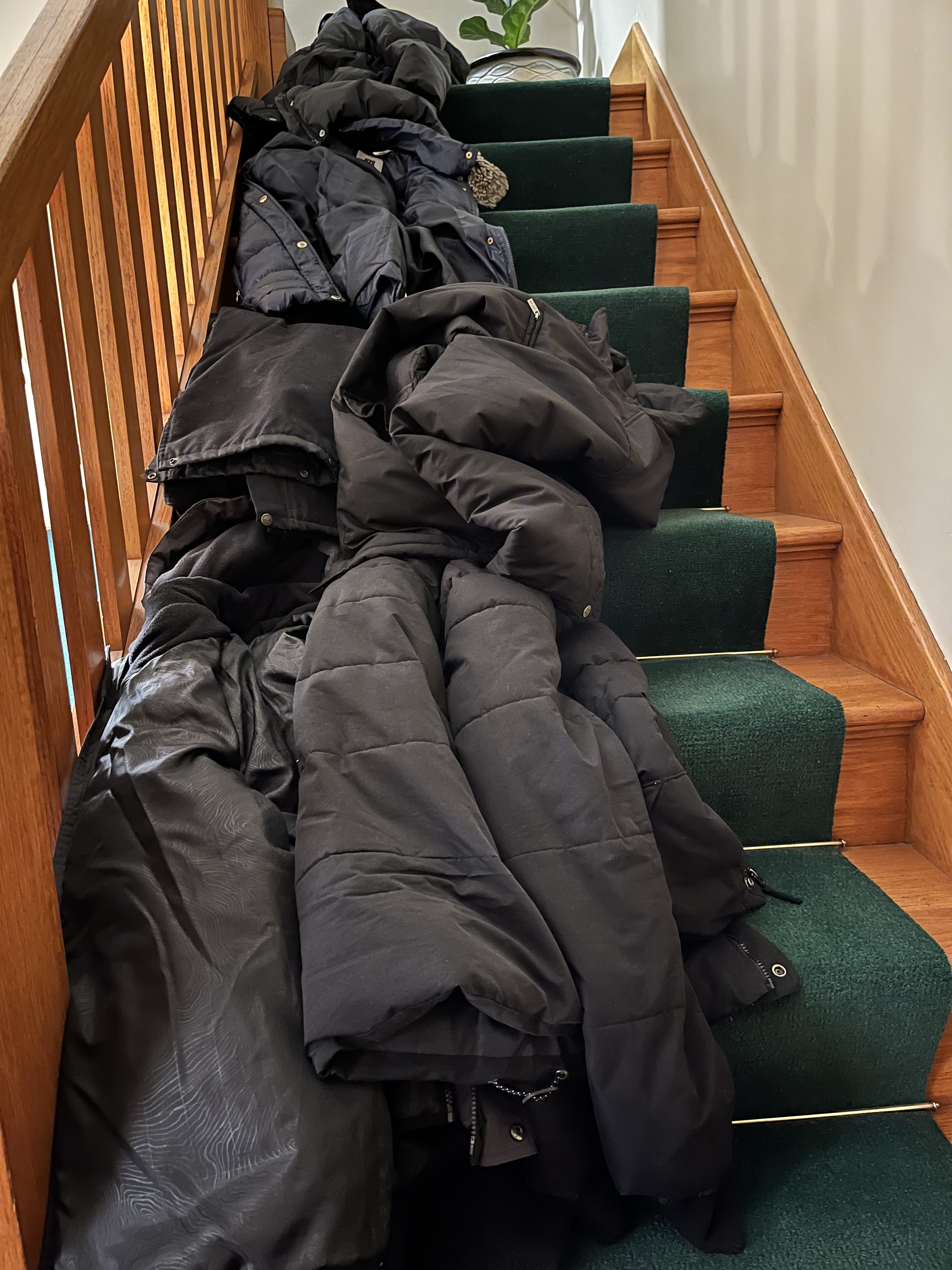
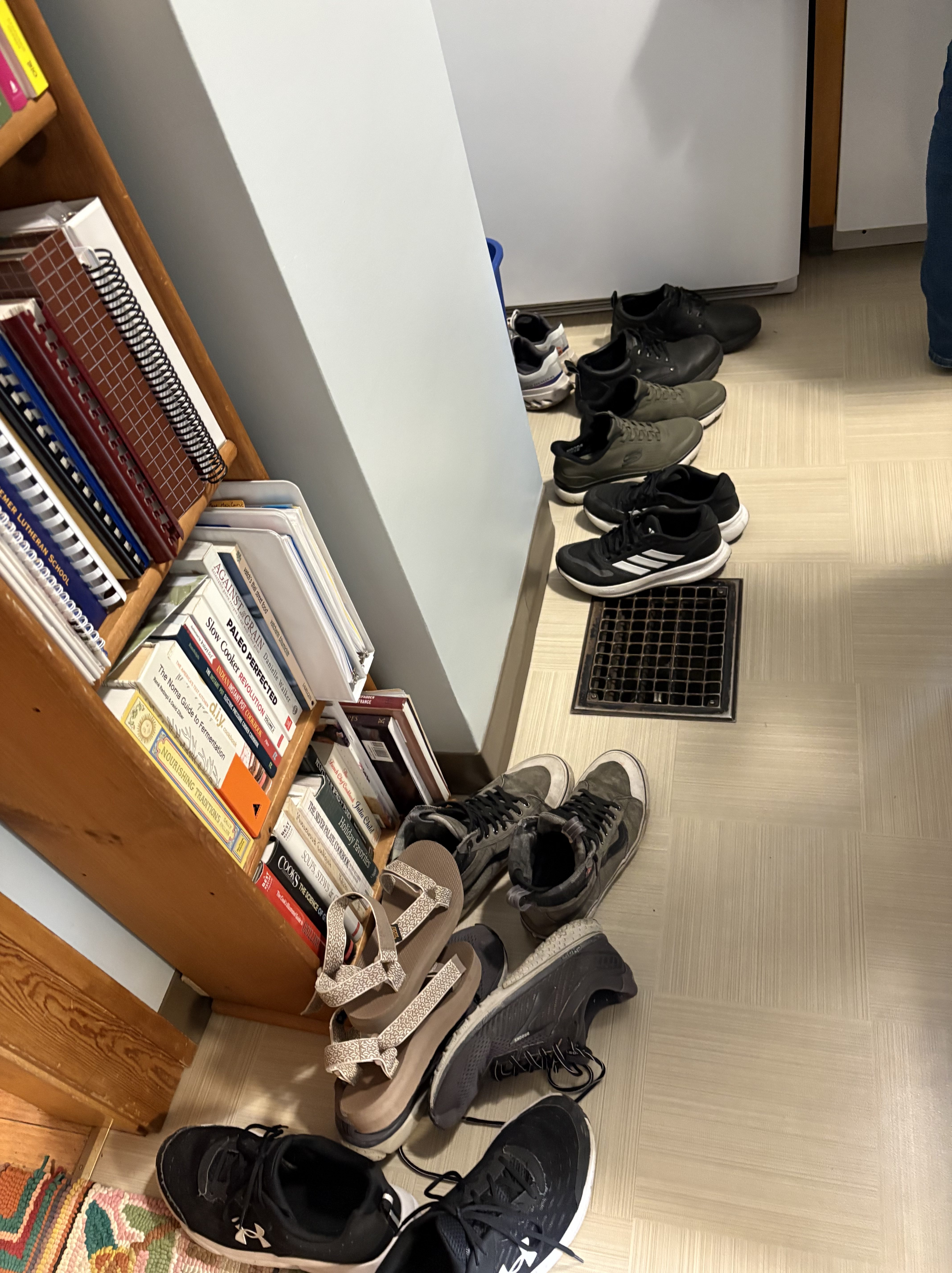
“She has her stairwell and kitchen full.”
For in a plot twist no one saw coming, God called my husband seven years ago to serve as pastor of University Lutheran Church in Champaign, Illinois. “UniLu,” as everyone in the community fondly calls the congregation, is a campus ministry located just one block off the main quad of the University of Illinois, and it exists primarily to serve undergraduate and graduate students attending the University of Illinois.
This means that Michael and I are finally, joyfully foster parents, though not through state certification like we originally thought. Instead, the church equips us to take into our little family of two around sixty children every year, all of them grown-up and sojourning away from home. We get to shelter them, feed them, teach them, sing with them, play with them, love them, and try to assist their parents in raising them in the faith, all the while knowing that these foster children will not be staying with us, that in the end, it is good — best, even — when they return to the families from which they came.
One of these precious foster children said to me the other day, “I could never do what you do.”
She was referring to the fact that every year our family changes. Every semester, we welcome new students into the church and launch graduating students into the world.
As I reflected further upon her comment, I realized something remarkable about our little story of barrenness.
Michael and I are able to endure this kind of transient family life. In fact, we expect it. We thrive in it.
The primary reason for our endurance, I believe, is because God equips us to serve where He sends us and whom He sends us. He prepares specific good works for us to do, and He completes these specific good works in us. It’s that simple.
But something a little less simple and a little less obvious …
When I view our present vocation through the lens of our barren years, I see plainly that God has been training Michael and me for this kind of transient family life our entire marriage. Never have we ever been able to keep the children who come into our home. Always, we must return those we cradle to another’s arms. Every single child we meet and love and welcome into our hearts belongs to some other family. Every single child who loves us calls other people “Dad” and “Mom” and some other house “home.”
What I am trying to confess is that our barren marriage has served as the perfect training ground for being foster parents at UniLu. Welcoming student after student and then blessing each on his way is simply a continuation of the kind of love and care we have always known and shown to other people’s children in our barrenness.
To think that this strange vocation might have been God’s intention all along — “It is high; I cannot attain it” (Psalm 139)!
And here is what really blows my mind.
In making us foster parents to so many college-aged children, God is filling not only our hands but also our hearts and our prayers and our hours and our table and our stairwell and our kitchen.
Never in my wildest dreams did I imagine such a big, beautiful family, one so plainly created by a God.
All I know to do in response to God’s gift of family life is to thank Him for His abundant mercy and sing a psalm: “Blessed is the man and woman who fill their quiver with college students!”
Though it was confusing — even embarrassing — in our marriage to be one flesh year after year but never pregnant, we understood that it went against God’s will to separate what He joined together (Matthew 19:6) in our one-flesh union.
For to force humans into existence outside of God’s procreative design of coitus would require harvesting and handing over our gametes (sperm and eggs) to a clinician who would then mix them in a petri dish in a cold room away from us. This separates what God has joined together in our marriage bed, and that goes against our religion.
If your conscience is burdened because you used IVF, know that you are not alone in your regrets. The apostle Paul teaches us in his letter to the Romans that “none is righteous, no, not one” (Rom. 3:10). He also writes that “there is therefore now no condemnation for those who are in Christ Jesus” (Rom. 8:1). Please, talk to your pastor or a trusted Christian friend about your regrets, and put your faith in Jesus’ words from the cross about His work of salvation on our behalf: “It is finished” (John 19:30). Because of Christ’s mercy, we can live our lives looking backward in repentance yet forward in hope.
Though having no children felt like we were already dying, my husband and I could think of no situation in which it was ethically acceptable for us to try to make children in a petri dish and risk their lives simply to fulfill our own wishes and desires.
Put another way, it would be wrong to ask our children to suffer in our place.
We know from the Bible that it is the strong who are called to protect and defend the weak (Micah 6:8, Psalm 82:3, Isaiah 1:17, Philippians 2:4, Zechariah 7:10, Proverbs 31:8-9). It is parents who are tasked with providing for their children, not vice versa, and the inherent disordering of human vocations in IVF alarmed us.
Therefore, we understood that it would be wrong to force the creation of our children in an environment that would put them at such a high risk of dying, simply to make us feel better.
If your conscience is burdened because you used IVF, know that you are not alone in your regrets. The apostle Paul teaches us in his letter to the Romans that “none is righteous, no, not one” (Rom. 3:10). He also writes that “there is therefore now no condemnation for those who are in Christ Jesus” (Rom. 8:1). Please, talk to your pastor or a trusted Christian friend about your regrets, and put your faith in Jesus’ words from the cross about His work of salvation on our behalf: “It is finished” (John 19:30). Because of Christ’s mercy, we can live our lives looking backward in repentance yet forward in hope.
This post is not a flex. I am not boasting of any special talent or ability. I am simply trying to put into words the visceral, to explain something physical that happens when being disciplined by the Lord, when barrenness persists beyond everyone’s expectations, when “take up your cross and follow Me” (Matthew 16:24) translates into decades.
It opens you up, that’s what.
So when my optometrist confides in the darkened exam room that she now has to take a hormone-suppressing pill to keep her breast cancer at bay, my tears fog the very lenses trying to correct my vision.
When my neighbor texts me a picture of her positive pregnancy test, I bend at the waist in my kitchen and cry to the Lord both in praise and in pain for His goodness to her and to me, though His goodness bears different fruit in each of us.
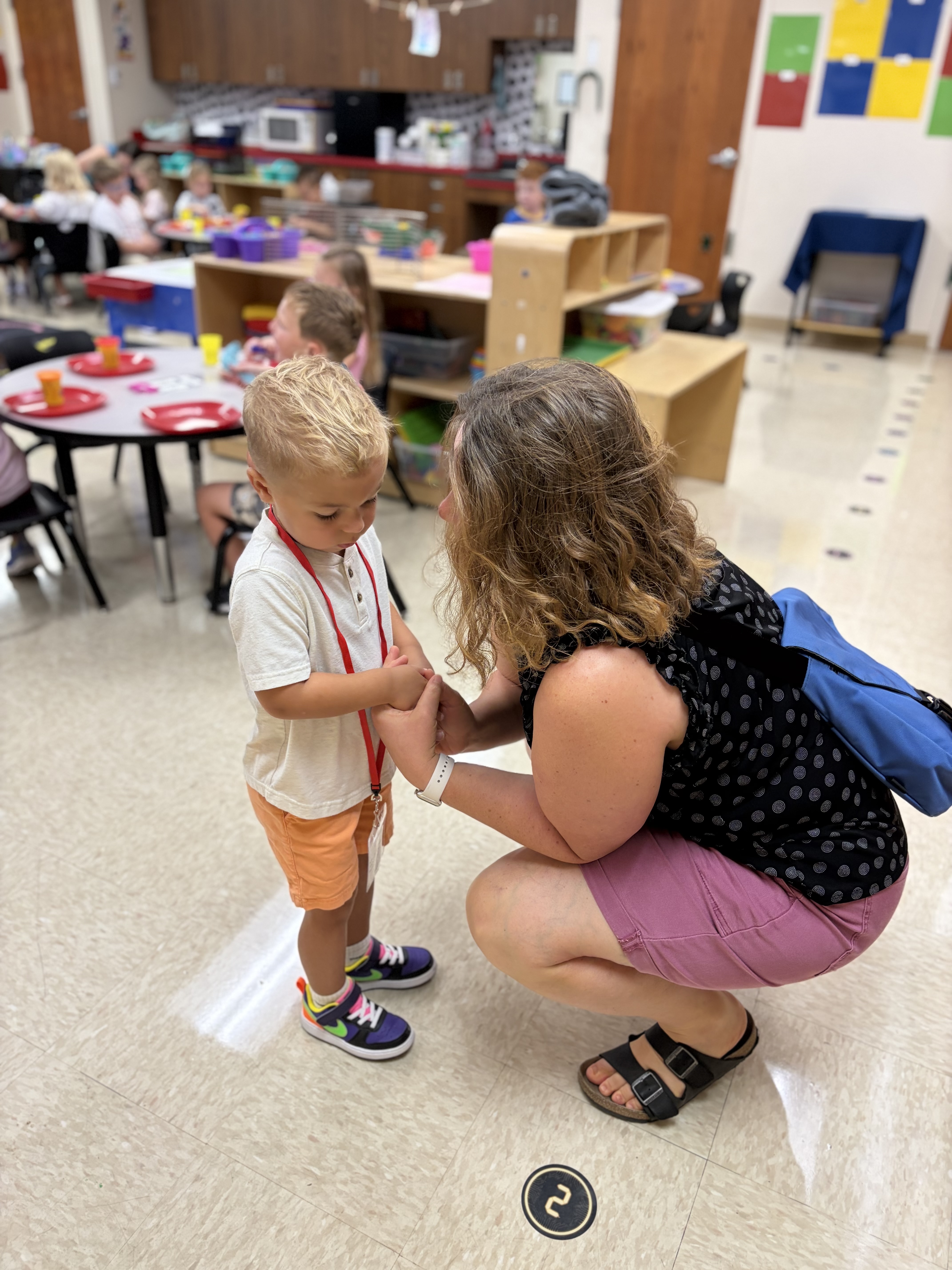
When my godson bows his head and begs me not to leave him on his first day of preschool, my tears fall to the floor and splash beside his own.
Why do I live like a fissure — a rock cracked open — my hot-lava emotions always bubbling just below the surface? One little earthquake, one tiny seismic event, and my face becomes a volcano.
From my perspective, it is because the cross of barrenness is so very public, so very painful, so very present. It already demands attention and energy both from me and from those living around me, no matter what else comes our way. It is a heavy thing, a burden carried into every moment, a tax exacted upon every personal and public interaction.
I’m not saying that barrenness is the focus of my life. I am saying that it accompanies my living. It enters the room with me, not like an elephant, exactly, but more like a hole. For it is the absence of my children in the room that everyone feels, and carrying all of those feelings wears a girl down.
But something important needs explaining.
My easy tears do not always come because I am in pain. More often than not, they come because my pain is being relieved.
In the case of my optometrist, I cried because, in bearing her burden, I was unburdened of my loneliness. I have no children in my home to nurture, so when God puts children-grown-up on my path in need of my motherly attention and care, I am more purposed than pained.
In the case of my neighbor, I cried because I experienced relief upon remembering that God does give the gift of children, if not to me. I was able to catch my breath for a minute under the ongoing weight of my cross, because I recalled that God’s withholding children from my own womb must serve some greater good (Romans 8:28), or I would be pregnant, too.
In the case of my godson, I cried because I was stunned with joy to be so wanted and cherished by a child not my own.
My point is this. I am a crybaby, but my weepy ways are not simply the result of world-weariness. I blink tears, because God in His abundant mercy deigns to comfort me in my barrenness day after cross-bearing day.
By the world’s standards, Michael and I are utter, complete failures at manifesting our own destiny as parents. There are probably even some church bodies who are ashamed to claim us as believing Christians, seeing as our hands remain empty after years of petitioning God for the gift of children. For with God, nothing is impossible (Luke 1:37). Surely our faith must be the problem. Surely our prayers are found to be wanting.
Honestly, I’ve always taken issue with this accusation. It’s as old as my wedding vows, and I’ve received it from church members, family, strangers, readers, employers, movie scripts, false prophets, podcasts, and countless blogs and books over the years.
I don’t mean to suggest that I deserve better than barrenness. No, I can easily imagine why someone would look at me and think my faith little, my prayer-life wanting, my heart undeserving of children, for that is all true.
But such an attack on my own faith does not take into account the faith of the thousands of kind, loving people who have prayed for me all of these years. What about my sweet mama? my self-sacrificing dad? my grandparents and sisters and nieces and nephews? What about all of my godchildren and my church family and my friends and pastors and even the compassionate strangers who read this blog? Do all of their (your) prayers count for nothing? Is God punishing all of us through my barren womb?
Or could it be that God’s good answer to all of our prayers is my barrenness?
Here is what I can tell you with assurance.
I am barren, and that is always bad. But miraculously, God works my barrenness for good, both for me and for you (Rom. 8:28). Barrenness continually calls me to repentance of my sins (Luke 13:1-4), and that is good. God’s persistent withholding of the gift of children from me repeatedly turns me toward Him for help, reminding me that He is my Father (Heb. 12:5-11), and that also is very good. And I maintain hope that my barrenness is something through which God’s works can be made manifest (John 9:1-3). Again, very, very good.
Maybe it would be helpful to consider my daily reality in this particular matter.
If, indeed, my prayer-life is found wanting, then everyone can rest assured. God is tending to this public concern very nicely, for in His wisdom, He continues to make me barren. And I promise you, barrenness drives me to pray to God over and over and over again.