Tough Love

by Rebecca Mayes


No adopting mother who brings her child home for the very first time would ever in her wildest imagination consider that she might someday ask this same child to leave.

But I did.

And now this child has had two mothers send him away. What must that feel like?

Have you ever seen one of those horror movies where a family realizes they are being targeted by some kind of evil, whether it be aliens, birds, zombies, or whatever, and they do everything they can to secure their home so the evil cannot penetrate? They keep remembering forgotten entrances, like the chimney or the old coal chute, and they keep boarding up every crevice they can find. The mother hovers in the corner with her child, arms clasped tightly, holding fast so no matter what, nothing will take this child from her.

That was me.

I saw, even early on, that this boy was an easy target for the devil and the world and that his own defenses were weak. Knowing this, his father and I planned out every protection and deterrent we could think of. For years I huddled in that metaphorical corner, murmuring assurances to him and to myself, all the while feeling like the evil was getting closer, regardless of all our efforts. I kept repeating the Lord’s promise that “they shall never perish; neither shall anyone snatch them out of My hand” (John 10:28).

But the real horror was not in seeing the invader’s hands reaching out to him. The real horror was in seeing him turn from me – from the Lord’s hand – and reaching out for them.

And so I let go. I let go because if I had kept holding on, the demons would have stayed and threatened us all. Their presence had already taken a toll on our family, and there was just no other way.

Our eviction notice came as no surprise to this adult-child, for he knew our values and our rules, and by his behavior he had chosen to relinquish the privilege of room and board. He was anxious to leave, to be free of our confining rules and evident disappointment. And so on his 19th birthday, after finding another place to stay, he got his wish. He was gone.

I had heard the phrase “tough love” over the years and thought I understood what it meant. I didn’t. My body and soul had been in perpetual motion, providing and protecting, these 19 years. Choosing to stop that momentum was like trying to stop a train.

“For this child I prayed…” said Hannah in 1 Samuel 1:27. I thought this meant that she prayed for his conception and birth. She got was she requested. Mission accomplished.

But no. She then handed her son over to Samuel in the temple. I handed my son over to the world.

For this child I prayed….and prayed…and prayed...and prayed…

This momentum does not stop.

As with Hannah, the Lord answered my prayer, and I had one job to do: “Train up a child in the way he should go” (Proverbs 22:6). But I felt like I had failed. Eventually I realized I could control this child, his choices, his faith, his life, his future no more than I could control my fertility. My job is to remain faithful to the Lord and serve Him in all my daily vocations (albeit imperfectly), and this faithfulness often requires making tough choices – like letting go of the very child you had prayed for for so long.

It felt like I was handing him over to the world to be devoured and spit out, but I was really handing him back to the Lord, for only He can control the future. He redeemed this child by His own blood, brought this child to us, washed him in baptismal waters, surrounded him with a loving family, gave him the opportunity for a Christian education, and continues to move countless friends and family to join us in praying for his return to the faith.

Our heavenly Father has not given up. I have witnessed His pursuit of this child in the years since he left. The boy’s life did not fall apart. He found friends, he found work, he is growing and maturing. Our relationship with him has been strengthened. He sometimes even finds his way to worship. There is hope.

Even though I have seen the Lord’s patience and mercy, again and again, for my child throughout his life, he does not yet see it himself. He seems to be still grasping in some kind of darkness. But just as the Lord can open wombs, He can also open the eyes of the blind.

She Has Her Hands Full

by Katie Schuermann


In twenty-four years of marriage, I have never been pregnant. In that same amount of time, my husband and I have received at least a dozen private adoption queries from five different states, and not a single one has worked out in such a way as to make us parents. And in spite of our multiple foster parent training sessions completed through the states of Texas and Illinois, no child ever has been placed in our home by the government.

Which means, in twenty-four years of marriage, no one has ever said of me, “She has her hands full.”

But do you know what people can say of me? that is, if they are looking closely?

“She has her stairwell and kitchen full.”

For in a plot twist no one saw coming, God called my husband seven years ago to serve as pastor of University Lutheran Church in Champaign, Illinois. “UniLu,” as everyone in the community fondly calls the congregation, is a campus ministry located just one block off the main quad of the University of Illinois, and it exists primarily to serve undergraduate and graduate students attending the University of Illinois.

This means that Michael and I are finally, joyfully foster parents, though not through state certification like we originally thought. Instead, the church equips us to take into our little family of two around sixty children every year, all of them grown-up and sojourning away from home. We get to shelter them, feed them, teach them, sing with them, play with them, love them, and try to assist their parents in raising them in the faith, all the while knowing that these foster children will not be staying with us, that in the end, it is good — best, even — when they return to the families from which they came.

One of these precious foster children said to me the other day, “I could never do what you do.”

She was referring to the fact that every year our family changes. Every semester, we welcome new students into the church and launch graduating students into the world.

As I reflected further upon her comment, I realized something remarkable about our little story of barrenness.

Michael and I are able to endure this kind of transient family life. In fact, we expect it. We thrive in it.

The primary reason for our endurance, I believe, is because God equips us to serve where He sends us and whom He sends us. He prepares specific good works for us to do, and He completes these specific good works in us. It’s that simple.

But something a little less simple and a little less obvious …

When I view our present vocation through the lens of our barren years, I see plainly that God has been training Michael and me for this kind of transient family life our entire marriage. Never have we ever been able to keep the children who come into our home. Always, we must return those we cradle to another’s arms. Every single child we meet and love and welcome into our hearts belongs to some other family. Every single child who loves us calls other people “Dad” and “Mom” and some other house “home.”

What I am trying to confess is that our barren marriage has served as the perfect training ground for being foster parents at UniLu. Welcoming student after student and then blessing each on his way is simply a continuation of the kind of love and care we have always known and shown to other people’s children in our barrenness.

To think that this strange vocation might have been God’s intention all along — “It is high; I cannot attain it” (Psalm 139)!

And here is what really blows my mind.

In making us foster parents to so many college-aged children, God is filling not only our hands but also our hearts and our prayers and our hours and our table and our stairwell and our kitchen.

Never in my wildest dreams did I imagine such a big, beautiful family, one so plainly created by a God.

All I know to do in response to God’s gift of family life is to thank Him for His abundant mercy and sing a psalm: “Blessed is the man and woman who fill their quiver with college students!”

Reasons We Never Used IVF – #2

by Katie Schuermann


Though it was confusing — even embarrassing — in our marriage to be one flesh year after year but never pregnant, we understood that it went against God’s will to separate what He joined together (Matthew 19:6) in our one-flesh union.

For to force humans into existence outside of Godโ€™s procreative design of coitus would require harvesting and handing over our gametes (sperm and eggs) to a clinician who would then mix them in a petri dish in a cold room away from us. This separates what God has joined together in our marriage bed, and that goes against our religion.


If your conscience is burdened because you used IVF, know that you are not alone in your regrets. The apostle Paul teaches us in his letter to the Romans that “none is righteous, no, not one” (Rom. 3:10). He also writes that “there is therefore now no condemnation for those who are in Christ Jesus” (Rom. 8:1). Please, talk to your pastor or a trusted Christian friend about your regrets, and put your faith in Jesus’ words from the cross about His work of salvation on our behalf: “It is finished” (John 19:30). Because of Christ’s mercy, we can live our lives looking backward in repentance yet forward in hope.

Reasons We Never Used IVF – #1

by Katie Schuermann


Though having no children felt like we were already dying, my husband and I could think of no situation in which it was ethically acceptable for us to create children in a petri dish and risk their lives simply to fulfill our own wishes and desires.

Put another way, it would be wrong to ask our children to suffer in our place.

We know from the Bible that it is the strong who are called to protect and defend the weak (Micah 6:8, Psalm 82:3, Isaiah 1:17, Philippians 2:4, Zechariah 7:10, Proverbs 31:8-9). It is parents who are tasked with providing for their children, not vice versa, and the inherent disordering of human vocations in IVF alarmed us.

Therefore, we understood that it would be wrong to force the creation of our children in an environment that would put them at such a high risk of dying, simply to make us feel better.


If your conscience is burdened because you used IVF, know that you are not alone in your regrets. The apostle Paul teaches us in his letter to the Romans that “none is righteous, no, not one” (Rom. 3:10). He also writes that “there is therefore now no condemnation for those who are in Christ Jesus” (Rom. 8:1). Please, talk to your pastor or a trusted Christian friend about your regrets, and put your faith in Jesus’ words from the cross about His work of salvation on our behalf: “It is finished” (John 19:30). Because of Christ’s mercy, we can live our lives looking backward in repentance yet forward in hope.

Fearfully and Wonderfully…Hormonal

By Melissa DeGroot


When I turned 41, my body entered the Twilight Zone.

Up until then, things had been clicking along pretty well. I was eating low-carb, going to the gym, feeling pretty good, and generally thought I had figured out what worked.

And then, seemingly overnight, my body said . . .Nope.

My thyroid tanked. My metabolism, pshh, what metabolism? seemed to pack its bags and leave. Things that had worked for years suddenly stopped. I gained 50 pounds despite continuing to exercise and trying to adjust my diet. I felt anxious, depressed, angry. . . and let’s not even get into libido. As far as east is from the west did I even want to think about that. I remember feeling so disconnected from my body, yet thinking, What in the world is happening to me?

Welcome to perimenopause.

Thankfully, I eventually found a doctor who helped me sort through some of what was going on. With medical care, supplements, hormone replacement therapy, and a few other things, I slowly began feeling more like myself again. The weight eventually came offโ€”slowly, but surelyโ€”and over the last few years, Iโ€™ve managed to maintain some semblance of normalcy.

And I use the word normalcy loosely.

Because, apparently, perimenopause also means if you “do the supplemental things,” you may discover hair growing in places where hair has absolutely no business growing. Sorry. Just the truth! Then PMS sometimes decides to become PMDDโ€”and other months, nothing at all. Thankfully, I havenโ€™t struggled with hot flashes yet. Sleep, however, occasionally goes off the rails, though certain supplements have helped tremendously with that.

And by the way, if you are low in testosterone and do take a supplemental version of it, both you and your husband will thank you. Wink. You’re welcome.

Story time: One of the more surprising episodes happened last year shortly after I began a new vocation as a deaconess. I was settling into this new job and a completely new season of life post-homeschooling when suddenly my period was two weeks late.

I thought:

Oh. My. Gosh.

What if Iโ€™m pregnant?

After years of secondary infertility, there I was in my mid-forties, beginning a new chapter of life and wondering whether God had decided to throw the ultimate plot twist into the story.

Breaking news: I was not pregnant.

Just perimenopausal.

And honestly, that story pretty well sums up this season of life. It is a wild ride of hormonal shifts, strange symptoms, unpredictable cycles, and occasionally wondering, What in the new, fresh H-E-Double hockey sticks is going to happen next?

Thankfully, my husband has been wonderfully supportive and loving through all of it. (Again. Thank you, testosterone.) We understand a little better now what may be happening when I suddenly donโ€™t quite feel like myself.

Sometimes.

Because beneath all the unpredictabilities that is this body of mine, something much deeper is happening.

My body is moving toward menopause. And menopause means that the possibility of conceiving another child will finally and permanently be off the table.

For a woman who has lived through secondary infertility, that realization could have been devastating at another point in my life.

But strangely, now, I think I’m okay.

Somewhere along the way, I learned to let go.

Not because the longing and hurt didn’t matter, but because life has continued unfolding around it. God continued providing. He gave me people to love, work to do, neighbors to serve, a husband and son to cherish, and fulfillment in vocations I never could have imagined. And healthcare to help me feel a little bit better!

There has been purpose, meaning, and even flourishing in places I wasn’t looking. Thanks be to God.

But perimenopause is another reminder that my body is changing. I’m getting older.

That can stir up other fears and questions. What will aging look like? What will happen to my health? What will life look like twenty or thirty years from now? Who will be there? What losses will come?

Some of those questions require practical and faithful wisdom since, ultimately, planning and healthcare can’t answer the deepest problem.

Our bodies are headed toward dying.

Perhaps dramatic for a blog post that began with chin hairs. But there it is.

Our bodies bear the effects of a fallen world.

And yet these bodies are also fearfully and wonderfully made. So much so, they are redeemed.

Christ did not come merely to rescue some spiritual part of us from our troublesome meat suits. He took on a body Himself. He suffered in that body. He died in that body. And He rose bodily from the grave.

Which means my hope isn’t that I can keep this body looking 35 forever.

Thank God, since that ship’s sailed.

My hope is the resurrection of the body and the life everlasting.

So for now, I can laugh (if my estrogen or testosterone haven’t dipped) at some of the unpredictabilities of perimenopause. I can seek good medical care. I can exercise, eat reasonably well, take the things that help me sleep, and occasionally pluck the mysterious hairs that seem determined to spring forth.

But I can also receive this strange season for what it is: another reminder that I am a creature whose life and body belong to God.

Fearfully and wonderfully made.

Currently somewhat hormonal.

And waiting, with all creation, for the day when Christ returns, raises, and restores our bodies.

Crybaby

by Katie Schuermann


I can cry at the drop of a hat.

This post is not a flex. I am not boasting of any special talent or ability. I am simply trying to put into words the visceral, to explain something physical that happens when being disciplined by the Lord, when barrenness persists beyond everyone’s expectations, when “take up your cross and follow Me” (Matthew 16:24) translates into decades.

It opens you up, that’s what.

So when my optometrist confides in the darkened exam room that she now has to take a hormone-suppressing pill to keep her breast cancer at bay, my tears fog the very lenses trying to correct my vision.

When my neighbor texts me a picture of her positive pregnancy test, I bend at the waist in my kitchen and cry to the Lord both in praise and in pain for His goodness to her and to me, though His goodness bears different fruit in each of us.

When my godson bows his head and begs me not to leave him on his first day of preschool, my tears fall to the floor and splash beside his own.

Why do I live like a fissure — a rock cracked open — my hot-lava emotions always bubbling just below the surface? One little earthquake, one tiny seismic event, and my face becomes a volcano.

From my perspective, it is because the cross of barrenness is so very public, so very painful, so very present. It already demands attention and energy both from me and from those living around me, no matter what else comes our way. It is a heavy thing, a burden carried into every moment, a tax exacted upon every personal and public interaction.

I’m not saying that barrenness is the focus of my life. I am saying that it accompanies my living. It enters the room with me, not like an elephant, exactly, but more like a hole. For it is the absence of my children in the room that everyone feels, and carrying all of those feelings wears a girl down.

But something important needs explaining.

My easy tears do not always come because I am in pain. More often than not, they come because my pain is being relieved.

In the case of my optometrist, I cried because, in bearing her burden, I was unburdened of my loneliness. I have no children in my home to nurture, so when God puts children-grown-up on my path in need of my motherly attention and care, I am more purposed than pained.

In the case of my neighbor, I cried because I experienced relief upon remembering that God does give the gift of children, if not to me. I was able to catch my breath for a minute under the ongoing weight of my cross, because I recalled that God’s withholding children from my own womb must serve some greater good (Romans 8:28), or I would be pregnant, too.

In the case of my godson, I cried because I was stunned with joy to be so wanted and cherished by a child not my own.

My point is this. I am a crybaby, but my weepy ways are not simply the result of world-weariness. I blink tears, because God in His abundant mercy deigns to comfort me in my barrenness day after cross-bearing day.

I am tearing up now just thinking about it.

Family Growth

by Kristi Leckband


The Lord has given me blessing upon blessing. He placed me into a loving family at my birth, and my parents made sure I knew Jesus Christ as my Lord and Savior. I taught in Lutheran schools for several years and married Jerome, who eventually became a pastor.

After four years of marriage, we were blessed with the birth of Joanna. Her arrival brought joy upon joy into our home. While this blog was active, we endured suffering while wanting to grow our family. No children came. Then, in 2013, after seven long years of waiting, Maria joined our family via international adoption. Two brief months after that, Josiah joined us as a newborn via domestic adoption. Oh, the blessings of the Lord!

Fast forward to 2026. Our family picture looks a bit different. Jerome and I have celebrated 28 years of wedded life in Christ, and we are both past the age of 50. Joanna graduated from college, married a Lutheran man, and is now mother to a five-month-old baptized child of God. She and her family live ten hours away from us. Maria and Josiah have both grown into teenagers and will live at home with us for a few more years. We now reside in Arkansas, where Jerome serves as associate pastor and headmaster of our classical Lutheran school. Upon our arrival, we enrolled our children in that school. Gone are the days of homeschooling. I now spend my days preparing music for our church and school. I am blessed to have many interactions with the people in these places on a daily basis.

Our family has seen its share of changes. One of our children developed an autoimmune disease. That was pretty rough. We sent our oldest off to college, nearly twelve hours away. That was a quiet ride home. After twenty-three years in one place, we packed up our belongings and moved south. A lot of memories came with us. We stopped homeschooling so that our children could be part of a classical Lutheran school. That was another huge adjustment for all of us. Throughout all of those changes, though, the Lord has continued to bless our family. He has taken care of each one of us and still continues to do so today. I look forward to sharing the goodness of the Lord with you this month.

15 Years Later

by Rebecca Mayes


How do I even begin to describe all the blessings, all the pain, all the mercy I’ve experienced these past 15 years? But I will try this month, thanks to Katie’s invitation.

Maybe you’ll want to know about the ongoing challenges of parenting adopted children into adulthood, or what the finality of a hysterectomy meant to this barren woman, or how my faith has deepened and matured as a result of our Lord’s testing. I will share these stories – the ugly and the beautiful – in the weeks to come.

But first, allow me to share where my family is now and remind you where we came from.

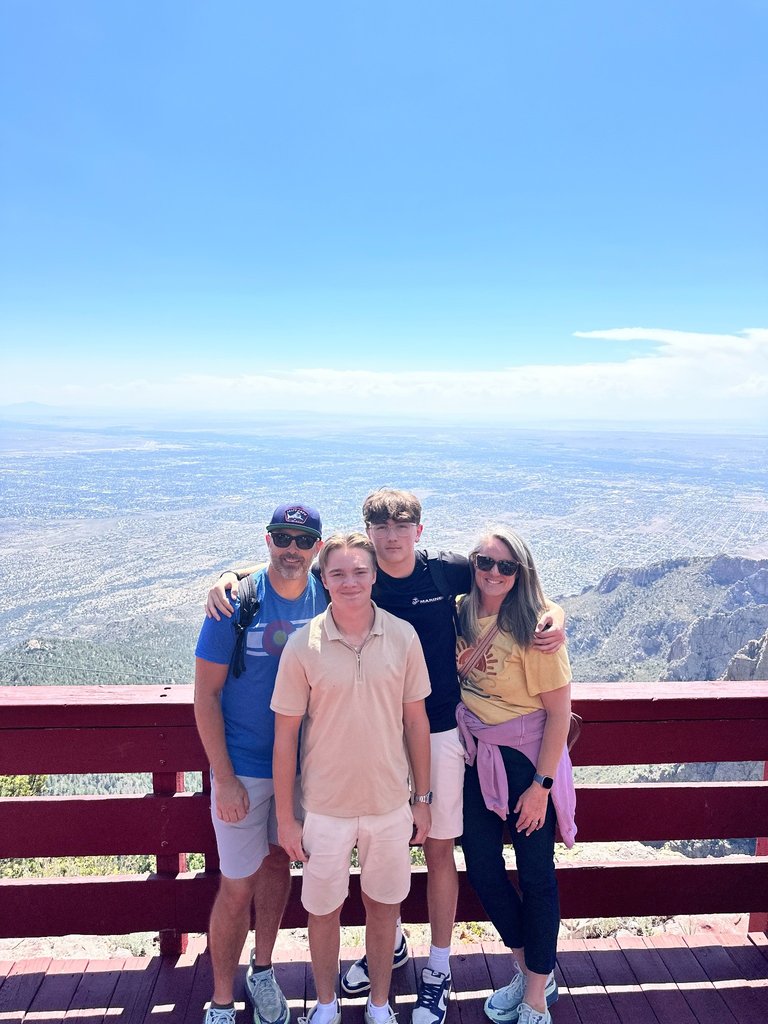
When we first started blogging, our family was in St. Louis, but for the past 10 years we’ve been in Indiana. My husband has gone from a nine-to-five editor in a cubical to a well-known professor, scholar, and writer. I had to wrap my mind around this fact most recently when, during our visit to the Grand Canyon this past summer, we were stopped by a stranger who recognized him.

I’m so proud of the work he is doing and the way he is serving his students and the Church. I feel so blessed to be his helpmeet and cheerleader.

Our oldest (just eight-years-old when I published my first post) has been on his own for several years now, living and working nearby. It is a strange transition, this parenting of an adult. Once upon a time we provided for his every need. Now we have to beg him to come over for dinner just so we can see him and hear about his life.

The transition was not only strange but tumultuous, and it left some scars. Right now I find great joy in receiving his phone calls, hearing how his skills are developing at his job, and seeing his texts requesting another favorite recipe. We were a bit terrified about this little bird leaving the nest…but it looks like he can fly after all!

Speaking of strange transitions…our newly adopted infant son from 15 years ago is now a sophomore in high school and crossing that bridge from boyhood to manhood. This awkward stage is most evident when I call his phone and hear this much deeper voice on the other end enthusiastically answer, “Buddy the Elf, what’s your favorite color?”

Out of the blue one day a couple years ago he asked if his birthmother lived nearby. He revealed that when he sees a woman in a store with big brown eyes like his, he wonders if that’s her. That is the only question he has ever asked about her, but there must be more questions stored up in his heart. I hope they surface when he’s ready.

What has surfaced is a love for piano (which I delight in every time I hear him practicing Rachmaninoff or Debussy) and a quick wit which he wields in many a conversational spar around the dinner table. None of us seems to know where life will lead this one–except that eventually he’ll be the one doing the leading.

In my current vocations I find the most joy in continuing to care for the children that surround us in our various communities, whether that’s being in front of a Sunday School class, driving a carpool of kids home from school, or babysitting for family members and friends. What a blessing from our Lord that this barren woman is now part of a church and school with SO. MANY. CHILDREN. How ironic that I am, at the beginning of my “senior” years, surrounded by more children to care for than ever.

I can only imagine what changes the next 15 years might bring.

I’ll Say It If You Won’t

by Katie Schuermann


The thing is, I deserve to be barren.

The list of my sins is life-long and Ten Commandments-deep.

I have made a god of my own wishes and desires so many times in my home life and in my career as an author and musician that I can no longer recall them all.

I continually neglect to call upon the name of the Lord on behalf of others, and I often daydream during the prayers in church.

I have skipped Sunday morning worship in my anger, and I often stare at my closed Bible on the dining room table, picking up my fork and eating breakfast instead of sanctifying the morning with reading the Word of God.

I have gone against my parents’ wise counsel on more than one occasion, despising their authority and imagining myself wiser than them, even going so far as to tell them so.

I have hated so many people. So, so many people. I have even hit people in my anger. All of my excuses be damned.

I have worn dresses too short and gowns too low. In my twenties, I even played the unchaste role of Maggie in a St. Louis production of Lend Me a Tenor, a choice I regret to this very moment.

I once stole a broken stopwatch from a cousin.

I lied to my math teacher about the (in)completion of an assignment.

I frequently look on Zillow for properties bigger and better than my own, and I walk by properties in my community, imagining myself living in their homes in their place.

I see other peoples’ adopted children, and I would rather they be mine.

In other words, I’ve broken all of God’s Commandments, from the First to the Tenth, there and back again, many times over. I am disgusting. I am dust, the kind that dirties everything and chokes people.

So, I’ll say it again: I am barren, and I deserve it. But that is not why I am barren.

I am barren, because God displays His own works, not mine, in my suffering (John 9:1-3).

I am barren, because the death in my womb reminds you and me to repent of our sins (Luke 13:1-5).

I am barren, because God disciplines His children like the good Father that He is (Heb. 12:5-11). But discipline is not punishment.

For God does not punish His baptized children for their sins. He won’t, because He already punished Jesus in our place. He poured out His wrath fully upon His Son on the cross, and Jesus Himself said before He gave up His Spirit, “It is finished” (John 19:30).

And so, to say that barrenness is punishment for my sin is to confess falsely that Jesus’ sacrifice on the cross was not enough, that the blood of the Lamb of God did not fully atone for all of my wrongs.

To get right to the point: to confess that barrenness is punishment for my sin is to mischaracterize God’s nature, not mine. Because God is “gracious and merciful, slow to anger and abounding in steadfast love” (Psalm 145:8). He saves His people and blesses His heritage (Psalm 28:9), and He does so by punishing Jesus in our place.

I may deserve to be barren, but I am not barren because I deserve it.

I am barren, because God deems it wise for me to be so.

A Wanting Prayer-Life

by Katie Schuermann


By the world’s standards, Michael and I are utter, complete failures at manifesting our own destiny as parents. There are probably even some church bodies who are ashamed to claim us as believing Christians, seeing as our hands remain empty after years of petitioning God for the gift of children. For with God, nothing is impossible (Luke 1:37). Surely our faith must be the problem. Surely our prayers are found to be wanting.

Honestly, I’ve always taken issue with this accusation. It’s as old as my wedding vows, and I’ve received it from church members, family, strangers, readers, employers, movie scripts, false prophets, podcasts, and countless blogs and books over the years.

I don’t mean to suggest that I deserve better than barrenness. No, I can easily imagine why someone would look at me and think my faith little, my prayer-life wanting, my heart undeserving of children, for that is all true.

But such an attack on my own faith does not take into account the faith of the thousands of kind, loving people who have prayed for me all of these years. What about my sweet mama? my self-sacrificing dad? my grandparents and sisters and nieces and nephews? What about all of my godchildren and my church family and my friends and pastors and even the compassionate strangers who read this blog? Do all of their (your) prayers count for nothing? Is God punishing all of us through my barren womb?

Or could it be that God’s good answer to all of our prayers is my barrenness?

Here is what I can tell you with assurance.

I am barren, and that is always bad. But miraculously, God works my barrenness for good, both for me and for you (Rom. 8:28). Barrenness continually calls me to repentance of my sins (Luke 13:1-4), and that is good. God’s persistent withholding of the gift of children from me repeatedly turns me toward Him for help, reminding me that He is my Father (Heb. 12:5-11), and that also is very good. And I maintain hope that my barrenness is something through which God’s works can be made manifest (John 9:1-3). Again, very, very good.

Maybe it would be helpful to consider my daily reality in this particular matter.

If, indeed, my prayer-life is found wanting, then everyone can rest assured. God is tending to this public concern very nicely, for in His wisdom, He continues to make me barren. And I promise you, barrenness drives me to pray to God over and over and over again.

Lord, have mercy.

(Thankfully, He does.)