Cysts

The Hysterectomy

by Rebecca Mayes


There is a strange phenomena in Western medicine that if an organ is diseased you should just cut it out. This seems to be our best method of “healing” after thousands of years of practicing medicine. Much of our society is walking around without gall bladders, a kidney, a scrotum, part of their intestines, breasts, and, of course, a uterus.

It was recommended early on in my reproductive health struggles that I have a hysterectomy. This was the best promise for relief, they said. But I refused.

So why keep it around? Why not get rid of it? This organ was supposed to be healthy for me, and getting rid of it could put me at risk for cardiovascular issues, a decrease in bone density, or a messed-up metabolism. But most importantly, if it actually performed the way it was supposed to (and there was always the chance it could) then I would have a child, and that would be worth every minute of pain and discomfort and unpredictability. If I let them cut out this organ, I knew they’d be removing hope along with it. To let go of one meant letting go of the other.

So I kept it, despite the fact that it could not contain or control its own endometrial lining, but allowed parts of it to go astray inside my abdominal cavity, creating webs of tissue that would sear with pain when hormone levels changed.

I kept it, even though its partners-in-crime, the ovaries, would regularly spawn cysts that sometimes grew until they burst, causing me to go into shock and rendering me lifeless on the floor (once in the bathroom at work, where the EMS kindly extracted me).

I kept it, regardless of how disappointed my OB/GYN always looked when I handed in my fertility tracker, which was supposed to have green, yellow, and red baby stickers lined up and color-coded, in an obvious pattern. Mine looked more like a traffic light gone haywire.

I kept it, though its unpredictability and lack of punctuality pushed me to the brink of insanity by producing monthly (I use this term loosely) signs and symptoms that gave hope of a pregnancy and then dashed them to pieces, over and over and over again.

I kept it, and simultaneously detested it, when it neglected to nurture my one biological child and instead allowed him?/her? to die.

I kept it, though the amount of blood it was producing in my 40’s was enough to make me anemic.

Until one day, I finally told this uterus of mine (figuratively) and my OB/GYN (literally), “Cut it out.”

This was not, of course, without first praying about the decision and talking to my husband. I felt like a hypocrite, having denounced so many times over the years the over-prescribing of hysterectomies to women who were done having children. It’s true that this was (still is?) a flaw in our medical system, and few physicians or patients recognized the important role this reproductive organ serves beyond reproducing. But my doctor, a Christian man whose joy in life was to help couples bring children into the world and and also lead healthy, pain-free lives, could truly do nothing more for me. It was time to let go.

Seven years later, I can tell you that this surgery completely changed my life. My wise doctor left the healthiest ovary to help me gently transition through menopause, so there was no sudden hormonal shift. My physical pain was completely gone. The optimistic voice in my head that chanted “but what if??” incessantly each month had ceased to haunt me. I was no longer afraid of sudden, conspicuous leaks in public places, or of having a cyst episode while away from home. I could finally have an entire month where I was fully present with, and taking care of, my precious family. My heart had always loved my family, but my body had prevented me from taking care of them consistently. Now this cross had been lifted, and I “rejoiced with great joy.” I still do.

My story is not your story. My decision is not recommended to all who share my medical issues. Sometimes surgery does not provide the full relief a woman is looking for. I knew that going into it, which is one reason I was hesitant to do it earlier. There are no guarantees. The idea of intentionally removing all hope of conceiving probably sounds insane to those of you still without any children, but I was not in that position. I was at a place where I was ready to let the surgeon take both the hope and the pain together.

After our first adoption, someone gifted us with a beautifully framed poem, which read as follows:

“Not flesh of my flesh,
nor bone of my bone
but very remarkably,
all my own.
And never forget,
for a single minute,
that you weren’t born
under my heart,
but in it.”

I read the poem to my oldest son when he was around 5 years old. He looked up at me, bewildered and confused, and said, “That’s a big heart.” Maybe it was time to remove my uterus so I could have more room for the heart.
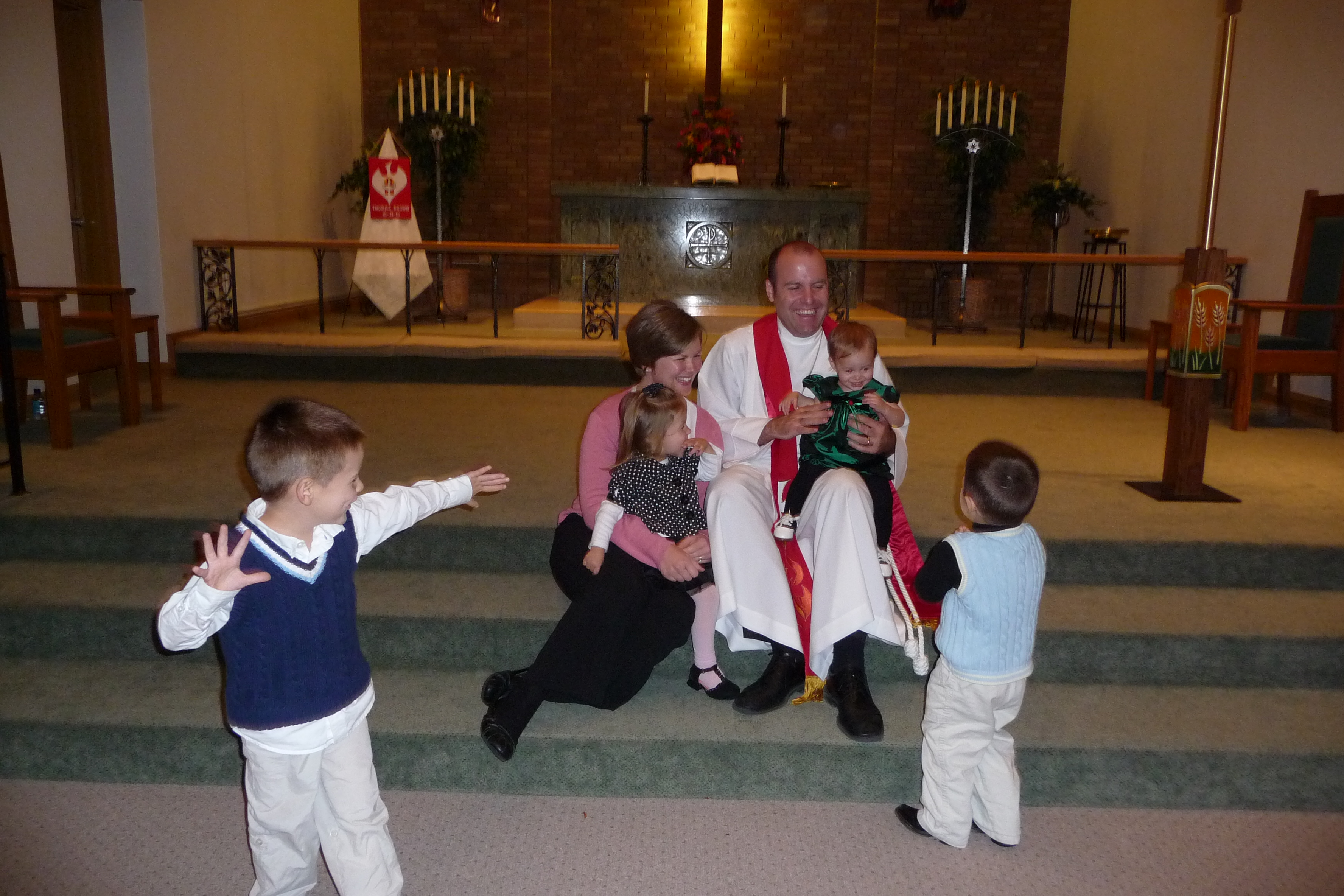
Happy Grandmother’s Day!

Have you considered the facts?

  • Your uterus is not performing at her peak these days.
  • Your doctors draw your blood regularly and order further medical tests.
  • Your pillbox has both an AM and PM dispenser.
  • You spend your evenings volunteering at church and around town because you have the time.
  • The majority of the Christmas gifts you wrap end up under other families’ trees.
  • You pull up pictures and videos on your phone of other adults’ children to show at parties.
  • You thrill when a small hand makes a sticky print on your clean window or spills apple juice on your polished floor.
  • You rejoice when a child asks you to read her the same book five times in a row.
  • Children tell you their secrets and ask you to display their colored artwork on your refrigerator.
  • Parents generously bring their children over to your house to visit at their best hours and then take them home for their worst hours.
  • You travel all across the nation just to sit on a bleacher and watch amateur sports.
  • You wash the dishes and wipe down kitchen counters for weary mothers.
  • You offer them your shoulder to cry on and hope they will allow you to mother them this late in life.
  • You watch parents struggle in raising their children and hold your tongue.
  • You pray for all of them day and night.
  • You grieve your own empty nest.

Have you considered the fact that you skipped motherhood altogether in this life and jumped straight into the role of grandma?

It’s not what you wanted, I know, but you have to admit: the joys are deep, the work abundant, and the sleep better than most. It is good to be you.

And for this reason, may I wish you the happiest of Grandmother’s Days tomorrow and every day?

P1040678

Bearing the Pain

pain

A co-worker sent me the link below. It’s an eye-opening account of what it’s like to live with chronic pain. I would imagine many readers of this blog will be able to relate to Christine Miserandino’s descriptions. Perhaps it’s not physical pain you carry with you each day – perhaps it’s emotional or psychological. It doesn’t matter. Whatever it is, if it occurs each day, or for certain seasons of your life, you know what it means to wear the “I’m doing fine” mask, and it makes you weary and feeling closed off from the rest of the “healthy” world. See Christine’s unique analogy here: ButYouDon’tLookSick.com.

Allow me to put things into perspective, though.

First, from Romans 8:18: “For I reckon that the sufferings of this present time are not worthy to be compared with the glory which shall be revealed in us.”

And second, from the Lutheran Service Book, Hymn 423:

Jesus, refuge of the weary,

Blest Redeemer whom we love,

Fountain in life’s desert dreary,

Savior from the world above:

Often have Your eyes, offended,

Gazed upon the sinner’s fall;

Yet upon the cross extended,

You have borne the pain of all.

The doctor’s in…

IMG_1879 copyWe were blessed to have an OB-Gyn speak with us at The Great Getaway last summer. Here is a collection of some of the wise tidbits he shared with us:
On infertility…

“Fertility is one of those areas in life where God has us where He wants us. We have to lay it down. We have to give it to God. Who ultimately is in control? It’s not me [the doctor]; it’s not you and your husband; God is the one in control.”

“Infertility is a cross. It’s the cross God has given us. We are to bear our crosses.”

“We can’t even claim to understand why this is happening. This is a wound only God can heal.”

“No matter what happens, your Father loves you. Your Father has your best in mind.”

“Our culture says, ‘I have a right to have my 2.2 children when I want them. Children are things.’ We do not have a right to have children…Children are a precious gift from God.”

“If we had something that worked 100% of the time, then we would lose the awe and wonder of creation.”

On IVF…

“Infertility is not a disease. It is a symptom of a problem. IVF circumvents that problem. Let’s figure out the problem rather than circumvent the problem.”

“Who in the world do we think we are in saying that someone is a Grade D embryo?”

“For every baby that is born through IVF, between 20 to 30 are lost.”

The cost? “$15,000-$18,000 per cycle”

On why life begins at conception…

“Genetically, that embryo is not the mom; that embryo is not the dad. That’s a new person.”

On whether or not the pill ever acts as an abortifacient…

“If it happens once, isn’t that too many?”

PCOS P.S.

IMG_1884 copyGina is someone I look up to in so many ways, not only because she is an extraordinary woman who bakes decadent, gluten-free desserts, but because she doesn’t hide from the crosses God has given her – and she encourages me to do the same:

PCOS is so hard to live with and deal with, not only because of the infertility but because all of it is the pits. At this point in my life, I can look back and see that my PCOS was/is a cross to bear that at times I threw on the ground and despised, but, as with all crosses, it continues to be bearable only through Christ and the love of Christian friends, my spouse, and family. From this perspective, I can tell you that I am in part shaped by the suffering of PCOS and, as with all suffering, God can use it for the good of both the sufferer and those around her; but I can only see that now that I am 47 and reconciled to my barrenness, and I still only glimpse this here and there.

A friend of mine and I were talking about the wounds and scars of life and we finally decided that we can’t hide them and we can’t repair them. We can only let them leak God’s mercy to others, that same mercy He showed us. 

Is procreation an intrinsic quality of marriage?

Portrait of a young boy crossing guard standing on the road holding a stop signQuestion Submitted: At a recent theological symposium, I posited that we in the Church need “to return to teaching properly about the positive locus of marriage – teaching about its procreative purpose and nature.” Another attendee replied in part that “procreation is NOT an intrinsic quality of marriage, as we do not say the infertile are not married.” If I had had a chance for rebuttal, I would have pointed out the error of his logic. Bipedalism is an intrinsic quality of humans, despite the sad reality of paraplegia. It would be very helpful to hear how you would counter the idea that infertility invalidates the argument that procreation is an intrinsic quality of marriage. I have my own answers to this false argument, but I would like to make sure I have an answer that is sensitive to the minds of those who suffer from infertility.

My pastors taught me that God institutes and defines marriage in Genesis Chapters 1 and 2. We learn in verses 1:27-28 that God created man in His own image; male and female He created them, and He blessed them. He told them to be fruitful and multiply, and God saw that “it was very good” (Gen 1:31).

The gift of procreation is not only a blessing God speaks over marriage, but God sees the blessing of children as good.

Barrenness is not good. Barrenness is a brokenness of God’s good creation. Endometriosis, PCOS, fibroids, hashimoto’s thyroiditis, low sperm motility, ovarian and cervical cancers, miscarriages, childlessness, and the groaning of all creation came about as a result of man’s fall into Sin; and we don’t use the effects of Sin to redefine that which God institutes and calls “good” in His Word, nor do we use the effects of Sin to defend the notion that procreation is somehow not a part of God’s intrinsic design of marriage. That is my biggest qualm with the other attendee’s rhetoric. His thesis does not fully confess barrenness as a post-Fall reality. Barrenness proves nothing about God’s procreative intent for marriage other than that God, post-Fall, allows the cross of barrenness to burden the shoulders of some married couples.

In regards to being sensitive to the barren, we should be careful not to turn God’s good, fruitful blessing for marriage into man’s good work. Scripture tells us that having children is not a law of God for us to keep but a heritage from Him for us to receive (Psalm 127:3). None of us would have children apart from God’s merciful blessing and giving. Only God in His wisdom knows why He does not open the wombs of the barren, and we should not burden the consciences of those who are unable to have children by suggesting they should be able to outwit the very Author of Life.

And as for using the existence of barrenness as an excuse to avoid the gift of children in marriage, I can think of no place in Scripture where God calls that good.

Top Ten

Top Ten Reasons for Training for a Triathlon:

10. Exercise is a heartening (pun intended) alternative to grieving.

9. Endurance sports are good training for enduring chronic physical pain.

8. Running helps you go all jedi on the havoc wreaked by Darth Lupron.

7. Swimming laps is a great time for running hymn lyrics.

6. Riding a bike through the country affords you views such as this one.

IMG_1556

5. Endorphins and dopamine, the natural kind.

4. You won’t be the only one wearing a wetsuit to the party.

3. You can train with your siblings and cousins and make race day a family reunion.

2. You get a really cool swim cap (and a really ugly T-shirt).

1. There is bacon at the finish line.

Ouch

I admit that I neglect the topic of physical pain on this site. It is a selfish decision on my part. I don’t like to dwell on it. Physical pain simply is, and I can’t do a whole lot about it. It is something to be managed and endured for the long run, and I am the queen of self-numbing when it comes to long runs. Deep breath, chin up, eyes ahead, slow and steady.

However, I do not mean to neglect or ignore your own physical pain, dear reader. I know you are weary. I know you have to stay home two days a month from your job because of the searing pain. I know your menses are more than inconvenient; they are debilitating and socially impossible. I know you can neither stand nor sit nor lie down when the pain hits, and I know you vomit and writhe and pass out from the experience. I know the injections, therapies, surgeries, and crazy dietary restrictions are giant feet kicking your already dead horse. I know you shake your head at heaven every time a cyst bursts and ask “Really, Lord? Isn’t my childlessness alone already painful enough?”

Yet, physical pain is a symptom, not the root, of the problem of barrenness. Sin is the culprit which leaves our bodies twisted in pain, and only Christ’s atonement for that Sin will do. His blessed exchange on the cross, His loving sacrifice of Himself for the Sin of the world, is the reason we have hope in the midst of our pain. For, we know that our Redeemer did not stay dead but lives, and though fibroids and cysts and scar tissue and cancer and worms may destroy our bodies, yet in our flesh will we see God.

So, by all means, consult your doctors, your naturopaths, and your pharmacists for help in managing your physical pain, for they are God’s good gifts to us in this life; but, when the pain cannot be managed and simply must be endured, remember your suffering Savior on the cross and cry out, “Lord, have mercy!” and know that He does.

Crucifix on a Wall