Church

HRTB Reflections: An Ides of Marching Forward

By Melissa DeGroot


I can hardly believe fifteen years have passed since the beginning of He Remembers the Barren. When Katie contacted Kristi, Rebecca and me a couple months ago to commemorate this blog, it gave me pause to reflect on so many things. Looking back to where this all started, I remember how new, exciting, and nerve-wracking it all felt—the blogging world itself, wondering how people would receive what we were writing, and hoping that ultimately in the midst of it all there would be real talk, real comfort and faithful theological grounding for people who were suffering. 

I can also look back at myself and cringe a little. Okay, maybe a lot.

I’m sure most writers (a title I hold very loosely) feel that way when they look at their early work. I was in my early thirties then. I was definitely more immature than I realized. I had professional, diaconal and mental health training and, if I’m being fair to my younger self, some good theology. But I was also a little zealous. Overconfident, even. Ego and pride were mixed in there, too. 

Seemingly an Old Eve disease that I am still getting medicine for each Lord’s Day. 

The chronology is a little muddled in my head (thank you, perimenopause!) – though I recall talking to Katie about this topic well before the blog took shape and before my son was born.  After a miscarriage early in my marriage, I recall having the fear that I was going to be barren, too. Like it was somehow contagious? There was this superstitious, self-fulfilling prophecy of sorts in my head that if I kept talking about barrenness, it was going to be my “fate.” 

So much for good theology.

Then, right around the time this blog started, my husband and I had been blessed with a son. Parts of me thought this conversation wasn’t really for me at that point, even though I knew it was still good to spiritually comfort those who were suffering with it.   

However, not too long after that, my husband, Adam, and I began walking through secondary infertility. It was a decades-long trek of fear, prayer and wondering whether we would have more children. I spent so many years worrying about it. I put so much pressure on myself.

HRTB hit me from a different angle, and it was one that I needed.

You see, I had high hopes of being a large, Lutheran family. I came from a larger family myself. Bring on the multi-passenger van transporting a gaggle of homeschooled, slightly-nerdy-but-athletic DeGroots! 

It was the dream. 

It never became a reality. 

And here is what made the conversations surrounding He Remembers the Barren so important to me.

During the fretting and faithful reckoning throughout my thirties, I felt this was a conversation our church body needed to have more openly anyway. Within the Lutheran Church—Missouri Synod, I was seeing a renewed appreciation for our confessional and liturgical heritage. There was much good in that. Along with it came a strong and thoroughly biblical affirmation of marriage, children, and family.

Thanks be to God for that.

But I felt pressure, too. It was compelling at times – yet not always in the best way: like there existed a stress to have “all the kids” to not only grow the church but have more joy in your life. I had pious people say some well-meaning yet off-putting things to me (“Just stop working and go have kids,” “Relax, and it will happen”) that simply didn’t fully align with what God says and our good understanding of the doctrine of vocation. I don’t begrudge them or hold any resentments. I certainly held some of those beliefs, too. It just didn’t happen for us that way.

Singleness. Barrenness. Miscarraige. Secondary Infertilty. Adoption. Families that don’t look the way we imagined they would. Our doctrine of vocation is beautifully spacious precisely because the Lord is the One who gives and takes away our callings.  

Those were some of the conversations Katie and I began having all those years ago. I was (and still am) grateful to be a cheerleader and small contributor in the arena—to encourage the conversation, to have seen this blog created, and the book published.

And then there were Kristi and Rebecca, whose experiences helped fill in still more of the picture. Different women. Different stories. Different kinds of suffering connected to barrenness and their own way of articulating it. Yet the same need for substance.

Fifteen years later, I think that is what I appreciate most.

Barrenness has a way of confronting us with just how little control any of us actually have. We can enjoy the intimacy of marriage. Make appointments. Try treatments. Change diets. Track, plan, pray and de-stress! Those things can be good and worthwhile. But eventually, we run into the limits of our own ability to make life happen according to our plans.

Which can be terrifying, but also expose some of the false gods we didn’t realize we were carrying.

For me, one of them was the idea that my family needed to look or be a certain way for me to feel that I had somehow measured up. “Image Manager” was a false calling that I created to feel valuable and worthy. I put pressure on myself that God simply had not put on me. Perhaps I even put that pressure on others, too.

And suffering has a way of bringing those things into the light.

I’m 47 years old now. My perspective has definitely changed over the past fifteen years. Marriage, motherhood, ministry, friendships, disappointments, and simply getting older have shaped and refined how I think, speak and serve. As a result, I have let go of so many things. But acceptance of what is doesn’t require me to pretend that all my thoughts, hopes and feelings weren’t somehow real, unholy or unwarranted. 

The longing for a child is real. The disappointment is real.

Yet Christ is just as real yesterday, today and forever.

That is where I hope this conversation continues to lead.

Christ does not meet us merely as an idea or a theological explanation for why suffering exists. He comes to us in the flesh. He comes every time His Word is preached and His Sacraments are administered. He surrounds us with sisters and brothers in Christ, with pastors, deaconesses, pious friends, and the whole family of God. Because we still need forgiveness and the Church, no matter what stage of life we’re in.

And sometimes, through those people, He even gives us the gift of feeling some (or a lot) of the comfort He has already promised to us.

What a gift it is when a sister in Christ sits beside me and says, “I know this hurts.” What a gift when a pastor speaks Christ’s promises into suffering. What a gift when another woman’s story reminds me that I’m not alone.

Though, whether we feel it or not, assurance is based on the truth of God’s Word. We are redeemed, precious, and loved. Christ’s death and resurrection has power, even now, to bring us faith to trust that no matter the trial, He is still with us.

So fifteen years later, I’m grateful to contribute to this conversation again. I’m grateful for Katie, Kristi, and Rebecca, and the many women and men who have been willing to speak honestly about barrenness, infertility, miscarriage, adoption and a host of other life issues. I’m grateful that He Remembers the Barren became a place where these conversations could happen.

And I’m curious about where it goes from here.

Maybe fifteen years have given us a little more perspective. Maybe we can speak about these things with greater spiritual maturity—without minimizing suffering, but also without allowing suffering to have the final word.

Because while it’s real, Christ is more real still.

And He has not forgotten us.

Looking back and moving forward, God is always remembering us, even when our memories fail and fade.

God continue to bless and strengthen us as we seek to share our unique experiences, strength, and hope in Him now in our midlife years. Perhaps this blog commemoration is a connection point to a new generation who are walking through these hardships, a generation who may be seeking a sisterly, motherly (gosh, some might even say, grandmotherly), ear to listen, receive love and care with greater understanding and grace. I hope so.

Because while striving to serve each other well, to care for and raise faithful children, God reminds us Christ crucified and risen for us is the only Way, Truth and Life certain in this world.

Ides years later, God continue to bless these conversations and this blog as He sees fit.

15 years

by Katie Schuermann


It has been 15 years since this blog was born. Can you believe it?

Our lives have changed much since Rebecca, Kristi, Melissa and I first started blogging about barrenness. Some of our crosses remain, others have been lifted, and still others have been exchanged.

We first ceased blogging all of those years ago, not because barrenness and secondary infertility no longer affect us, but because we thought it wise for our readers to start engaging more with their pastors face-to-face about their suffering, especially on matters of the conscience.

But we would like to honor the 15th anniversary of the first edition of He Remembers the Barren’s publication as well as this blog’s birth by announcing that we plan to blog every day in the coming month of October.

Because we are older and, we pray, wiser.

And because miscarriages, adoption, IVF, endometriosis, secondary infertility, grief, and all the things still affect us.

And because we would like to re-engage in that centuries-old Christian tradition of comforting you with the comfort with which we ourselves have been comforted (2 Cor. 1:3-4).

May the God of all mercies be glorified.

Lord willing, see you in October.

No One Knows the Hour

iu-3This final feature from our Lenten writing contest list of honorable mentions is written by Deaconess Michelle Domin.

Oh, LORD, hear our cry.


“I waited patiently for the LORD; He inclined to me and heard my cry.” Psalm 40:1

I have waited many times throughout my life (sometimes patiently and sometimes not so patiently). In fact, my everyday life consists of constant waiting. Waiting for the toast to pop, the phone to charge, the water to boil. Waiting for the kids to fall asleep, waiting for a moment to myself, waiting for the weekend. Every year I wait for warmer weather, special family trips, birthdays, and Christmas. I have also waited on difficult things throughout the years. I have waited to find out if a family member has cancer, waited for physical restoration after a botched surgery, and waited for the pain of broken relationships to subside.

Never have I felt a more intense sense of waiting than when my two-year-old daughter, Eliana, was diagnosed with Restrictive Cardiomyopathy and given a death sentence. The doctors gave her a maximum of six years to live. Unless. Unless they took out her broken heart and replaced it with a strong, healthy one. The incomprehensible decision was made to put Eliana on the heart transplant list, and I waited. I did not know if I was waiting for her to die or waiting for someone else to die and give her a heart. Either way, I knew I was waiting for certain death. Every night I waited to see if Eliana would wake up in the morning. Every day I waited to see if her heart would keep beating. As Eliana’s condition quickly deteriorated, I knew she did not have six years. I knew she did not even have six months.

I cried to the LORD, not even knowing what to pray. I desperately wanted healing for my daughter, but I certainly could not pray for another child to die, just so mine could live. Yet, as I cried to the LORD, I knew that the very God to whom I prayed had already done exactly that. He sent His own Child to die that Eliana might live, securing her life in the waters of Holy Baptism. There at the font she received her new heart. Her heart sick from sin was drowned in Baptismal waters, and a new heart and Spirit were given to her. As she was united to Christ’s death and resurrection, I knew that whenever her temporal death might come, she would certainly be raised to eternal life.

Waiting for Eliana’s new heart felt like a lifetime. In reality, it was five short months. Joy and relief washed over me, thankful the wait was over. Yet, grief and sadness also washed over me, knowing another family had just experienced the death of their child.

No one knows the hour of life or death, but waiting is a key component. What joy we have that the wait for deliverance is over! God has heard our cries and sent His Son. In Christ’s death, He conquered death. In His resurrection, we too will most certainly be raised. Now, instead of waiting for certain death, we wait patiently for eternal life, knowing confidently and fully that we will be delivered from this vale of tears. As surely as Christ has been raised from the dead, He will come again and bring an end to all suffering. He has inclined to us and heard our cry. To God be the glory!

By Deaconess Michelle Domin

I, LORD.

7b9a1d97a9799e28a8114d1d32b8aedeThe author of this honorable mention selection from our Lenten writing contest has requested to remain anonymous.

We hope you are encouraged by this truth: the LORD shows up.


“I waited patiently for the LORD.”

Patiently.  A laughable description, and an adverb rarely used about even my best actions. My constant state of edginess suggested maybe a slight edit would make the verse a more accurate reflection of my life.

“I waited for the LORD.”

After all, the writer of Psalm 40 ascribes patience to the waiting, but the author of Psalm 130 seems more realistic when he leaves out that detail. So why should I, a 21st-century frazzled working mother and no Hebrew poet, impose the higher standard of patience? Waiting itself should be sufficient. Yet, even after removing the pesky willingness to endure, something about the phrase still rang untrue. More begged to be deleted.

“I, LORD.”

And there it was – the fully edited, honest version of how I lived my life. Not patiently, not even waiting. I had simply become my own god and, as such, lorded my thoughts and desires over everyone around me.

Waiting for the Lord to fill those wants seemed like an utter waste of time. My recurring antiphon was something more akin to “If you want something done right, do it yourself,” so I sought control of the blessings I would receive. As lord and master of my life, I could arrange the aspects of my career to best fit what I enjoyed doing by referring to those things as gifts from my Creator. I could convince and cajole the people in my congregation to worship, give, budget, and plan in the ways that I determined best for the Kingdom of God. I could badger and ridicule my husband and children into being people that I was proud to call my own flesh and blood. I could manipulate, gossip, rant, and belittle, all for the greater good, of course. So I did, with a mighty refrain of “God’s will be done.”

Imagine my shock when the blessings I was sure would be mine did not occur. God’s will had not been done.

Or so it seemed. It turns out that I had misplace a capital letter ‘g’.  My will, as my own god, remained unfulfilled and my desired blessings were largely unrealized. But the will of the Triune God – Father, Son, and Holy Spirit – had been done perfectly.

Uncomfortably for me, part of His will was to bless me through my own self-inflicted suffering.

He allowed me, like Jacob of the Old Testament, to be a complete heel, grasping desperately at my brothers and sisters in Christ in order to yank them below me so that I received positions of honor. To win the favor of those I respected, I stirred up an appealing concoction of my best attributes in hopes of persuading them that I was worthy of their returned admiration. I covered my sins with false acts and words of piety, thinking I would fool not only those around me, but my Father. I was flailing about in disbelief. 

As I struggled in the darkness against a mire of my own making, I failed to realize I wasn’t the only one there. God was with me. He was the One who wrestled me into that place. He never removed His Word from me. Day in and day out it was spoken in my presence. 

Attendance to preaching and the reading of the Scriptures is inked into my daily schedule as a church worker. Even so, I failed to hold fast to Christ. Instead, I fell prey to Satan’s oldest trick, the one he used to tempt both Eve and Jesus. I listened to God’s word with alterations and deletions. At best, I simply let my mind wander during daily Matins, staff devotions, family prayers, and the Divine Service. At worst, I used the time to fixate on the faults of those standing in the same holy space hearing and speaking the Gospel. I revised God’s Word to include only that which validated my own truth. 

God would not, however, let my edits stand. There is more to the first verse of Psalm 40. It continues, “He inclined to me and heard my cry.” As I blubbered over the loss of selfish blessings, the Holy Spirit worked on my defeated heart to reveal that God had been inclined to me all along – inclined upon the cross for the forgiveness of each and every one of the sins I had committed against Him and those whom I should love.

So I returned to the first half of the verse and waited patiently for the Lord. He showed up about eleven minutes late in the vessel of my apologetic and overbooked pastor. I held fast to the promise that the Lord would not despise my broken and contrite heart and spoke aloud the painful truth of my sins. My pastor laid his hands upon my head and spoke aloud an even greater truth: “In the stead and by the command of my Lord Jesus Christ, I forgive you all your sins in the name of the Father and of the Son and of the Holy Spirit.”

Amen.

“He Will Return” – Contest Winner

Alleluia! Christ is Risen!returnofchristicon

On this blessed Easter Day, it is our pleasure to share with you the winning submission to our Lenten writing contest.

We asked all of you to reflect on the prompt, “I waited patiently for the LORD; He inclined to me and heard my cry” (Psalm 40:1), and your responses were overwhelmingly rich in wisdom and that special brand of perspective that comes from personal experience. You gave us much to ponder and contemplate this holy season, and we are so grateful for the opportunity to learn from all of you.

When it came down to the actual judging, it took two rounds of sorting and ranking for us to narrow down the entirety of the submissions to a final five. “This is hard!” was a constant refrain from those doing the reading and sorting. Thank you to everyone who participated and made the judging so difficult.

It is our joy to share with you our five favorite submissions over the next several weeks, starting with our contest winner, Emily Olson. Congratulations, Emily, on winning a museum-quality giclée print of artist Edward Riojas’ cover art for the second edition of He Remembers the Barren, and thank you for reminding all of us that, whatever our station in life, we are all waiting for the same, certain thing: Christ’s returning to us.

Come quickly, Lord Jesus!


I am not a patient woman.

I am impatient in my daily vocations. I drum my fingers on the steering wheel at stoplights. My frustration rises when my children ploddingly put on their shoes before school. I shift from one foot to another when my son prattles on about superhero plots and I need to make some calls. My temper grows short when dinner isn’t coming together quickly enough for my taste. I frustratedly text my husband “ETA?” when he’s two minutes past his expected arrival home.

And my impatience seeps past the everyday struggles to keep schedules and order. The relentless passage of time presses upon my flesh and my heart. I want our financial goals met now. I want sick and despondent friends and relatives healed and soothed immediately. I want to know my marriage will last and thrive for many decades and our children will grow to faithful and joyful adulthood. I want to know that I matter and those that I love matter. I want to know that we are not forgotten. Too often, this means I reach for my gleaming phone, impatient for another hit of dopamine, desiring connectivity amidst the gaping hole of mortality that hovers over us all.* Too often, this means I am angry and irritable, eating my bread anxiously and toiling miserably, fallibly trying to make this world and us and me matter.

So I sit in the pew, cognizant of the nervous flit of my thoughts, the selfish grasping of my desires, and the ultimate hardness of my heart. I am like Jonah, huddled in the back of a boat, trying in vain to hide from God.  I am like the citizens of Babel, mucking about in the mud of my own internal universe, enthralled at my own dirty and miniscule tower. I am like Pharaoh, obstinate and brittle, trapped in my pride. I do not deserve Christ. Yet here I am, unworthy and hopeless. I am seeking the only salvation possible.

Jesus comes to me.

“I have not come to call the righteous but sinners to repentance” (Luke 5:32).

The pastor speaks His forgiveness.

“In the stead and by the command of my Lord Jesus Christ I forgive you all your sins in the name of the Father and of the Son and of the Holy Spirit.”

The faith granted at my baptism hears the name of the triune God and listens.

“What man of you, having a hundred sheep, if he has lost one of them, does not leave the ninety-nine in the open country, and go after the one that is lost, until he finds it?”

The Word enters my frail ears and kindles my weak faith.

“And when he has found it, he lays it on his shoulders, rejoicing. And when he comes home, he calls together his friends and his neighbors, saying to them, ‘Rejoice with me, for I have found my sheep that was lost’” (Luke 15:4-6).

Jesus enables my quivering voice, and I sing, my heart breaking. Jesus has done what I never could.

“Yes, Father, yes, most willingly
I’ll bear what You command Me.
My will conforms to Your decree,
I’ll do what You have asked Me.”
O wondrous Love, what have You done!
The Father offers up His Son,
Desiring our salvation.
O Love, how strong You are to save!
You lay the One into the grave
Who built the earth’s foundation. (LSB 438:3)

I stand and file out into the aisle, and I step, haltingly, toward the altar.

Let all mortal flesh keep silence
And with fear and trembling stand;
Ponder nothing earthly minded,
For with blessing in His hand
Christ our God to earth descending
Comes our homage to demand. (LSB 621:1)

Jesus comes right to my mouth, my tainted, impatient, sinful mouth. His scarred body touches my tongue, and I swallow. His blood spilled for the world splashes down my throat. I am cleansed and forgiven, again. I am restored and made new.

From the moment water and the Word combined to make me God’s child, He has relentlessly pursued me. Hopeless and impatient me falls away and falls apart again and again. And over and over, Christ inclines His loving ear to me and hears my desperate cry (Psalm 40:1). I know that the One thing needful will never leave me nor forsake me (Luke 10:42, Hebrews 13:5). Christ has promised, and He is faithful (Hebrews 10:23). He never fails. Amidst all of life’s incompletes and suffering, He remains, the Eternal Rock.

In the Word and in the Sacrament, I am immediately, and right now, with Christ.

I am not a patient woman. But Christ is patient and persistent, forgiving and loving. He will return to me again. I believe this. And so I wait.

By Emily Olson


* Idea acknowledgment to Peter Kreeft, quoted in 12 Ways Your Phone is Changing You by Tony Reinke (p.46).

Contest Details

Andy Bates and Sarah Gulseth of KFUO Radio’s “The Coffee Hour” chatted with us last week about our Lenten writing contest.

Listen here for details on what we’re looking for in your submission on the prompt, “I waited patiently for the LORD; He inclined to me and heard my cry” (Psalm 40:1).

Remember, this contest is for anyone who breathes, has chromosomes, and reads the Bible.

Submit your entries to katie@katieschuermann.com by noon on March 25th to be considered for the grand prize: a museum-quality giclée print (14.7″ x 18″) of artist Edward Riojas’ cover art for the second edition of He Remembers the Barren.

Happy pondering and writing!

BARREN giclee image

Writing Contest: He Remembers the Barren

Dearly beloved readers:

The generous folk at Emmanuel Press are joining us in sponsoring a writing contest this Lent.

The purpose? To reflect on the goodness of the Lord as we wait on Him.

The prize? A museum-quality giclée print (14.7″ x 18″) of artist Edward Riojas’ cover art for the second edition of He Remembers the Barren:

BARREN giclee image

The contest rules? They are simple:

  • Who: Any person with a continental U.S. shipping address may submit an entry.
  • What: Write a reflection (no more than 800 words) on the following prompt: “I waited patiently for the LORD; He inclined to me and heard my cry” (Psalm 40:1).
  • When: All entries must be submitted via email to katie@katieschuermann.com by noon on March 25, 2019, to be considered. There are no rules for formatting or style, but submissions will be judged on quality and content by both Emmanuel Press and the hosts of this blog.
  • Where: It will be our pleasure to publish the winning entry right here on this blog on Easter Sunday. One runner-up will also be published the following week.

We are certain your entries will be as distinct as God’s good gifts are specific. We wait eagerly for your submissions.

Sincerely,

Your HRTB Team

Why you should go to church tomorrow

20091019-496 copy

I know you are tempted not to go to church tomorrow, but please do. Jesus wants to give you the gifts of His Word and Holy Supper there, and His gifts are far better than any old carnation or corsage or greeting card.

Yes, you may have to endure the awkward, faltering “Happy Moth– Oh, I’m sorry” greeting at the door, but you will be fine. Just remember how many times you have misspoken to people, and thank God that He forgives both you and them.

You may grow red-cheeked before the tongue-tied usher handing out carnations, but red looks good on you. The man understandably doesn’t know what to say in the face of your childlessness, so rejoice in his recognition of your plight. Graciously give him a polite smile and nod of the head, and move on for both of your sakes.

You may very well be shamed and shunned by the pastor’s preservice announcements, children’s message, and sermon anecdotes, but there are worse things to endure in this life. You know it is true, for you, with God’s help, have already endured them. Mother’s Day shenanigans in the Divine Service are nothing compared to the death of your children. This too shall pass.

You also may cry during the service, but you will not be the first nor the last to do so. The Church is made up of cross-bearing criers, and you have nothing to hide. No one will begrudge a barren woman tears on Mother’s Day. Just be prepared to grab the tissues that are passed your way, and welcome them as the gift of love that they are.

By all means, go to church so that you may pray these words:

Forgive us, renew us, and lead us, so that we may delight in Your will.

Go to church so that you may sing with all the people of God:

Lord, have mercy.

Go to church so that you may confess:

I believe in Jesus Christ…who was conceived by the Holy Spirit.

Go to church so that you can hear the prophet promise:

I will sprinkle clean water on you, and you shall be clean from all your uncleanness, and from your idols I will cleanse you (Ezekiel 36:25).

Go to church so that you can be exhorted by the apostle:

As each has received a gift, use it to serve one another (1 Peter 4:10).

Go to church so that the evangelist may remind you of Christ’s command:

This is My commandment, that you love one another as I have loved you. Greater love has no one than this, that someone lay down his life for his friends (John 15:12–13).

Go to church so that you may take and eat, take and drink:

For the forgiveness of your sins.

Go to church so that you may return thanks to the Lord for all His benefits to you:

He recalls His promises and leads His people forth in joy with shouts of thanksgiving. Alleluia, alleluia.

Go to church so that you may be blessed by God Himself through your pastor:

The Lord bless you and keep you.
The Lord make His face shine upon you and be gracious to you.

The Lord look upon you with favor and + give you peace.

Go to church so that you do not miss out on what really matters: receiving Christ’s gifts. Being thus refreshed, I think you will find that you can celebrate your sisters’ joys, and they, in turn, will learn to bear your burdens. This is what we do. Together. Even tomorrow.

Especially tomorrow.


Born for You

fullsizeoutput_a9

My routine is identical every year.

I watch the last child leave the church — the first Christmas Eve service rehearsal officially in the books — then I drive home, unlock the front door, set my purse and music down on the front entryway bench, walk to the living room, lower myself onto the couch, and cry.

I usually cry for the entire afternoon.

It’s not that I am unhappy. It is that I am sad-happy.

So many hugs. So many songs. So many curious queries. So many eager entreaties for personal attention. So many little heads turned toward mine for affirmation. So many children, and none of them mine and all of them mine.

My barren heart overdoses on the sweet stimulation, and it comes out as salt water on my pillow. Grief is strange that way. It’s triggered by happiness. To be loved stirs up memories of loves lost. So many children, but none of them from my home. None of them in my home.

This year, the tears started long before any of us left the church.

“Christ the child was born for you!” the children sang into my face. The words entered my ear but landed in my heart. “Christ the child was born for you!”

The final chord faded, and the children — my children — stared openly at my red cheeks, my wet eyes. One of them giggled nervously.

“It’s okay,” I reassured, wiping at the river. I tried to think of anything but the present moment. It wasn’t time to commit to the annual cry. Not just yet. I took a deep breath. “Do you realize what you just sang to me? Those words are so comforting. Jesus was born for me! He is born for you! Thank you for comforting me with your song.”

The children simply watched, mystified.

“I will try not to cry when you sing on Christmas Eve,” I winked, still wiping, “but I might. This song comforts me, and I sometimes cry when I am happy.”

One boy scrunched up his nose. “People cry when they’re happy?”

“Adults do,” I said. “At least, some of them.”

“Why?”

No one was giggling anymore. Everyone was listening.

“I think,” I started, “it’s because adults have known a bit of sadness in their life, so when they hear something comforting, it relieves them of their sadness. Crying is a way of relieving sadness. It is a way of being happy.”

It could be explained better, I think, but the children took my answer in stride. They usually do.

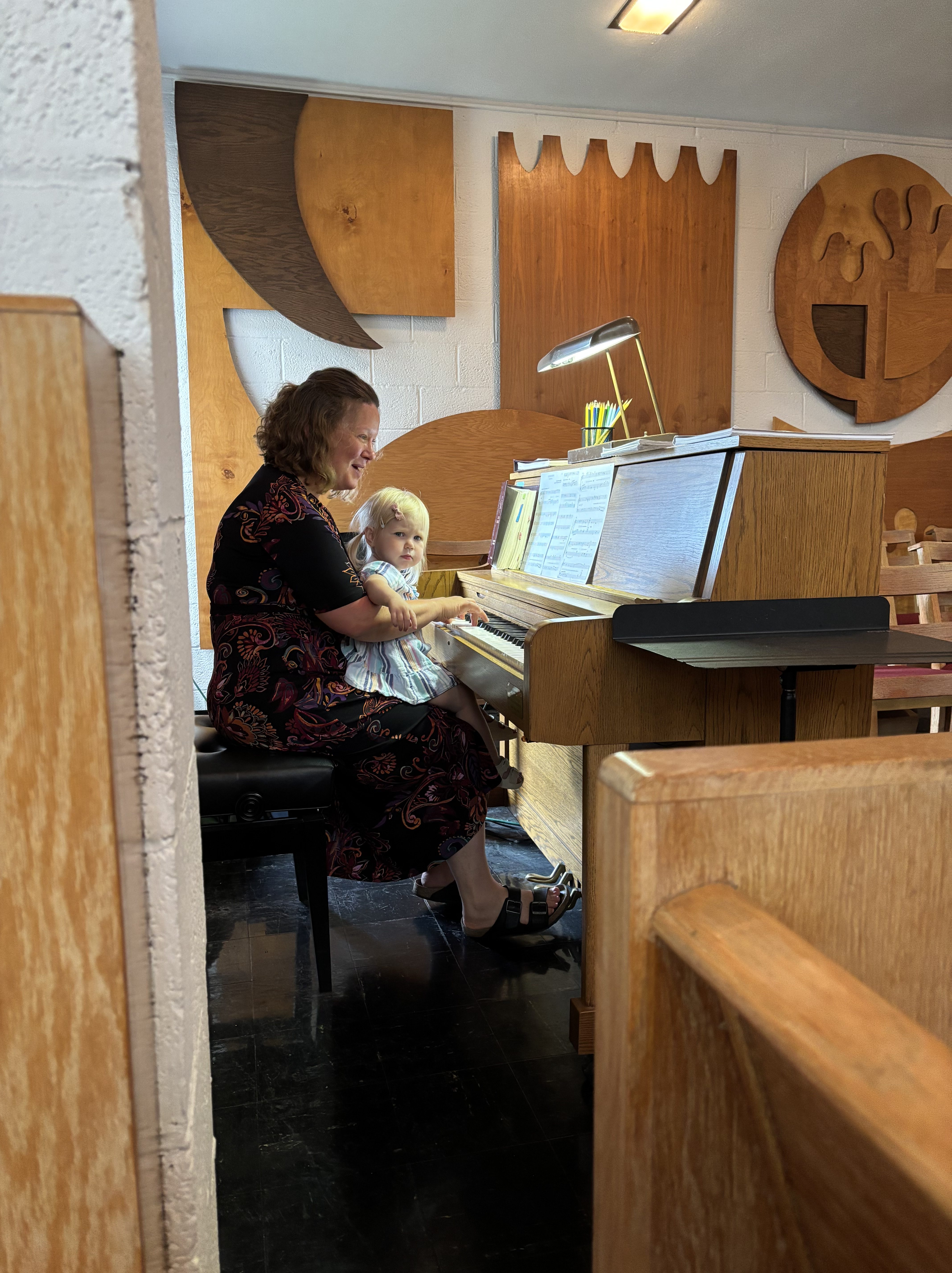
We sang some more songs. We practiced some more notes. Before the children left, some of them waited in line at the piano to tell me some of their wishes, to confide in me some of their hopes, to cry onto my shoulder some of their own sadnesses, and to hug my heart close to theirs.

Such sweet stimulation. Such sad-happiness.

I cried the rest of the day.