Author: Katie Schuermann

I believe the Holy Scriptures to be the inerrant Word of God, inspired by the Holy Spirit and fulfilled in Christ Jesus, our risen Lord and Savior. Therefore, I have faith that children are exactly what God tells us they are in His Word: a heritage to receive from Him. Children are not a prize for me to earn, a commodity for me to demand, nor an idol for me to worship. They are a gift which my Heavenly Father only has the privilege to bestow and to withhold. If God makes me a mother, then I can receive His good gift of a child with all joy and confidence in His love for me. If God does not make me a mother, then I can still know with all joy and confidence that God loves me completely in His perfect gift of the Child Jesus whose sacrifice on the cross atoned for my sin and reconciled me to my Heavenly Father. I am God’s own child, purchased and won by the blood of Jesus, and God promises in His Word that He will work all things - even my barrenness - for my eternal good. For this reason, I can in faith confess that my barrenness is a blessing.

Reconciling with Death

Many of you know the pain of losing a child. I hope you find Christ’s comfort in Pastor Bo Giertz’s devotional writing for the Sixteenth Sunday after Trinity (taken from  To Live with Christ: Daily Devotions by Bo Giertz):

I say to you, arise. Luke 7:14

Death is our enemy and keeps us in bondage. That’s the realistic, Christian view of death. Death is not natural or something we can befriend. Deep in our nature there’s a very real feeling that death for us is something frightening, something that shouldn’t be allowed to happen. We weren’t meant to die. Death is a sign that a catastrophe has happened, that life has become something it never should have become. It’s both sound and correct to be afraid of death and experience it as an adversary, the destroyer, the foe.

The funeral procession that is coming through the city gates in Nain shows us how agonized we are by death, our foe. The sorrow here is as desperate as it can be. There’s a young man dead. Behind the bier is a widow who’s lost everything, even her livelihood and security in the community. Since the funeral must take place the same day, she’s had only a few hours before they shovel the dirt into the grave to ponder the most precious thing she had.

Then Jesus comes. What He does is what He always does when performing a miracle – preaches and gives us a lecture, a promise to all of us. He shows us that our enemy, death, has met his match. He shows us that there’s a possibility, just one possibility, to escape the power of death. He says the same thing in deeds that He later says in words: He is the resurrection and the life, and that he who believes in Him will never see death. Exactly what He said here in Nain – “I say to you, arise” – He has the power to say to all of us at our graves. And He will.

Being a friend of death can mean resigning and surrendering, trying to accept the inevitable – we all have to die. Then we’ve renounced something that’s the hallmark of mankind. You have to try to convince yourself that you’re a fragment of matter that, in accordance with the laws of nature, will disintegrate and fall into pieces again. God, however, has put eternity into man’s mind (Ecclesiastes 3:11), and therefore it’s not so easy to wipe out the feeling that death is the destroyer. That’s not the point either. We can’t come to grips with death on our own. It becomes more and more important to become a friend of Jesus than a friend of death.

(Prayer) Without You, my Lord Jesus, death is just tremendous darkness and a huge mystery. No one can say what I’ll meet on the other side. Some people say it’s all over, but no one knows for sure, and no one can say when darkness overcomes me. I can try not to think about it, but it overwhelms me again. I see people who are younger than I go there. When is it my turn? You know when, Lord. Therefore I leave it all to You and only pray that You are also with me then. For the sake of Your faithfulness.

+Anastasia+

Thank you, Pastor Chepulis, for writing these words of comfort and for sharing them with us for our benefit:

On July 5th, 2011, I stared at the deafeningly silent ultrasound monitor.  I watched the technician stoically glare at the screen, her foot nervously shaking.  No heartbeat.  The only sounds were the rapid thumping of my own heart and the gentle humming of the ultrasound machine.  We learned our first child had died around the tenth week of pregnancy.

We went back to the hospital very early the next morning to have the child surgically removed- an extremely long and silent 85-mile drive to Grand Forks, ND.  Then, the following week, my wife Amy and I, along with our families, gathered at the cemetery of St. Paul Lutheran Church in rural St. Thomas, ND, where our circuit counselor officiated a grave-side service for our little one.  

David confesses, “For you formed my inward parts; you knitted me together in my mother’s womb.  I praise you, for I am fearfully and wonderfully made.  Wonderful are your works; my soul knows it very well.  My frame was not hidden from you, when I was being made in secret, intricately woven in the depths of the earth.  Your eyes saw my unformed substance; in your book were written, every one of them, the days that were formed for me, when as yet there was none of them.” (Psalm 139:13-16) God creates life; life that begins even at the earliest stage of development. 

God saw our little one as she was being intricately woven together.  He lovingly formed her body and imparted to her a soul.  Our child is a person created by God; a person for whom Christ Jesus suffered, died, and was raised again; a person who is loved by God and her mother and father.

There is Gospel for faithful Christian parents.  Not that the faith of the parents save their child, but as parents who prayed for the child and brought him or her to church, Christian parents are to be distinguished from those of other religions; and Luther certainly sets his thoughts this way. 

A good friend of Luther’s, Rev. John Bugenhagen, wrote a commentary on Psalm 29 and in the appendix to his book Luther wrote about Christian women who suffer  miscarriages, “…because the mother is a believing Christian it is to be hoped that her heartfelt cry and deep longing to bring her child to be baptized will be accepted by God as an effective prayer.  It is true that a Christian in deepest despair does not dare to name, wish, or hope for the help (as it seems to him) which he would wholeheartedly and gladly purchase with his own life, were that possible, and in doing so thus find comfort…One should not despise a Christian person as if he were a Turk, a pagan, or a godless person.  He is precious in God’s sight and his prayer is powerful and great, for he has been sanctified by Christ’s blood and anointed with the Spirit of God.  Whatever he sincerely prays for, especially in the unexpressed yearning of his heart, becomes a great, unbearable cry in God’s ears.  God must listen, as He did to Moses…”  (Luther’s Works: AE Volume 43; Copyright 1968; Fortress Press; Published Concordia Publishing House; Saint Louis, Missouri, page 247, 248)

The Lord has heard the prayers offered on behalf of the child by her mother, father, friends and family.  Prayer isn’t simply psycho-therapy to make one feel better but they ascend to God like sweet incense, and He is, indeed, moved by them.  We don’t just wag our tongues in prayer, but God Himself has promised to hear them.  

We have been given hope and comfort from a God who hears the petitions offered to Him  by His people; hope and comfort that flow from the grace and mercy of our Lord, who came to earth, died on a cross for our sins, for even the sins of our little child.  He went to the deathly grave, but it couldn’t hold Him; rather, He was spit back out.  Jesus has conquered death and the grave for us.  He is risen and has given the promise that all who trust in His work of salvation we will be raised to new life in Him on the last day. 

What a gift our Lord has given us!  Forgiveness, salvation, and eternal life graciously given to us through the death and resurrection of Jesus.  Gifts He continues to give through Baptism, the Lord’s Supper, and the precious Word of His Gospel.  All the benefits that Jesus won on the cross are given to us through these ordinary means; gifts that our child was given, even as she was developing in the womb.

Though our child, of course, wasn’t baptized, her mother dutifully brought the child to church where the Gospel was preached.  The child wasn’t sprinkled with the waters of baptism, but was immersed in the Gospel each Sunday and in our home devotions.  The Word is active and alive.  It creates faith and trust in Christ.  “Faith comes by hearing and hearing through the Word of Christ,” Paul writes in Romans 10:17.  The Word of God is powerful and efficacious enough to penetrate the womb and enter the unformed ears of a child.  

It is interesting to note that when Jesus healed the deaf and mute man (Mark 7:31-37), the Lord opens his ears by speaking.  Jesus said to the man, “Ephphatha,” that is, “Be open” and it was so.  The spoken Words of Jesus were the cure for the man’s deafness and his sin.  At the command of Christ, His Word entered into the ears of a deaf man and caused, not only his ears to become open, but also imparted to him faith.  The tongue that Jesus loosed immediately began to proclaim Christ.  As the Word of God entered and restored a deaf man’s ears, so too has it entered the unformed ears of our child.

Our child, even in the womb, was given faith in Christ.  She trusted in a Lord who redeemed her.  Some might say, “How can a child know of such things?”  Faith and knowledge are two very different things.  A small child can have faith, but not theological knowledge and a person can have all the theological knowledge in the world but lack faith.  We’re not saved by how much we know about God, but through the grace of God brought to us through Christ; that is received by the faith that He gives through His gifts of the Gospel, Baptism, and the Lord’s Supper.  (Matthew 19:14) “Let the little children come to me,” Jesus says.  Even a child so small can have faith.

David’s child is a good example of this.  After his adultery with Bathsheba, the child which resulted in this adulterous affair dies.  Not only does the child die, but he dies on the 7th day, (2 Sam. 12:18) one day short of being brought into the covenant of God through circumcision.  Yet David confidently says, “I shall go to him [his child], but he will not return to me.”  (2 Sam. 12:23b)  David looks to the resurrection where he will go to his son in heaven.  He proclaims the trust in a merciful God who has received David’s child.  David also makes his confession in the resurrection, that he will see his son again in the flesh.  There, at the joyful reunion in Paradise, we will see our child again.  What joy to know, what a wonderful promise we’ve been given. 

That’s what the Lord does.  He doesn’t always give us answers to all our questions, He gives us promises.  He promises that though we are sinners from conception, Christ has paid for our sins and the sinful nature we inherited from Adam’s fall.  He promises that on the last day, He will raise all the dead from their graves and give eternal life to all who trust in Christ.  This is our hope and joy.

A hope and joy that we wish to confess.  We don’t know the gender of our child but regardless of gender, we decided to name our child Anastasia.  The name Anastasia comes from the Greek word ἀνάστασις (anastasis), which means “resurrection.”  Whenever we think of our child’s name, we remember the promise the God has given.  The remains of our child that we recently buried won’t remain there forever, but will be raised again out of the grave and we’ll see our child in the flesh.  We look forward to seeing Anastasia again at the glorious return of Christ, when He will return to resurrect and bring to Himself all His faithful people.  We take great comfort that death has been swallowed up in Christ’s victory.  (1 Cor. 15:54b)  

Hope and joy, even in the death of a child.  God has heard our prayers, worked faith through His Word, and has given eternal life to one so small.   We commend our child to a merciful God, who has conquered death for you, me, and our child; looking to the resurrection of all flesh and the joyful reunion in Paradise.

Rev. Mark Chepulis
Our Savior Lutheran Church, Cavalier, ND

Gift Language

There is an eerie silence that surrounds the topic of barrenness in the church today. All of us are afraid to talk about it, and, in my humble opinion, it is because we have abandoned the use of “gift language” in the body of Christ.

Rarely do we talk about children as God defines them in the Bible, using His words of “heritage, fruit, blessing, reward.” Instead, we refer to children as the world does, adopting cultural phrases like “family planning, baby machine, reproduction, fertility science.” By our language alone, we suggest to each other that children are something to be planned for and controlled.

Blech.

This “control language” is a waste of breath in the church, because it isn’t true. It isn’t God’s language. It doesn’t come from His Word. It is something we humans have made up in an attempt to explain and define and harness that which remains mysterious and untamed. “Control language” falls short every time. Family planning? My family isn’t working out the way I planned. Baby machine? Mine didn’t come with a warranty, and I’m still trying to figure out the return policy on this thing. Reproduction? It’s procreation, dude. Fertility science? With a 33% success rate of implantation in IVF, even fertility’s most exact science can’t give me a baby 67% of the time.

That’s why you, Church, are afraid to talk to me. The world has given you faulty language that fails to deliver truth, comfort, or babies. Give me God’s “gift language” every time. Remind me that children are a heritage from the Lord, a gift from Him that is received. And when I get mad that God has not yet given me the gift of children, keep watch with me in my grief and use some more of God’s “gift language.” Tell me about the gift of salvation won for me by Christ on the cross and applied to me in my baptism. Tell me about the gift of God’s Word which creates and sustains my faith in Him. Tell me about the gift of Christ’s Body and Blood given to me at the altar every Sunday for my benefit. And when I still grieve at my childlessness, gently remind me that God gives other good gifts in this life (fellowship, recreation, music, food, education, etc.), not just the gift of children.

So, don’t be afraid. Come up and talk to me. Just, please, leave all of that “control language” out in the world where it belongs and, instead, talk to me about the good gifts we share in Christ. I will try to do the same for you.

Interview on “Studio A”

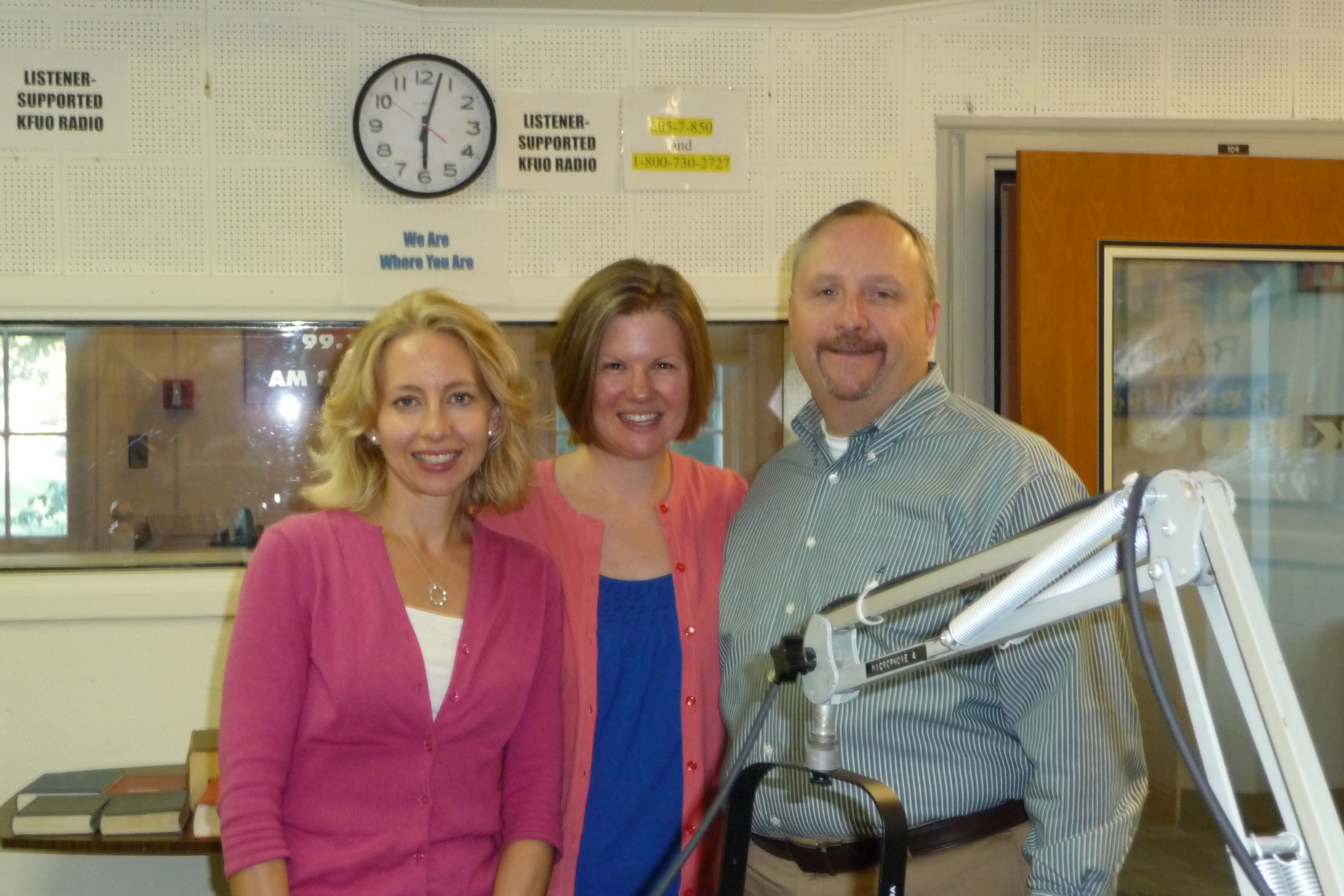
Thank you to KFUO Radio and Roland Lettner for interviewing two of our site hosts on the “Studio A” program yesterday afternoon. We hope you’ll have a listen, too.

Click here for a direct link to the program’s MP3 file. (Our interview begins at 29:10.)

Or, if you would like to learn more about KFUO Radio and the “Studio A” program, click here. (To listen to our interview from this link, click on the hour 2 MP3 file of the Wednesday, September 7th broadcast. Our interview starts at 29:10.)

But You’re Still Young!

Whenever new acquaintances learn that I do not have any children, the first response I usually get from them is, “But you’re still young! You have plenty of time to have a baby. Your time is coming.”

I’ve been hearing that for nine years, now, and each year it gets a little harder to hear. Part of me is thankful for the optimism of strangers, because deep down inside I really do hope they are right. But what if they aren’t? I often think of my barren friends who are past the childbearing age. What was it like when new acquaintances stopped making plenty-of-time-platitudes to them, when strangers could tell that their time had indeed passed? What kept them from despairing when all physical, worldly hope of ever carrying a child in their womb had gone?

I recently received the following email from a woman who is past the age of childbearing, and her confession of faith brought me great joy. How comforting to know that the same promises of God which console me in my barrenness today will continue to sustain and comfort me should I remain childless past the time of my own fecundity.

My heart goes out to you, since I am also barren. Even though I am 57 years old, it still is difficult to realize that God did not intend to give me the blessings of children of my own. From early childhood on, I only wanted to be a mother. That never happened. When it didn’t seem to be happening for us naturally, we explored first adoption, and then medical help, but neither were options for us. We waited too long and were considered too old to be considered adoptive parents by church and state social agencies, even though we were in our mid 30’s. Private adoption at that time meant that the birth parents would have all the say in how we raised our children, and we weren’t comfortable with that. We then went as far as we felt it would be God-pleasing in the medical procedures of that day and time. We finally had to accept that God’s will for us was His will for us!  Knowing that He loved us even more than we loved each other, we could look forward to whatever He planned for our future. 

Now, two decades later, I still mourn the fact that the infants I hold and the children I love will never be mine. God is good. My family is huge. There are new babies joining our family every few months. The most recent was born in June, and now we hear that another niece will be blessed with her second child in January. God has given me many nieces and nephews to love and cherish. However, it will never be the same as raising one of His precious lambs. 

So…we hold to God’s love for us and our love for each other. He has blessed us in so many ways! His wisdom is not mine, and that is good. He does know what is best for me, for my husband, for my family, and for you. Whatever God has in store for you will be a blessing to both you and to others. I pray He gives you a child, but only if that is His perfect will.


The Book Is Now Available!

Now available through Lutheran Legacy!

Order your print copy here.

He Remembers the Barren by Katie Schuermann is a tender conversation with women in the church who wrestle with the issue of barrenness in marriage. Addressing questions frequently asked by those struggling with infertility, the author walks alongside the reader, relaying personal stories to both encourage and support those who are suffering. Issues such as control of our bodies, family planning, and the source of conception are examined through a theological lens, reminding the reader of her clear vocation in Christ and pointing her to the ultimate source of fruitfulness, vitality, and comfort, our Triune God.

With Psalm readings, beloved hymn texts, and collects penned by Dcs. Melissa A. Degroot, each chapter of He Remembers the Barren resonates on a devotional level that is pitch perfect for women struggling with the grief and shame which often accompany barrenness. This book also serves as a valuable resource for pastors, family members, and friends seeking to better understand the barren experience of a loved one.

John T. Pless, Assistant Professor of Pastoral Ministry at Concordia Theological Seminary and respected commentator on Christian ethics, has this to say about the book: “This is a book that is about Christ who alone is the source of our joy and hope, our life and peace. Katie does not hold out a Jesus who will fix the problem of barrenness but a Jesus whose favor for sinners reaches to the very depths of our being. As Katie so aptly puts it, fulfillment is found not in the womb but in Christ. Writing with tenderness and a realism shaped by the cross, Katie makes a lively use of the Gospel to draw her sisters away from the temptations to self-pity and despair to the sure and certain promises of the Son of God recorded in the Scriptures and proclaimed in sermon and sacrament. Only in Christ is there true contentment.”

The Difference

I recently had the joy of spending a few days this summer in the home of my dear friend in South Dakota. From dawn ‘til dusk, my friend’s five, little blessings ran around in baseball caps and tutus (sometimes at the same time) alternately playing doctor, reading books, putting together puzzles, working in the garden, and “helping” Mommy. My friend’s home is delightful chaos, and I found myself basting in the youthful commotion until my barren-weariness was good and tenderized from all of the love and attention.

I stayed long enough to need a load of laundry done, and my friend generously offered me the use of her washer and dryer. I popped down to her basement with my laundry bag in hand, and I almost tripped over my own dropped jaw at the sight of her laundry room floor.

There, sitting in an organized row, were six, full laundry baskets. Six! Upon closer inspection, I noticed that some of the laundry baskets even had extra baskets stacked underneath them. I counted them all. Sixteen. My friend owns sixteen laundry baskets!

All of those blessings running around upstairs obviously came with some dirty, back-breaking responsibility. Their life of playing and growing and learning resulted in my friend needing more laundry baskets than I have fingers on my hands. The term “mountain of laundry” took on a whole new meaning for me. I looked down at my wimpy lavender and lime green polka-dotted laundry bag and felt kind of embarrassed at its meager size.

I went upstairs and asked my friend, “Do you ever use all of those laundry baskets at the same time?”

She blushed. “Yes. Don’t tease me!”

“Um, that doesn’t warrant teasing. That warrants a maid!”

Here is the difference: I yearn for more laundry, and my friend yearns for less. I crave a little more chaos, and she craves a little more privacy. We can see the blessings and the burdens in each others lives. What a gift it is to know and trust that God in His wisdom and love gives both of us good gifts, and what a privilege it is to pray for each other and support one another in the body of Christ.

I hope my friend can come visit me in Dallas. I think she will be refreshed by the quiet and solitude of my home, just as I was refreshed by the perpetual, snuggly motion in her own. Though I may leave my laundry room door closed when she comes…