Grief

Aftermath

You told me one night.

Though Easter had come and gone, I saw the fast of Lent alive in your eyes. Yes, even now you keep a pious vigil, twenty years of Tenebrae, still afraid of the strepitus.

You all but cover your ears.

“I had a miscarriage in between the boys. They told me the baby was dead, so I went in for a D&C.”

It happened a generation ago, but you still can’t look at me. You shake your head.

“I couldn’t sleep for weeks. I was afraid. What if I had- ”

You stop. You are a grandma, a happy grandma, but your second child’s Good Friday still haunts you. It is not finished for you. Not yet.

“I went to the hospital and made them show me the records.”

I suck in my breath. This is not grief over death as I had thought. This is something different. This is fear. Over murder.

“I had to know that the baby was really dead before, you know…”

I did know, though I had never considered it. Of course. It is the same procedure, the same legal procedure whether dead or alive.

“The records said she was dead before the D&C.”

I feel relief. Then sudden guilt. Then relief again. She miscarried not murdered.

Wait.

I catch myself in the considering, and my anger is immediate. Burning hot.

This is the sick world in which we live: A mother cannot merely grieve the death of her miscarried child. She cannot simply undergo a procedure and trust that it is reserved for mothers who want their babies but have lost them. She now has to question, has to fear the hostile world that willingly, profitably D&Cs babies to death, and wonder whether or not her procedure of healing medicine was really healing or not.

This is a cruel cruelty.

Cherry Blossoms

Let Us Care for You!

A Middle Eastern woman with her daughter-in-lawI know one of the reasons you won’t confide in people about your barrenness. There are those who insist on fixing you. You know, the people who slip you a piece of paper with the name of a health book they think will cure your barrenness, or the people who tell you to relax or – my personal favorite – start the adoption process in order to get pregnant.

But not everyone wants to fix you. Some people just want to care for you. Leah Houghton, a mother and part-time social worker, is one of those people, and she has something she wants to say to you:

The journey to parenthood has certainly been very trying for my family. Just of few of these trials include a partial-miscarriage of my first pregnancy where I miscarried one of the twins with which I was pregnant. During a standard sonogram, our second child was diagnosed with a cleft lip and palate. We were told by doctors that he would be blind, deaf, and mentally delayed. We were also told he would have heart and lung problems and would be “grossly disfigured.” We would have to wait until his delivery to discover that none of these things were true about our son. Yet, we still faced (and are still facing) numerous surgeries, doctor’s visits, clinic appointments, speech therapy evaluations, etc.   

Just a little over a year after our son’s diagnosis, we experienced the miscarriage of our third pregnancy. I have also experienced moderate postpartum depression after the birth of my second child. Then, after I stopped nursing my daughter, I began experiencing severe anxiety and panic attacks (related to hormonal changes) that nearly incapacitated me for months. However, throughout all of these trials, the Lord has provided our daily bread and given us such grace and comfort. All these gifts truly surpass our understanding.

Sisters, I know from the outside that the woman who has a handful of young and energetic children may seem like the last person on earth to be able to provide you with any comfort when you are struggling with barrenness, and it is true that I cannot imagine the grief that an empty womb and an empty home must be. Yet, I encourage you to please tell your sisters in Christ your struggles. Let us care for you. Let us be a quiet ear to listen, a shoulder to cry on, and a comforting hand to hold. No, I don’t know what it is like to walk by empty nurseries that have been prayed over night after night with hopes that God would choose to fill that nursery in some way. No, I don’t know what it is like to have empty arms that so long to hold a child near. But, I do know what it is like to carry a child when you don’t know if you will ever get to bring that child home from the hospital; I know what it is like to grieve the loss of a child that you will never see on this earth; and I also know the strength and peace that can come from waiting on the Lord. And, sisters, I want to encourage you and carry that burden with you in prayer and love.

Please let us care for you!  Let us pray with and for each other and bear with one another in love!

Leah Houghton

I Just Can’t

LSome of you look at me like a deer in the headlights. You see the book I have in my extended hand. You see my intent to give it to you, and you flee.

“No,” you shake your head. Some of you even wave your hands. “No, I just can’t. I can’t read that.”

I am not into waterboarding, so I quickly slip the tool of torture back into my bag. Out of sight. “It’s okay. You don’t have to read it.”

This is usually when you start to cry. “I-I’m sorry. I’m sure it’s good. It’s just that…that…”

I know. I really do. You don’t want the word barren anywhere near you. You don’t want to read about someone else’s pain, because your own is already too much to bear. Your disappointment and fear and anger have all but extinguished the little flicker of child-fire inside of you, and you think this book is a swift wind that will snuff it out. You don’t want to be content in your childlessness. You want a child, and you will have one or go down fighting.

Most of us go down fighting, and that, dear sister, is why I wrote the book; not because I want your child-fire to die, but because I want you to be encouraged by the truth:

You are special, beloved by God, your Father. He has not forgotten you, nor has He forgotten that you want a child. Yet, children are not a prize for you to earn, a commodity for you to demand, nor an idol for you to worship. They are a gift which the Heavenly Father only has the privilege to bestow and to withhold. If God makes you a mother, then you can receive His good gift of a child with all joy and confidence in His love for you. If God does not make you a mother, then you can still know with all joy and confidence that God loves you completely in His perfect gift of the Child Jesus whose sacrifice on the cross atoned for your Sin and reconciled you to your Heavenly Father. You are God’s own child, purchased and won by the blood of Jesus, and God promises in His Word that He will work all things – even your barrenness – for your eternal good.

It’s okay to be sad. It’s okay to be okay. It’s even okay – Dare I write it? – to be content today without a child. His grace is sufficient for you. It really is.

Now, would you please go read the book? There are so many other comforting things I want to tell you.

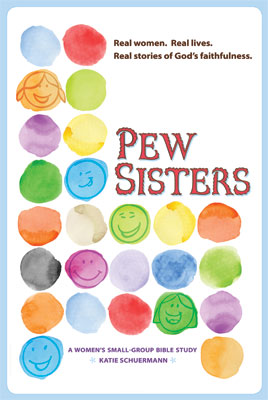
True Sisterhood is Pew Sisterhood: A Review of Katie’s Newest Book

204152The term “sisterhood” conjures up images of sororities, family gatherings, or that classic song from the movie White Christmas (“…there were never such devoted sisters”). Throughout a woman’s life she meets other females like her, women who are “in the same boat” at the time and can relate to what she’s going through in life. This blog is a prime example of a place where sisterhood is fostered and common experiences shared. Our readers feel a connection with one another and a sense of belonging.

This is a good thing, of course, but it’s important to realize the pitfalls of exclusive sisterhood. Katie Schuermann’s newest book, Pew Sisters, is a wake-up call to all of us who may be tempted to think only of the crosses that we bear and forget the battles that other women around us may be waging. Pew Sisters, which is arranged as a small group women’s Bible study, dives into the lives of twelve real women who experienced emotional, physical and spiritual trials in their pasts and were guided through these valleys by the loving hand of their Savior. This book is a reminder not only to open our eyes to those around us, but most importantly to fix our eyes “on Jesus, the founder and perfecter of our faith, who for the joy that was set before him endured the cross” (Heb. 12:2).

Pew Sisters exposes the secrets of the women you see each week in your own congregation. What often lies behind the practiced smiles and the “Oh, I’m fine” responses to your flippant “How are you?” are hardships. Katie so delicately reveals these hardships from the lives of women she has personally known at different times in her life. These women, who have so courageously allowed their stories to be told, do not hold back their faults or cover over poor decisions they may have made. Because of their honesty, Pew Sisters does not shy away from showing both saint and sinner. This realistic perspective helps the reader better identify with the woman who is highlighted in each session by bringing to the surface those sins and struggles that are common to so many of us—worry, regret, weariness, guilt, anger, doubt, despair—and documenting those specific ways in which the woman was comforted, found peace, or was encouraged. Sometimes the help came through her spouse, friend, or pastor, but it always came from the mercy and grace of Christ Jesus, revealed to her from His Holy Word.

This help comes to us, too, as we follow along with the study questions at the end of each story and eagerly turn to the study guide in the back to find out how Katie’s own pastors answered each question. The reader is not left to wonder if she is interpreting God’s Word correctly; she is coached by the professionals, those who have been trained and called to teach her what they have learned from years of study. This is an amazing addition to the Bible study: to be able to hear how two different theologians reflect upon those really tough questions about suffering and pain, forgiveness and hope.

What Pew Sisters will do for you, as a barren woman, is engage you in the very healthy practice of getting outside yourself and identifying with the sorrows of others. Maybe you’ve never been through a divorce, like Marianne, or dealt with the serious illness of a child, like Anna, or been diagnosed with cancer, like Christine. But you know some of the emotions they’ve experienced, and as a fellow member of the Body of Christ you have a connection with them—a sisterhood, if you will— that qualifies you to reach out in love. Katie even includes suggestions for how you can show this love to them in the “Moment in the Pew” sections that go along with each story.

It’s true that sharing in the suffering of another inevitably brings you both closer together. But Pew Sisters‘ intent is not to show the bond that exists between women who suffer in various ways. Rather it highlights the familial bond formed between us by our Baptisms and adoptions as daughters of our heavenly Father. This unity should motivate us to treasure each of those sisters in Christ who sit in front of, behind, or next to us on Sunday mornings. It should drive us to our knees in repentance for not caring for or about them, and in thanksgiving for those whom our Lord has sent to care for and about us.
No More Hush-Hush

For years now, our talks at home about children have been somewhat restrained. We have endured years of waiting and hoping. It was painful to talk about growing our family. There were no guarantees that the Lord would answer our prayer. Yes, we talked about our hopes for a larger family, but those conversations were short and cautious. It was hard to imagine a larger family when nothing seemed to make that a reality. Meals were eerily quiet. Talking aloud about having children made the pain of not having them all the more real.Hush now.

As we draw closer to receiving our little girl, our dinner conversations have become more lively. We talk about the personality our little girl might have. Family vacations and birthday parties are being planned as we sit around our table. More smiles are shared together.

This does not mean to say that the Lord has abandoned us during our wait. On the contrary, He has carried us through the sorrowful days and meals. He has continued to provide food for our table and an environment in which we can continue to receive His good gifts.

Dear friend, I encourage you to speak aloud your pain. It’s okay to talk about wanting children, even if they haven’t been given to you. I wish I had shared those sorrows with my loved ones. I cheated them out of the opportunity to love me and help carry my grief. They had often told me that they loved me, but I was still too scared to actually talk about my barrenness with them. Share your sorrow with your spouse. Tell your pastor; then hear him read the psalms to you. God’s Word brings true comfort to a hurting soul. God says that He loves you. Now that’s something to share.

An Agonizing Absence

Woman Praying in ChurchA barren friend recently confided to me, “I broke down crying the other day. I don’t really know why. I mean, I thought I would be over this by now.”

I don’t think we ever get over this barrenness thing, because no matter how comfortable we become, no matter how content we grow in our childlessness, it is still not the way things are supposed to be. God commanded us via Adam and Eve in the garden to be fruitful and multiply, and we know that it is God’s good will for us to have the blessing of children in marriage.

Yet, we don’t.

Our barren wombs are a reminder, a manifestation even, of the brokenness of this Sin-sick world, and, even though we are blessed and fruitful beyond measure today in Christ, the wrongness of our childless marriage still stings. And so we grieve.

Rev. Gregory Schulz describes it this way in The Problem of Suffering: A Father’s Hope:

[G]rief is love. This means that grief is a kind of care…Grief as care is an obsession, an attention – not to “mortality” or to “the human condition” – but to a person who is at the same time dearly loved and agonizingly absent. (Schulz, 102-3)

We cry, because our dearly loved children are agonizingly absent.


Pain as Poetry

little boy cryingKristi recommended this book, and so I read it.

Rev. Schulz perfectly articulates in his book the very reason a blog like this exists:

My life is lived in the genre of lamentation…

Lament isn’t an inarticulate wail. Lament notices details, images, and relationships. Pain can become poetry. Poetry is our most personal use of words. It is our way of entering deeply into the experience and bringing beauty out of it.

Lament is deeply private, but it can also be deeply public…Lament keeps us connected with reality, and with the deepest of all realities: God. (Schulz, 117-8)

Thank you, dear readers, for reading our laments, poetic or not, and for sharing your own with us.

Blessed to Suffer

Nurse Behind Intravenous TubeJane Jensen reminds us in her reflection on “My Suffering Is a Blessing” that God blesses us with His good gifts even while we suffer.

Three years ago I heard the dreaded words, “the biopsy came back cancerous.” I remember counting the tears that fell, only three before hanging up the phone. Crying is not going to do you any good, I told myself, start your stunned brain, instead. What should I do first? Pray? I’d already been doing that since the mammogram found the tiny spot. I decided it was time to put my head down and walk this path the Lord was showing me.

My friend, Cheryl, had taken me up to the hospital for the needle biopsy. She never hesitated when I asked if she could take a day off and go with me. A needle passing through your breast is terrifying. However, the technology, the doctor, and the nurses were all blessings from God. There was no pain, none. Those were the first of many blessings to come.

The Lord had the scheduling all planned out, another blessing.  Everything fell into place.  My daughter and son-in-law were with me when I had the lumpectomy surgery. Best friend, Bill, went with me to find out my treatment options. Friends called every day to check on me.  When the chemotherapy began, the support increased. Four times I sat in a chair to receive the drugs by IV that was mixed before my eyes. People almost fought over who would take me to the cancer center and wait with me.

The cancer center was only 30 miles away. I did not have to travel to Omaha which would have been 3 hours away. Here again the Lord had the best place all provided.

I received the blessing of new friends through chemo and then radiation. One is especially dear to me, keeping in touch by phone, letters, and lunches. Cards and letters of encouragement came four and five at a time. I started to scrapbook them, but they were so great in number I gave up and bought a beautiful rose covered box. I had to weight them down for the lid to stay on. People prayed for me. My church family and I grew especially close all because of their concern and love for me. It was humbling.

I lost my hair, and my complexion turned a strange color. Still, my friends comforted me and asked about me. Could they bring anything to me? That was when the tears came, not when I went under the knife, not during the torments of chemo or the exhaustion of radiation. The LORD God of heaven had provided sinful, sick me with a family that spoiled me and friends who did everything they could to cheer me. It was humbling and overwhelming. God had sent them all to me at just the right time. My cancer journey was a blessing. I can explain it no better than that.

Jane Jensen

The Cross We Bare

surgical team workingLaura Koch reminds us in her reflection on “My Suffering Is a Blessing” that the crosses we bear can be very hard to bare. Thank you, Laura, for baring your cross to us.

Blessed by God – I suppose that would be the “category” that might describe me since I have four children that were created by God in my womb. But I also know the pain and sorrow of a body filled with stage 4 endometriosis. I know, too, the guilt and suffering that goes with losing an ovary by disease and then deciding to “tie the tube” on the other side because childbirth was becoming too hard.

Our first daughter came to be very early in our marriage. My husband was at the seminary, I was a Lutheran school teacher…we had barely enough money to live on, and yet she came. I was so afraid. How would we take care of her? God provided beautifully for all our needs….and even granted us a son while we were still at the seminary. Another daughter came during my husband’s early years in ministry. Our last daughter came three years later but two months premature, as I was severely bleeding due to placenta previa. After receiving 5 pints of blood, I was just fine. And after 4 weeks in the hospital she came home.

So, why then am I writing here? Because I find so much comfort in the words written on this blog. I believe God has created a natural desire in women to have children. We, on most days, comfortably nurture the people in our home. When this blessing of children is not granted or ceases to be, the pain that a women suffers can become unbearable at times. And when one chooses not to have children because of fear or because of a risk to her body, her grief can be insurmountable, too. I know.

The years following my tubal were filled with so much grief and tears. I wish I had not made that decision in haste – lying on a hospital bed in pain due to an enormous cyst on the other ovary. I don’t know if God would have granted us any more children. I don’t know if my body would have been able to handle it anymore. Eventually, endometriosis would claim my very womb, too.

The guilt over that decision, though, grieved my heart for many years.

A barren womb is not always easy to see.

We all know that we live in a sin-cursed world. We are children of God, saved by grace in the death of His Son, Jesus Christ, and we live in the freedom of our sins being forgiven. We know that God does indeed love each of us. We need to hear that spoken in our ears every Sunday, if not more! I know that God has forgiven me for that decision and He has calmed my spirit as years have gone by. I look at my children as the true gifts that they are, created in a body that was broken by sin. And I weep with the barren woman because I have shared in her grief, too.

Laura Koch

Open Hands

MP900321168Come with me to the other side of the fence for a moment and sit with a sister in Christ whose daily life looks markedly different from your own.

Aubri reminds us in her reflection on “My Suffering Is a Blessing”  that children are a blessing because God says they are, period. For, more often than we’d like to admit, the suffering that comes with mothering makes us feel anything but blessed.

Being the mother of five children, ages four and under can make it easy to feel more burdened than blessed and call my struggles, suffering. The endless work with little to show for it, the emotional strain of teething infants, defiant toddlers and helpless preschoolers wears on me; enduring fussy, fighting children and wondering if they’ll ever become kind, rational people; being needed by everyone, all the time and the worrying that I’m doing everything wrong.

Somedays I’m embarrassed by all the mess, noise and chaos that comes with a lot of children. The wreck of a porch strewn with tricycles, containers of dirt, old strollers and half-naked children screaming at each other; or opening the door to our van, loose diapers, sippy cups and crayons falling out onto the street and a load of fussy children tumbling out behind all that. My pride is damaged and humbled, knowing many people look at us and think, “I’m glad that’s not me” or “Don’t they know better?” I become so afraid of being “those people with all the wild, dirty kids.” It’s hard to fight the shame for what is all over my family; weakness, sin, failure all on display everywhere we go.

I fear being judged for living the only way I feel is right and godly. For embracing children and God’s authority over all of life and being thought a fool. I reluctantly confess that my own flesh feels like a fool! How many times have I pitied myself and been frustrated by those who look at us with a freak-show curiosity, resenting that we can’t even share the joy of an expected child without discouragement and comments of “concern” from loved ones who don’t understand our beliefs.

But my public cross is light compared to what I bear in private, in my heart where the sin of fear sits firm for days. I’ve had five babies in five years. I could have five more in the next five years. Pregnancy after pregnancy. I’m weary and worn down. Lord, how much more will you give me? How can you ask me to mother these babes well when I’m so tired, so scared and so angry over the sacrifices I have to make all day long?

In the trenches of motherhood it’s hard to feel blessed but that is true regardless of how I feel. I am blessed because God says I am. By His grace I can confidently confess that and give thanks.

I have to hold my hands open to God’s blessing of children because it’s right, not because I always want to. It’s foolishness to think I control life. God says that children are His gifts. He gives and He withholds as He wills. I can only live by faith and rest in what God has ordained. That is not easy—but what we are all called to do.

By God’s grace, despite my worries, I rejoice when I’m found to be with child again. I’m amazed that He would open my womb and our family to another life. I am blessed five times now with a front row seat of watching God’s greatest creations as they grow. I thank God for the moments I can relish my blessings, letting the mess of the day wash off of me; for the moments like none other when one of my precious children grins at me, puts their head on my shoulder or says something remarkable. I know that these moments are just for me. God is good. And He always provides grace and strength to make it through today.

Aubri H.