Infertility

Baby Blankets

One of the things I look forward to most at baby showers is the unveiling of a homemade, quilted baby blanket that was lovingly made by a devoted friend or family member. I like to finger the soft material and admire the creative patterns and tiny stitches. In that awe-filled moment, I honestly feel more jealous of the quilter’s talent than the expectant mother’s blanket. Maybe that is because I never expect to be on the receiving end of a baby quilt of my own.

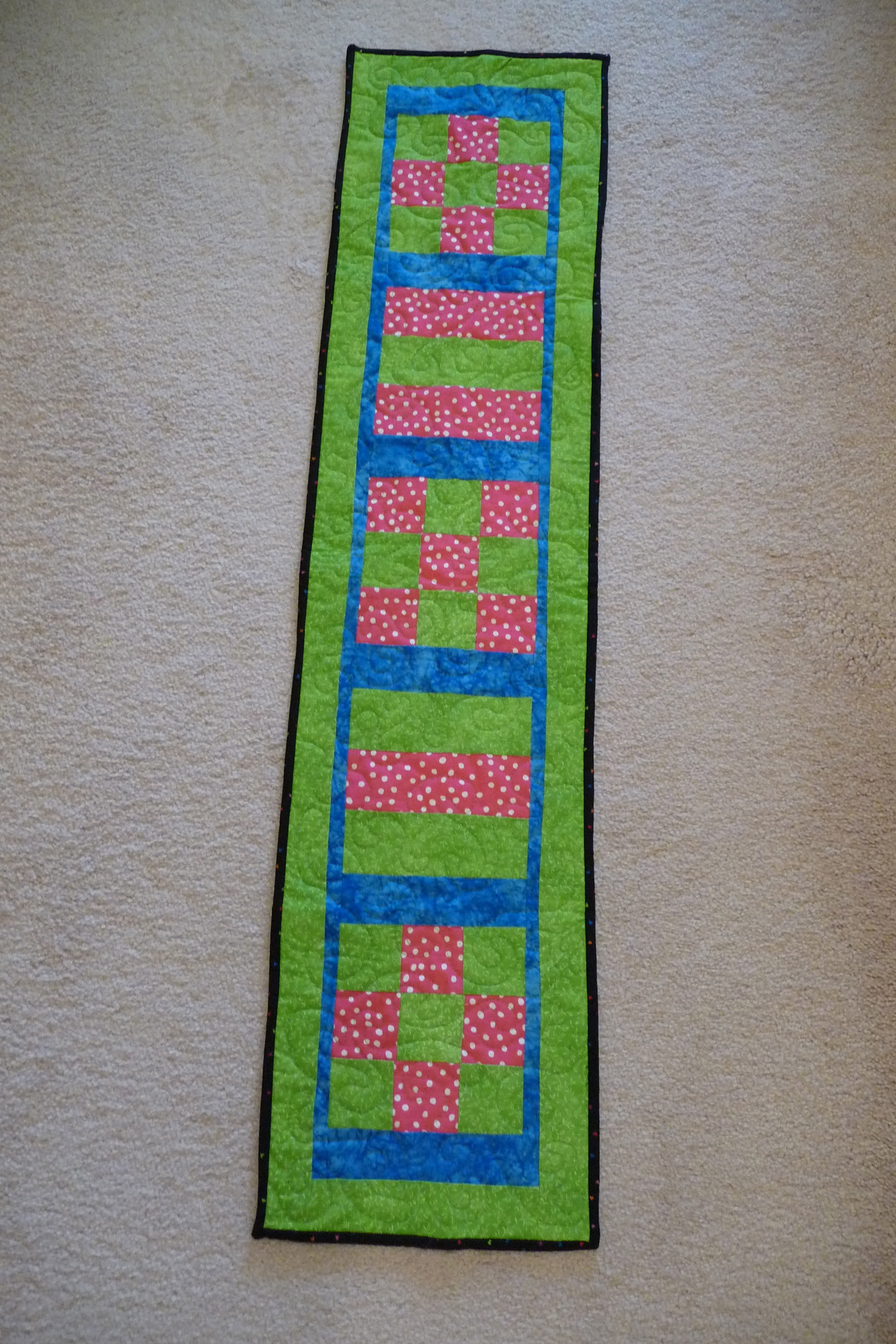
I think that is why I was so undone last week when I opened a package that came in the mail. My hand reached in and pulled out a quilted, green-and-pink (Two of my favorite colors!) table runner. It could have been a baby blanket for all of the excitement I felt.

A corresponding note read, “This runner reminds me of spring and the joy of Easter. I hope it will brighten a corner of your home.”

Do you know of what else it reminds me? It reminds me that I am remembered and “showered” with love by my friends, even without a baby. Thank you!

A Change of Heart – Part 2

A continuation of A Change of Heart – Part 1…

“I think we should call her,” Ben said as we stood in the kitchen that evening, going over the unbelievable events of the day. I had fumbled through the rest of the phone call with Keisha, eventually encouraging her to contact the agency we were already working with. I knew that they could provide her with some resources she might need, as well as be a facilitator between us if she was really serious about wanting to pursue adoption.

Ben continued, “If we are really open to this then we need to find out more about her and the birthfather and her situation so we can know all the facts. What if she decides not to contact the agency for some reason? We might never hear from her again.”

His sentiments both surprised and touched me. He was suggesting a much more aggressive approach than I would have considered and it reminded me that although he did not often express  his frustrations with this long wait for a second child, his desire to have a baby was just as strong as my own.

So I called Keisha. She was excited to hear from me again and heartily agreed to come over that very evening to meet Ben and continue our discussion. When she arrived she seemed a bit more timid in Ben’s presence, but still willingly answered the countless number of questions we threw at her.

During the conversation that evening and over the course of the next few months we obtained a picture of this woman and her life, both past and present, that brought to light the realities of what life is like for so many girls who grow up in a culture of poverty. Her father was never in the picture. Her mother was verbally abusive and their relationship now was strained and sporadic. The birthfather–her first and only boyfriend–was repeatedly unfaithful but yet the connection to his family provided her with a place to live, a family support system, and a father to the other three children they had had together. She felt trapped, without any real options in front of her for making a better life.

As she and I visited with each other during this time I couldn’t help but look at my own past and all the privileges I had had: married parents who loved me, moral guidance, boundaries, pastors, a Christian education, a selfless and faithful spouse…too many to count. And I looked at Keisha’s life and felt again a sense of injustice, but this time it wasn’t for me, it was for her.

We eventually had the opportunity to meet Keisha’s other children, whom she obviously loved dearly. Despite the fact that she had experienced very few healthy relationships in her own life, she was a gentle and attentive mother to these little ones who seemed to adore her. These children showered her with the love and affection that she had not received from anyone else in her life. Could it be that perhaps, despite her poor choices, these children were God’s gifts to her  to fill a need that no else had even tried to fill? She loved these children, but she felt that a fourth one would be more than she could handle  in her current living situation. Family members suggested abortion but this was not an option for her.

For four months we spoke with Keisha and the boyfriend, encouraging them to work with our adoption agency. While both of them seemed adamant that they could not raise this child and that we were the right family to do so, they were reluctant to follow through with visits to and from the agency social workers. “Why?” we kept wondering. “What was preventing them from making that next step?” This was not the only red flag that had emerged. There were others as well. Ben and I knew we needed to proceed with great caution. We prayed, we asked for advice, and we waited, all the while wondering if it was realistic to think that this baby would really be our own someday.

To be continued (and concluded)…

Puzzled

Our household does not have a dual income.  My husband is the provider.  I stay home, making our home a safe and pleasant place.  I enjoy preparing meals and tending my garden.  I don’t find quite so much joy in dusting and ironing (which I rarely do).

There are moments, too, when I have some free time.  I can read or sew.  Recently, I’ve started doing puzzles.  The current one has 500 pieces.  I’m frustrated by this puzzle because its colors are only various shades of brown.  I sit down to put some pieces together and walk away without finding a single match.  I get tense. I think, “I can’t even put together a puzzle.  How could I be expected to have a baby?”  During those moments, I wonder if I should go back into the work force.  Maybe I’d feel better about myself if I was “contributing to society” instead of “tending the hearth.”

Therein lies my sin.  I’ve started listening to the voices of society.  They say, “Get out there and do something.”  That’s when it’s time to redirect my attention. It’s time to listen to the voice of Jesus, the Good Shepherd.  What does He tell me in Scripture?  I need to confess my sin of idolatry.  The Lord will provide for the needs of my family.  He has already given me His Word and Holy Sacraments.  I am forgiven; I am His child.

I have no idea what God’s plan is for me regarding family life.  I don’t know if my family size will grow or remain the same.  I don’t know if there will ever be grandchildren.  Who will care for me and my husband in our golden years?

The Lord knows.  He is the One who formed me.  He knew me in my mother’s womb.  He knows my life’s steps.  He has given me the vocations of wife, mother, daughter, sister, friend.  I don’t have to worry about how to make everything fit into its proper place.  God has it covered; He’s taking care of everything.  No need for me to be puzzled about that.

Mother’s Day

Mother’s Day is almost here.

I have such mixed feelings every second Sunday in May. I enjoy celebrating my mother, grandmother, mother-in-law, godmother, sisters, friends, and all of the other women in my life who make sacrifices to care for me, yet…you know.

There’s that whole I’m-not-a-mother thing.

The awkwardness is unavoidable. I am now too old to remain an inconspicuous, innocent daughter of the church who simply joins in on the celebration of the matriarchs around me. I am a childless, married woman – one of those alien non-mothers – and everyone has to suffer through the uneasy, painful, blushing, frozen, horrible moments of trying to figure out what to say to me on Mother’s Day.

I feel it most for the poor ushers delegated to hand out carnations. I know they want to give me a flower – I can see the chivalrous struggle in their eyes! –  but I have “childless” stamped across my forehead. So, they hand me a service bulletin, instead. “I’m sorry,” one of them inevitably whispers during the exchange, and I am left in the inelegant position of comforting others for my own childlessness.

How did things get to be this way? When did we decide that it was good, right, and salutary in church to give out discriminatory gifts as a coda to Christ’s gifts of Word and Sacrament?

I am going to be blunt. Mother’s Day is a secular holiday that has worked its way into our Sunday services. I am not of the opinion that we should stop celebrating mothers. Quite the opposite, I think we should celebrate mothers every day of the week and with more than just flowers and praise. We should be offering them our time and talents to help them in their God-given vocation of caring for others as well as praying that God would sustain them as they daily die to self in order to serve our youngest church members.

I don’t even think we should stop commemorating Mother’s Day in church. At this point, it would be culturally rude to withdraw from the church the tradition of honoring women whom God has gifted with children, but we need to be mindful of the pain this secular, gift-card-selling holiday inflicts on those from whom God has withheld the gift of children. Sometimes, pastors (often unknowingly) drag this secular holiday’s pain into their sermons, their children’s sermons, their preservice announcement anecdotes, and their prayers. In an effort to be culturally relevant, they slay the barren in the pews and grieve the hearts of mothers who have lost or are estranged from their children.

Perhaps, instead, pastors could use Mother’s Day as an opportunity to use gift language and remind their congregations to celebrate all of the women who serve as mothers in the church: godmothers, aunts, school teachers, deaconesses, babysitters, sewing circles, LWML, secretaries, altar guild, VBS bakers, and every woman who faithfully lives out her vocation in service to others. Perhaps, we could give these women carnations, too – not to dismiss the love we have for the mothers who bore and raised us, but to properly recognize that motherhood is a vocation given by God, not an achievement rewarded by men.

A Change of Heart – Part 1

Living in a large city has been an eye-opening experience for my family. We had previously been surrounded by primarily white, middle-class communities. Not anymore. We now live among people of various ethnicities and cultures, many of whom are living in poverty and do not have traditional family units. I see this almost every day that I leave my house. Single moms wait at bus stops with several children in tow.  I see high school girls walking home after school, several with bellies protruding, evidence of the life they carry within. At first it was hard to see these girls day after day and not feel a great deal of injustice. It appeared that lack of self-control and poor decision-making were being rewarded by God when my husband of 14 years and I continued to wait for a child. It felt unfair.

We are on the Caucasian waiting list with our adoption agency. The decision to have our names on the Caucasian list as opposed to the list that includes all races was not made flippantly, nor have we resolved to only have white children in our family. Because we have a choice as to what list we go on we picked the Caucasian list, but we’ve always agreed that if an opportunity to parent a child of a different race was dropped in our lap we would certainly be open to this. And then, one warm and bright October morning, the opportunity arrived–not in our laps, exactly, but on our doorstep.

“Keisha” rang our doorbell with the intent to ask some questions about the “for sale” sign in our front lawn. She and the large family she was living with were looking to move out of their small apartment and they wanted to remain in the same neighborhood. She loved our house and had been admiring it for several weeks. Although I would not normally have invited in a perfect stranger to take a tour, for some reason I felt very comfortable with her and asked if she’d like to take a look around. I was thrilled that someone was showing some interest in the place. We hadn’t had many lookers.

Keisha was sweet, with a wide smile that brightened the room and starkly contrasted her dark skin. She had a calm, confident presence about her, perhaps accentuated by her tall, brood figure. In our conversation during the tour it somehow came out that our son had been adopted and we were hoping to adopt more children. Keisha was intrigued  by this fact and commented on how well Caleb seemed to fit into the family and how content and cheerful he was. She soon left with the realtor’s number and mine in her hand and I prayed that the experience might move us a little closer to getting this house sold.

Not twenty minutes later I received a phone call from her. We exchanged the initial greetings and then, after a quiet moment of hesitation, she blurted out, “I’m pregnant. And I’ve been thinking about adoption. You were so kind to me when I was in your home and your son seems like he is so loved and so happy. I really feel like you’re the family I’ve been looking for.” I almost dropped the phone.

To be continued…

True Comfort

I recently sat with my mother at a kitchen table on vacation, weeping in my grief at having no children. “I may never be a mother,” I confessed.

All my mother said was, “I know.” And I was comforted.

I was comforted, because my mother did not try to change me or my situation; she did not try to minimize my suffering by labeling it or explaining it away; she did not offer empty suggestions for how to fix my barrenness; she made no false promises that God would someday give me a child, for, outside of giving me the Child Jesus to save me from my Sin, God has made no such promise to me in His Word. My mother simply acknowledged my burden and then sat with me to share the weight of it.

This is when a barren woman will be comforted: in the safety of someone’s watch who believes and confesses that we are okay in Jesus, even when we suffer. A barren woman finds comfort in being reminded that there is no need to fix that which Christ has already made whole. I feel most loved when my friends and family let me be barren and remind me that the death in my womb cannot snuff out the true Life given to me at the font.

Keeping Watch

I had let my guard down too soon.  I cried.  I grieved for that which was not given to me.

Thanks be to God for you, my dear sisters, who kept watch with me.  You listened and didn’t try to offer a rosy outcome.  You hugged me and cried with me.  You gave me space to let it all out.  You reminded me that I am God’s child, and you prayed for me.  You sent me a baby elephant.  Thank you.

It Does Get Better!

I have heard it many times from women who are past the age of fruitfulness in the womb, who have never been given the gift of children: “I often feel that I am not the person that most ladies going through the thick of the infertility journey want to hear from, since I represent the person who no one wants to wind up being!”

“But I want to hear from you,” I usually whine. “What you say comforts me!”

So, indulge me a little and read Joanna’s joyous account of what life is like “on the other side.” I think you’ll find yourself cheering and rejoicing with me in God’s good gifts at the end:

I’ve realized a few things with age. As I look back on how my experience of infertility has changed with the years, I want to let you in on a little secret from further on down the road: In God’s mercy and timing, it does get better.  While you’re in the throes of waiting for children (or waiting for more children), life can seem somewhat brutal. But when the door of fertility finally closes without any living children, the world doesn’t end. In fact, here are just a few of the many ways I’ve found that things got better; actually, much better after fertility passed:

I stopped putting life on hold

I spent the vast majority of my earlier years putting my life on hold while waiting for children. Don’t get me wrong: I was walking with God, and trying to do my best to profitably fill my days, but there was a part of me that was just, well, on hold. I wouldn’t consider taking a professional position because I thought I might get pregnant and would need to quit. I remember a period of about 10 years when I wouldn’t take an aspirin if I had a headache, or a cold remedy if I had a cold because I thought I might be pregnant and would hurt the baby. I planned my days around “What if’s” instead of “What is.”  When the fertility door closed, I found that there is a whole new freedom to fully engage in the life that is, and not in the one that was only hoped for. And it’s a great place to be!

Friendships became much easier

When I was younger, the world seemed to revolve around having babies. My friends were having them, and I wasn’t, and it made me feel very left out of the loop. I remember one year I helped hostess eight baby showers! Conversations at social gatherings inevitably revolved around pregnancy and birth stories, and I never had anything to say. Then, once the initial flush of pregnancies were past, the women begin to coalesce around their children. Their lives revolved around play dates, and then soccer games, and quite frankly, I never could really find a way to fit in. But it has gotten better. Once my friends’ children began to leave home, they began to come back to an equilibrium. They may be moms, but that started to no longer be the center of their days or their perceived identities. They have more time, and we have begun to find we have more in common. In the meantime, though, I learned to cultivate single friends, and older friends, both of whom are a source of great joy to me!

I’m free from the constant hope/disappointment cycle

If you’re an infertile woman, I’ll bet you’re intimately familiar with the scripture that says, “Hope deferred makes the heart sick, but a desire fulfilled is a tree of life.” (Prov. 13:12) The desire I had for children was never fulfilled in the way that I hoped. It may sound really strange to say this, but finally being free from the hope of having children is liberating. Why? Because when you’re not constantly hoping for something, there is no corresponding disappointment. I’m free to thankfully enjoy my life…just the way it is.

I’m free from obsessing

After the fertility door closed, I was finally free from obsessing about what I should or shouldn’t be eating; about whether or not to try this or that fertility treatment; about whether or not to adopt; about what I might be doing wrong. And I was free from constantly being on the lookout for a way to fix whatever was wrong. What a relief!

People stop intruding

In my experience, when you hit your forties, people kind of stop intruding. You stop getting the “When are you going to have kids?” questions. You stop getting the “Why don’t you adopt?” questions. You stop getting the “If you would just relax/adopt/try-this-or-that-home-remedy/pray more/have more faith, you would get pregnant” advice. I still get asked whether I have kids, and I still get asked why we chose not to adopt, but other than that, it eased up a lot.

My personal life went back to being personal

Let’s see, how to say this? Your marital relations come out from under the microscope, and go back to being the loving expression of intimacy that they were meant to be. ‘Nuf said? 😉

I realized that fruitfulness and fertility are not the same thing

“I am the vine; you are the branches. Whoever abides in me and I in him, he it is that bears much fruit, for apart from me you can do nothing.” (John 15:5)

“For this very reason, make every effort to supplement your faith with virtue, and virtue with knowledge, and knowledge with self-control, and self-control with steadfastness, and steadfastness with godliness, and godliness with brotherly affection, and brotherly affection with love. For if these qualities are yours and are increasing, they keep you from being ineffective or unfruitful in the knowledge of our Lord Jesus Christ.  (2 Pet. 1:5-8) 

In the kingdom of God, being fruitful is not equivalent with being fertile. Being fruitful is simply an outgrowth of abiding in Christ, and it’s available to everyone. Fertility can be an expression of fruitfulness in Christ, but it is only one expression. Being fertile doesn’t guarantee that you’re fruitful. Only abiding in Christ brings fruitfulness. And the fruit that we bear in Christ will remain for eternity. I think I always knew this with my head, but now that my fertility is past, my heart has begun to really grasp it, and let me tell you — it’s a very good place to be!

My relationship with God changed

When the door of fertility closed for me, my relationship with God changed. It stopped being so much about me trying to find ways to get Him to do what I wanted, and it became more about me trying to find ways to do what He wants. I still have a long way to go in this, but it’s very freeing to begin to live life on His terms instead of trying to get Him to order my life on mine.

So what did I find on the back side of the infertility door? Depression? Emptiness? Loneliness? Despair? Heartache? Actually, that’s not what I found at all. By God’s grace —  and in His timing, I found joy, peace, laughter, love, life, and fruitfulness. Do I occasionally feel wistful about what I haven’t been given? Sure, there are times when I do; but most of the time they happen because I’ve decided for some reason that I want myself to feel that way (and I’m guessing I’m not the only one who’s ever done that). The overwhelming majority of the time I feel incredibly thankful for what I have been given, and filled with anticipation at the wonderful adventure that God has laid out for me each new day in the second half of my life! The Lord is good!

Joanna Barnes
Rest

Is it the weekend yet?  After a busy week of cooking, cleaning, teaching, playing, and more, I’m tired.  I’ve replied to emails; I’ve “liked” pictures and posts on social networks; I’ve answered phone calls.  It’s time to slow down and relax.  When I rest, my mind and body aren’t actively doing anything.  I’m  recharging and refreshing.  I’m resting.

When having difficulties trying to conceive a child, I met with my doctor several times to discuss what could be done.  For a while, there were some daily measurements, some things to mark on the calendar, and some anxious waiting.  It was stressful.  Were the numbers reading correctly?  Was the test administered properly?  There was anxious anticipation while waiting for test results.  Undesirable answers were met with dejected emotions.  When all morally acceptable possibilities had been exhausted, it was time to be done.  I was tired of all the directions and requirements.  I was worn out.  It was time to rest.

The Word of God provides the best rest.  I need nothing more.  In the Holy Word, I hear of my sin and my need for a Savior.  In Holy Baptism, I am made God’s child.  In the Holy Absolution, I am pardoned of all sin.  The body and blood of Christ are given to me for my cleansing.  Nothing is required on my part to make these things come true.  I am simply the recipient.

That’s true rest.

A Quiver of One


Psalm 127

1 Unless the Lord builds the house, those who build it labor in vain.

Unless the Lord watches over the city, the watchman stays awake in vain.

2 It is in vain that you rise up early and go late to rest,

eating the bread of anxious toil;

for he gives to his beloved sleep.

3 Behold, children are a heritage from the Lord, the fruit of the womb a reward.

4 Like arrows in the hand of a warrior are the children of one’s youth.

5 Blessed is the man who fills his quiver with them!

He shall not be put to shame when he speaks with his enemies in the gate.

[The Holy Bible: English Stand Version]

+   +   +   +   +   +   +

On our wedding day, my husband and I read this psalm with the congregation.  It was our fervent prayer that the Lord would grant to us a quiver full of children.  We knew that children were a heritage from the Lord, and we hoped to inherit abundantly.

The Lord has been gracious to us, and we have one daughter.  She brings us much joy, and we know she is a gift to be treasured.  As the years have passed, however, we have not received any more daughters or even a son.  How can this be?  The psalm-writer pens words about a quiver filled with arrows.  Why shouldn’t my home be filled with children?

It is then that I mourn for my daughter.  I’m sad that she doesn’t get to play dress-up with a sibling.  I wonder how she feels about playing alone in her fort.  Is she tired of playing Dog-opoly with her mom and dad?  Does that bother her?  I feel like she must be missing out on sibling experiences – yes, even on sibling squabbles.

However, these worries are ill-founded.  My daughter doesn’t know any differently.  In fact, she has come to embrace her experiences.  She has made all sorts of crafts and read lots of adventure books.  She has learned to sew and cook and help in the garage.  Her activities are numerous and enjoyable to her.

Recently, a friend of hers lamented not having anybody to play with him at the moment.  My daughter replied, “That happens to me sometimes.  There are LOTS of things you can do by yourself.”  She didn’t say that it really stinks to be an only child.  She didn’t bemoan the fact that she doesn’t have a sibling for a constant playmate.  She didn’t mourn over the fact that she has to be creative in her play sometimes.  No, she simply stated how comfortable she is in her own skin.

And so I worry less for my only child.  In her I have a beautiful treasure.  She is a baptized member of the body of Christ.  She has a family full of sisters and brothers, who share the same faith in the Triune God.  The Lord has made her my daughter, and she is a blessing.  If I never receive another child, my quiver of one is still full.