Infertility

Beauty

Have you ever noticed that your perception of beauty changes as you age?

In grade school, I thought beauty was dressed in a blue ball gown, danced with a prince, and sang to birds and mice.

In junior high, beauty tight-rolled her jeans at the ankles and used a curling iron, pick, and White Rain ultra hold hairspray to achieve bangs that resembled water shooting out of a fire hydrant.

In high school, beauty stressed that her waist and hip measurements were so much bigger than those of Cyd Charisse, Judy Garland, and every other MGM musical star.

In college, beauty had the perfect smile and the most handsome date.

In grad school, beauty wrote the best papers, sang bel canto, and earned the trust and respect of department heads.

In marriage, beauty had the perfect home.

Today, that beauty grosses me out. Oh, I still chase after her like a fool (though I have retired my tight-rolled jeans), but I know now that she is self-absorbed. She is self-serving. She is consumed with consuming. She is a false product sold to me by a lying world.

True beauty is something entirely different. Beauty is Gloria preparing snacks for the VBS kids summer after summer. Beauty is Elvina getting up every morning during the Christmas season to water the dozens of poinsettia’s at the sanctuary altar, leaning on her walker the entire time. Beauty is Sue driving to Panera late every Saturday night to collect bread and goodies for the Sunday morning crowd. Beauty is Pam arriving to church before the sun comes up to make sure every Sunday school classroom door is unlocked and prepared for all of those precious children. Beauty is Maria making sure the altar guild has hand lotion next to the sacristy sink to keep serving hands from chapping after caring for the Lord’s tableware. Beauty is Joyce seeking out visitors in church every Sunday and making sure they feel welcomed. Beauty is Kate playing her flute for the voluntary in the early service. Beauty is Ann faithfully bringing her children to church and Sunday school week after week. Beauty is Olivia telling her baby brother that Jesus died for his sins.

And, beauty is Jenny walking up to me at the back of the nave and silently handing me her smiling, cooing baby with a look of love and understanding in her eyes.

You know it’s true. Though you have never seen these ladies, you already know them to be beautiful by the good works with which they have adorned themselves.

What joy to be part of such a beautiful Church!

Writing Contest

HeRemembersTheBarren.com is hosting a writing contest!

Tell us in 600 words or less about “Advent and Barrenness.” The winning post, chosen by our panel of hosts, will receive a free copy of He Remembers the Barren. The top three finalists will also see their posts featured on our website.

Simply compose your post in an email and send it to katie@katieschuermann.com by December 20th. The winner will be announced on Christmas Day.

Please be sure to include your name and shipping address in the email.

Throughout this Advent season, we remember that Jesus Christ, the Son of God and second person of the Trinity, took on flesh for our salvation. We look ahead to His second advent on the last day. O come, O come, Emmanuel!

Interview on “Family Shield”

Thank you to Family Shield Ministries and Kay Meyer for covering the topic of barrenness and He Remembers the Barren on the “Family Shield” radio program yesterday afternoon. I hope you’ll have a listen, too.

Click here for a direct link to the program’s MP3 file.

Or, if you would like to learn more about Family Shield Ministries, please click here.

Tablecloths

I opened my linen closet door today to put away some freshly folded bedsheets. I followed my usual ritual, tucking the bed linens just to the left of the stack of tablecloths. Only, this time I stopped to look at the tablecloths.

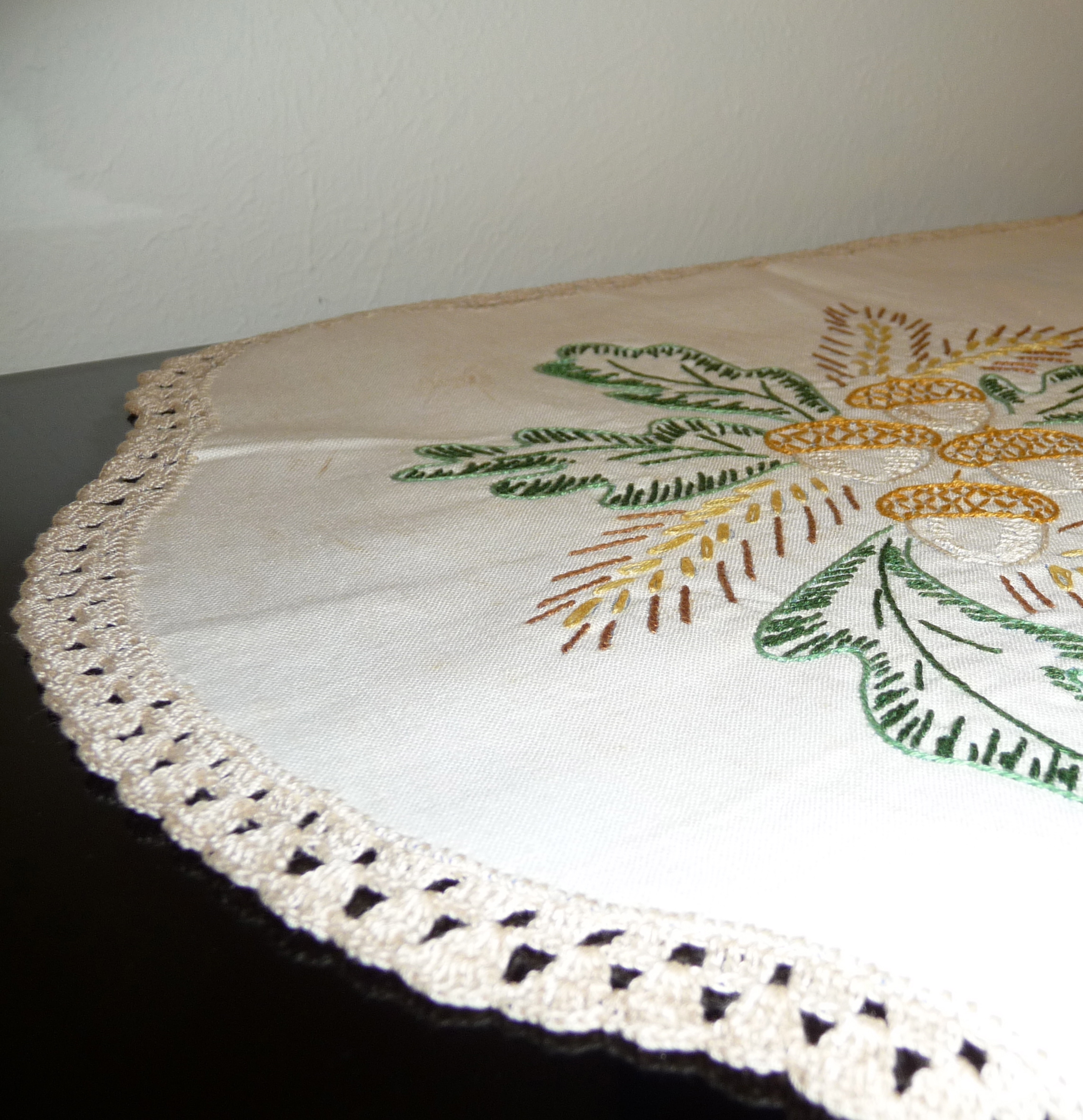
You see, I usually ignore the tablecloths. They are like distant friends I know but hardly ever visit except on holidays. The bright red cloth with a sheen that shimmers even in low lighting? Michael and I would feel silly eating our Tuesday night meal on something so fancy. The rose-colored cloth my grandmother gave me? It seems like it would go best with an Easter ham and several little chins tucked around it. The linen spread with the hand-embroidered flowers? It will be the perfect heirloom to set out when God gives us a family someday.

I stopped cold in my tracks. When God gives us a family someday? I felt instant shame. I have been waiting nine years to set out that cloth, and God has given me a family to celebrate every day of those nine years. Michael and I are a family, children or no, and there is no better reason to dress my table.

I wasted no time firing up the iron. Those nine-year-old creases were stubborn, to be sure, but our table is now properly dressed in an autumnal, flower-embroidered linen. Never mind the fact that we had popcorn for supper. We still dined in style. And, you better believe that red cloth is coming out of the closet next week.

So, whether you are a family of one or one hundred, I hope you dress your table and celebrate the family God in His wisdom has given you.

How close can we get?

We didn’t want to settle for anything less than the best. Not when it came to a decision about possibly bringing a new life into this world. Only the best would do.

I’m not talking about treatments. I’m not talking about doctors. I’m talking about us as a couple—our best motivations, widsom, and behaviors. When it came to forming a family, we didn’t want heavy consciences. We didn’t want hesitations, uncertainties or ethical dilemas. So we sought spiritual guidance and we read the best books and we found our answer.

I greatly appreciate the light that pastors and authors have shed on the questions surrounding reproductive technologies and I owe much to their wisdom and insight. Some theologians and bioethicists have done their best to evaluate all the options and rate them worst to—well, possibly OK. In our reading and conversations we noticed phrases like “may be allowable” or “might not violate the one-flesh union” or “might be compatible” with Scripture. There lacked a sense of certainty, and rightly so. Any alteration to the natural and God-ordained process of creating an eternal soul should require some hesitation and a proper sense of fear and awe, should it not? Considering whether to interfere with this process certainly made us tremble. We had to ask ourselves, “What right do we have? Would this really be the best way to grow our family?”

Dealing with Christian ethics isn’t about trying to find the lesser of two evils or making an educated guess about whether the choice you have in front of you contains a “sin-full” option and a “sin-less” option. It isn’t about trying to find out “How far can we go?” It’s about finding the ideal, the perfect target, and doing everything you can to achieve that ideal. It’s about using God’s ten commandments and His Word as a guide to keep us close to His will even if He has not addressed our specific questions in that Word.

The actual definition of sin is, appropriately, “missing the mark,” but our modern minds tend to be more occupied with the space outside the target than with the bull’s-eye. So what is our bull’s-eye as Christian couples seeking to have children? How can we be certain that our efforts to create a family will be pleasing to our Lord?

The book of Genesis spells it out very clearly as Moses reveals how the first family came about. “Therefore a man shall leave his father and his mother and hold fast to his wife, and they shall become one flesh,” (2:24). Marriage came first. Then, in chapter 4:1: “Adam knew Eve his wife,” (sexual intimacy) “and she conceived,” (conception) “and bore Cain…” (birth). There you have it—the four-fold process created by God for becoming a biological family. This is how it was meant to be. Couples who are able to have children in this way need never doubt whether they are acting in accordance with God’s will.

But alas, in chapter three sin entered the world and turned everything upside down. In ancient days and even now, barrenness, miscarriages and stillbirths rip away the fruits that are meant to be born from a couple’s most intimate sharing of one another. And in the 21st century, we have seen this four-fold procreation process intentionally rearranged, redefined, and even rejected. In the secular world, marriage is certainly not necessary anymore to be intimate, conceive and bear children. Conception can be suppressed so as to more fully enjoy the intimacy without the responsibility of the bearing and rearing. And when conception is desired but not achievable, it’s often seen as necessary to forego intimacy in an effort to medically intervene and help the life-creating process along. And in a rather extreme example of our “progress”, women today even have the option to skip the marriage, intimacy and conception altogether and go straight to just giving birth by participating in an embryo adoption.

How far have we gone? Is this too far yet? Where does one draw the line?

As much as our pastors, friends, and family want to give us hope that there is a procedure that will assist us in getting the child they “know” God has planned for us, not one of them can confidently say that intentionally drifting away from God’s four-fold family plan (for receiving a biological child) is not a sin in some way. There will always be doubt and uncertainty as to whether it’s really OK.

In the chapter “How Far is Too Far?” from Katie’s book, she presents questions that we should all be asking ourselves when considering whether to engage in a medical procedure that is not meant to heal a broken body but rather to circumvent God’s original process. “Do you wish to ‘make a baby’ at the risk of hurting your neighbor? Do you think that having a baby is the only thing in life that can make you happy? Do you put your identity in motherhood rather than in your baptism? Will your faith in Jesus be upset if you do not conceive?”

The true motivations for the choices we make while experiencing barrenness reflect what is in our hearts. Does our attitude about having a family drive us toward the center of the target, or does it push us to the outer edges? Which focus is best?

My advice to the barren couple who wants to avoid sinning as they seek to address their barrenness is this: Seek healing if there is a chance that your body is not completely healthy, and pray that you might receive the gift of a child as a result of your physical love or through adoption. Instead of asking yourself, “How far can we go?” consider asking, “How close can we get?”

Being Infertile

I get frustrated with the word infertile.

What do you think of when you hear that word? I think of faulty reproductive organs, doctors, syringes, ovulation, hospital gowns, sperm counts, hormones, petri dishes, and all kinds of medicine. Do you know what I rarely think of when I hear the word infertile? I rarely think of God.

That is why I prefer to call myself barren. I know that it sounds harsh, maybe even old to our twenty-first century ears, but barren conjures up Biblical images in my mind. It acknowledges that I have a Creator who opens and closes wombs. It affirms that my childlessness is a divinely-allowed state of being rather than a man-made diagnosis of a medical mystery.

I also think the word barren better represents the medical reality of childlessness. Not every woman who is without child is necessarily infertile. Barren means “not productive; desolate; fruitless; lacking.” There are many women in the body of Christ who are barren simply because they have not been given the gift of a husband – the unmarried and the widowed – and their childlessness has nothing to do with infertility. There are also married women who, much to the bewilderment of their doctors, simply never conceive.

If someone calls me infertile, I remember that I am the patient of a limited, human doctor who can only give me a child 33% of the time. If someone calls me barren, however, I remember that I am the child of a merciful, loving God who gives many good gifts, not just the gift of children.

Language is important, don’t you think?

A Time to Laugh?

I’ve always admired people who can look at a horrible experience and see the humor in it. Take Barbara Johnson for instance, who endured not one but four tragedies in her life and yet shared her experiences in a way that left her readers with tears of laughter streaming down their faces instead of tears of sorrow.

So I’ve been thinking—is there any humor at all in barrenness? Well, no, not really. But there are certain things that often go along with this state of being which, if you look at them in the right way (and a week/month/year or two later) can bring on a smile. Take “Beth” for instance, who like many of you battles with those unpredictable hormones (which may or may not be contributing to the infertility) that can often leave her wondering who she really is and if she’s possibly losing her mind. Perhaps the pregnant and the menopausal ladies thought they had all the fun, but Beth can attest to the fact that the members of the Unexplained Fluctuation Organization (UFOs) have certainly had their fair share. Let’s take a peak into the life of Beth, shall we?

While cooking a meal for an upcoming church potluck, Beth received a call from a dear friend. Although Beth’s rational side told her that it was dangerous to cook and chat at the same time, as had been proven by several previous botched recipes, her impulsive side told her, “You can do it this time!” The chicken had been cooked and chopped, the pasta was draining, and the dressing was tasting just fine as she completed the long and delightful conversation. Beth hung up the phone and went to complete the final step of the recipe when, to her bewilderment, she could not find the chicken.

Frantic searches of the refrigerator and all the cupboards were fruitless. Remembering that she had wandered to other parts of the house during her call, she searched every other room, including both bathrooms. On the verge of tears of frustration and self-chastisement, Beth uttered her first attempt ever at a poultry prayer: “Dear Lord, please help me find this chicken!” Almost instantly, the front door opened and in walked a six-foot-four angel, home early from work. Hearing of her predicament and making a quick glance around the kitchen, the aforesaid angel spotted the above-range microwave, which was at his eye level and happened to contain the missing fowl.

It isn’t just Beth’s mind that is affected by the endocrine enemies, though. Several years back she began noticing some rather coarse facial hairs under her chin. Just a couple you know, which could easily be plucked out and explained away. Over the years however, the pair got together and decided to be fruitful and multiply so that now the otherwise very feminine lady must constantly hide the fact that, left to its own design, her chin would sprout a rather full and scandalous goatee. While many people express fears of being stranded in places without their medication, sleep apnea machines, or clean drinking water, Beth has nightmares that she is stuck on a cruise ship for weeks and there are no razors on board.

And thanks to that much-needed yet painfully evident hormone progesterone, Beth’s bosom also likes to play tricks on her, depending on what part of the month it is. Due to its naturally small size, fluctuations are probably only noticeable to herself…and the angel, of course. She hopes. Beth has a hard time justifying the purchase of two different sizes of bras, but realizes that were she to remain in 36B during days 25-3 she would not be able to breathe. And likewise, remaining in 36C beyond day 3 would not only be wishful thinking, but would give the huggers in the household the unpleasant sensation of embracing a couple of deflating balloons. Two sizes seem to be the best way to go—except on those in-between days. She has not yet figured out where to get a bra with a C cup for the left bosom and a B cup for the right which, frankly, is becoming a freakish and lingering problem. So if you ever see someone like Beth and she seems to be a bit off-balance with her gait, rest assured that her barrenness has not driven her to drink. It’s probably just day 28.