IVF

Is IVF Healing Medicine?

I am an advocate of healing medicine, both traditional and nontraditional.

I daily take prescription medication to keep my already overactive pancreas from kicking out more insulin into my bloodstream. I then supplement my medication with lots of exercise and a low-glucose diet.

My most recent venture into healing medicine involved a short round of hormone therapy to help my doctor properly diagnose several masses that were growing in my abdomen. I then underwent surgery to remove a batch of endometriomas and accompanying scar tissue from around my colon, bladder, and ovaries. Next, came a six-month regimen of Lupron shots to kill off the residual scar tissue my doctor had to leave behind, and, on top of that, I now eat a mostly pescetarian (vegan with fish) diet on top of my low-glucose fare to avoid environmental hormones, additives, preservatives, gluten, and nutrients which may cause inflammation in my body.

In other words, I prefer my medical cocktail as follows: one part traditional, two parts nontraditional, shaken with ice, and then straight down the hatch.

Why am I over-sharing all of this with you? I want to make it clear that I am a champion of healing medicine. I believe it is part of the daily bread God provides for us and that it is good and right to try to make the body whole. I believe that we are free in Christ to take medicine and to undergo diagnostic tests and to have surgeries and to train for triathlons and to sit for acupuncture treatments and to avoid dairy (Oh, wretched cross that I bear!) and to drink liquified kale for the healing purposes of our flesh.

However.

Like the Apostle Paul, I believe that my freedom in Christ, whether applied to medicine or to circumcision or to meat-eating or to whatever, is intended by God to serve my neighbor, not myself.

“For you were called to freedom, brothers. Only do not use your freedom as an opportunity for the flesh, but through love serve one another.” Galatians 5:13 (ESV)

We are totally free in Christ to seek healing medicine in our barrenness, but that freedom is still intended to serve our neighbor, even the little neighbor we hope to conceive in our womb. For this reason, I do not consider in vitro fertilization (IVF) to be healing medicine, nor do I consider it to rest safely within the realm of Christian freedom.

IVF does not simply seek to make the body whole, but it seeks to create children for our own purpose and use, whether that be cherishing, rejecting, discarding, freezing, or even killing. This is not using our Christian freedom to serve our neighbor. It is using our freedom to serve ourselves at the expense of our neighbor.

Let me draw a clear picture for you. When children are created in a petri dish during IVF, those children have no rights of their own. They, at the whim of the parent*, can be:

  • graded by appearance for their viability,
  • genetically tested for their sex, chromosomal abnormalities, and diseases,
  • discarded (in some cases, literally flushed down the drain) for their potential flaws,
  • put on ice to be stored, used, adopted, donated, tested, or killed at the parent’s leisure,
  • inserted into potentially inhospitable conditions in utero,
  • and, if part of a multiple pregnancy, selectively terminated and sacrificed for the vitality of a perceived stronger brother or sister in the womb.

IVF does not serve these children (our neighbors!) through love, but, at best, disrespects the personhood of the children created, and, at worst, serves as the concentration camp of the fertility industry.

Please be certain, it is the procedures surrounding IVF, not the children that result, that I am calling into question. As I wrote in my book, “Whatever sin and controversies may surround IVF, the children that are conceived and born to us through such procedures are still a heritage from the Lord. These children do not cease to be blessings and gifts from God simply because of the method by which they were conceived. We are not to think of these children as anything less than human beings who are wanted and cherished by our Lord. God’s love is what makes any and every child valuable in this life, not the means of parentage. Whatever decisions and actions parents may regret, the children that result from such decisions and actions are to be celebrated as the precious treasures that they are.” (He Remembers the Barren, 44-5)

Dear sisters, you may have already made use of IVF thinking that it was healing medicine. You may feel confused, angry, even guilty, right now. Do not despair! Your help is in the name of the Lord, who made heaven and earth. (Psalm 124:8) Christ, the Lamb of God, takes away the sin of the world. “Repent therefore, and turn again, that your sins may be blotted out, that times of refreshing may come from the presence of the Lord.” (Acts 3:19-20a ESV) Confess your regrets to your pastor to receive the peace of absolution, and let it be done to you as you believe.

* A frozen child’s right to life can also be at the whim of a government or a divorce court judge.

The Cross of Barrenness

What is the cross of barrenness? Surely it is one of loss and death and grief, but many in the church don’t realize that the cross of barrenness is also one of warring against the world’s religion of control. The world expects us to manage and control our fertility, so, naturally, that same world also expects us to manage and control our infertility – never mind whether or not we really can.

It is not uncommon for friends, even strangers, to school me in this art of control, this “sure science” of making a baby. A woman standing behind a school lunch counter once told me, “Be sure to keep your cervix lifted for at least thirty minutes after intercourse.” A lady at a party said to me in front of a circle of friends, “Your husband could be shooting blanks. Get his sperm’s motility checked out.” A stranger sitting to my left at a women’s luncheon leaned over and announced during the main course, “My daughter was infertile, but she finally had a baby last spring through In Vitro Fertilization. You should go to her doctor.” A woman at a local farmer’s market stopped me to tell me that taking her suggested brand of vitamin supplements would even out my hormone levels and result in a pregnancy.

I don’t know what to say in return to those who publicly offer advice on sexual techniques or medically misdiagnose my husband’s fertility or tell me to engage in medical procedures that break the First and Fifth Commandments of my Lord. Giving a verbal response to those comments feels like I am somehow validating the very existence of them. If I share with the woman at the market that my hormone levels are already stable, then I am engaging her in conversation about something that is so personal and painful. I am inviting her to continue making suggestions and diagnoses and comments about my barrenness. I am giving her permission to continue trying to find a fix for my problem. I am handing her the salt well and telling her to rub it in my open wound. So, instead of telling her the truth, I simply thank her for her advice, and I keep walking. Then, I go home, and I cry.

I cry, because every time a well-meaning person tells me how to make a baby, I am tempted to believe that I can control my barrenness, that my present childlessness is my own doing, my own fault. I must be doing something wrong. I must be missing a key nutrient in my diet; I must be exercising too much or too little; I must have high levels of prolactin or low levels of progesterone; I must not be producing enough Type E mucus to sustain the lives of the sperm in my uterus; I must not be going to the right doctor. I must, I must, I must. When a well-meaning person makes suggestions to me in my pain and grief, I feel the weight, the burden, the law of my barrenness fully on my own shoulders.

Yet, I cannot control my barrenness. I know this, because God tells me in His Word that children are a heritage from Him – a gift – and that good gift is received, not manufactured or made. God is the Giver, and I am the receiver. And, at the end of the day, my faith must believe what God tells me in His Word, not what the woman tells me at the market.

Here We Come!

Won’t you come out and meet us?

Rebecca Mayes and I, God willing, are getting behind the wheel next Tuesday in hopes of meeting YOU. We will be presenting on the topic “Caring for the Barren Woman” at Concordia University Chicago, Concordia Theological Seminary, and various churches in Michigan and Indiana. And – Best of all! – my husband is coming with us. Rev. Michael Schuermann will be available to answer any questions you may have regarding how to care for the barren man.

Location and presentation details can be found here.

If you would like any of the HeRemembersTheBarren.com hosts to present “Caring for the Barren Woman” at a church near you, please let us know via the “Submit a Question” page on this website.

We can’t wait to meet you!

* Photo by Adriane Dorr

IVF: A Time to Mourn

Each January we are reminded of the millions of lives that have been lost through abortion since Roe v. Wade in 1973. Our churches have been sent materials to help us recognize and discuss the importance of life during this time of year when we remember the monumental court ruling that removed the right to life from the most helpless of our society. I was encouraged this past November to see that the state of Mississippi was allowing its people to vote on whether they believed that life began at conception. There seemed to be so much support for the amendment and pro-lifers were optimistic about the outcome. But it failed. It’s not surprising that Planned Parenthood was working overtime in an attempt to “educate” the public and I’m sure had much influence with some of the voters. But what really got me was that the other group leading the fight against the measure were what some might consider “my own people.” Infertile couples and fertility clinics were frightened by the possibility that, as a result of this measure passing, IVF might also become illegal in their state.

The attitude that helped prevent this amendment from passing came across loudly and clearly in the blogosphere during the time prior to the vote. While most of the barren bloggers that I came across who were against the amendment demonstrated a common obsession with self-interest regardless of what the truth might be, at least they appeared to understand the significance of the statement that life begins at conception. For some reason they fully understood what takes place during an IVF procedure. Many well-meaning Christians do not.

Or maybe they do after all. A CNN article that came out in early November focused on one Christian family who seemed to know exactly what they were doing with IVF, and the possibility of having personhood assigned to embryos didn’t give them reason to pause and reflect about what they had already participated in. Rather, it prompted them to move up the date of their next procedure.

I wish I could have a conversation with this family. I’m curious about how they would justify what they were about to do. Would they point to some Scripture passages that guided them to this decision? Would they say that their pastor counseled them to go ahead with this plan? Or did they simply feel that this was the right thing to do? How do their consciences handle the risk they were taking, when statistically 65% or more of their fertilized embryos will die?

If life begins at conception, and if all life is valuable, why don’t we as a Church likewise mourn for those tiny lives who have been conceived through IVF and either discarded to die, frozen to death, or who simply “didn’t take,” meaning they lost their lives in the struggle for the survival of the fittest? Abortion sacrifices the life of an innocent child for the perceived rights of the mother to control her own body. IVF sacrifices the lives of many children for the hope of one healthy, viable child for a desperate couple. Is one situation any less tragic than the other?

Sisters, please help me with this issue. If you take offense somehow or feel that I don’t have all the facts, please contact me (Rebecca) through the “Submit a Question” section. I want to dialogue about this. I want to know more than I do. Do you have a pastor who supported your own decision to do IVF? If so, I would love to talk to him. I want to find out if I’m missing something. But if I’m not–if I’m right on the money here–then we all need to be engaging our churches more in this topic and helping to educate both pastors and lay people about the significance of our actions when we seek to step in as the creator of earthly life and eternal souls. We need to love and cherish those children in our churches who were conceived through IVF while helping their parents and other couples look for alternative ways to fill the voids in their hearts. We need to repent, confess, forgive, and participate in a unified life together in our congregations, where we all have a common understanding of and appreciation for the sanctity of all human life.

We mourn for the deaths in abortions. We mourn for the deaths in miscarriages and stillbirths. Let us also mourn for the deaths that occur in IVF–deaths that are completely preventable.

How close can we get?

We didn’t want to settle for anything less than the best. Not when it came to a decision about possibly bringing a new life into this world. Only the best would do.

I’m not talking about treatments. I’m not talking about doctors. I’m talking about us as a couple—our best motivations, widsom, and behaviors. When it came to forming a family, we didn’t want heavy consciences. We didn’t want hesitations, uncertainties or ethical dilemas. So we sought spiritual guidance and we read the best books and we found our answer.

I greatly appreciate the light that pastors and authors have shed on the questions surrounding reproductive technologies and I owe much to their wisdom and insight. Some theologians and bioethicists have done their best to evaluate all the options and rate them worst to—well, possibly OK. In our reading and conversations we noticed phrases like “may be allowable” or “might not violate the one-flesh union” or “might be compatible” with Scripture. There lacked a sense of certainty, and rightly so. Any alteration to the natural and God-ordained process of creating an eternal soul should require some hesitation and a proper sense of fear and awe, should it not? Considering whether to interfere with this process certainly made us tremble. We had to ask ourselves, “What right do we have? Would this really be the best way to grow our family?”

Dealing with Christian ethics isn’t about trying to find the lesser of two evils or making an educated guess about whether the choice you have in front of you contains a “sin-full” option and a “sin-less” option. It isn’t about trying to find out “How far can we go?” It’s about finding the ideal, the perfect target, and doing everything you can to achieve that ideal. It’s about using God’s ten commandments and His Word as a guide to keep us close to His will even if He has not addressed our specific questions in that Word.

The actual definition of sin is, appropriately, “missing the mark,” but our modern minds tend to be more occupied with the space outside the target than with the bull’s-eye. So what is our bull’s-eye as Christian couples seeking to have children? How can we be certain that our efforts to create a family will be pleasing to our Lord?

The book of Genesis spells it out very clearly as Moses reveals how the first family came about. “Therefore a man shall leave his father and his mother and hold fast to his wife, and they shall become one flesh,” (2:24). Marriage came first. Then, in chapter 4:1: “Adam knew Eve his wife,” (sexual intimacy) “and she conceived,” (conception) “and bore Cain…” (birth). There you have it—the four-fold process created by God for becoming a biological family. This is how it was meant to be. Couples who are able to have children in this way need never doubt whether they are acting in accordance with God’s will.

But alas, in chapter three sin entered the world and turned everything upside down. In ancient days and even now, barrenness, miscarriages and stillbirths rip away the fruits that are meant to be born from a couple’s most intimate sharing of one another. And in the 21st century, we have seen this four-fold procreation process intentionally rearranged, redefined, and even rejected. In the secular world, marriage is certainly not necessary anymore to be intimate, conceive and bear children. Conception can be suppressed so as to more fully enjoy the intimacy without the responsibility of the bearing and rearing. And when conception is desired but not achievable, it’s often seen as necessary to forego intimacy in an effort to medically intervene and help the life-creating process along. And in a rather extreme example of our “progress”, women today even have the option to skip the marriage, intimacy and conception altogether and go straight to just giving birth by participating in an embryo adoption.

How far have we gone? Is this too far yet? Where does one draw the line?

As much as our pastors, friends, and family want to give us hope that there is a procedure that will assist us in getting the child they “know” God has planned for us, not one of them can confidently say that intentionally drifting away from God’s four-fold family plan (for receiving a biological child) is not a sin in some way. There will always be doubt and uncertainty as to whether it’s really OK.

In the chapter “How Far is Too Far?” from Katie’s book, she presents questions that we should all be asking ourselves when considering whether to engage in a medical procedure that is not meant to heal a broken body but rather to circumvent God’s original process. “Do you wish to ‘make a baby’ at the risk of hurting your neighbor? Do you think that having a baby is the only thing in life that can make you happy? Do you put your identity in motherhood rather than in your baptism? Will your faith in Jesus be upset if you do not conceive?”

The true motivations for the choices we make while experiencing barrenness reflect what is in our hearts. Does our attitude about having a family drive us toward the center of the target, or does it push us to the outer edges? Which focus is best?

My advice to the barren couple who wants to avoid sinning as they seek to address their barrenness is this: Seek healing if there is a chance that your body is not completely healthy, and pray that you might receive the gift of a child as a result of your physical love or through adoption. Instead of asking yourself, “How far can we go?” consider asking, “How close can we get?”

Being Infertile

I get frustrated with the word infertile.

What do you think of when you hear that word? I think of faulty reproductive organs, doctors, syringes, ovulation, hospital gowns, sperm counts, hormones, petri dishes, and all kinds of medicine. Do you know what I rarely think of when I hear the word infertile? I rarely think of God.

That is why I prefer to call myself barren. I know that it sounds harsh, maybe even old to our twenty-first century ears, but barren conjures up Biblical images in my mind. It acknowledges that I have a Creator who opens and closes wombs. It affirms that my childlessness is a divinely-allowed state of being rather than a man-made diagnosis of a medical mystery.

I also think the word barren better represents the medical reality of childlessness. Not every woman who is without child is necessarily infertile. Barren means “not productive; desolate; fruitless; lacking.” There are many women in the body of Christ who are barren simply because they have not been given the gift of a husband – the unmarried and the widowed – and their childlessness has nothing to do with infertility. There are also married women who, much to the bewilderment of their doctors, simply never conceive.

If someone calls me infertile, I remember that I am the patient of a limited, human doctor who can only give me a child 33% of the time. If someone calls me barren, however, I remember that I am the child of a merciful, loving God who gives many good gifts, not just the gift of children.

Language is important, don’t you think?

Interview on “Studio A”

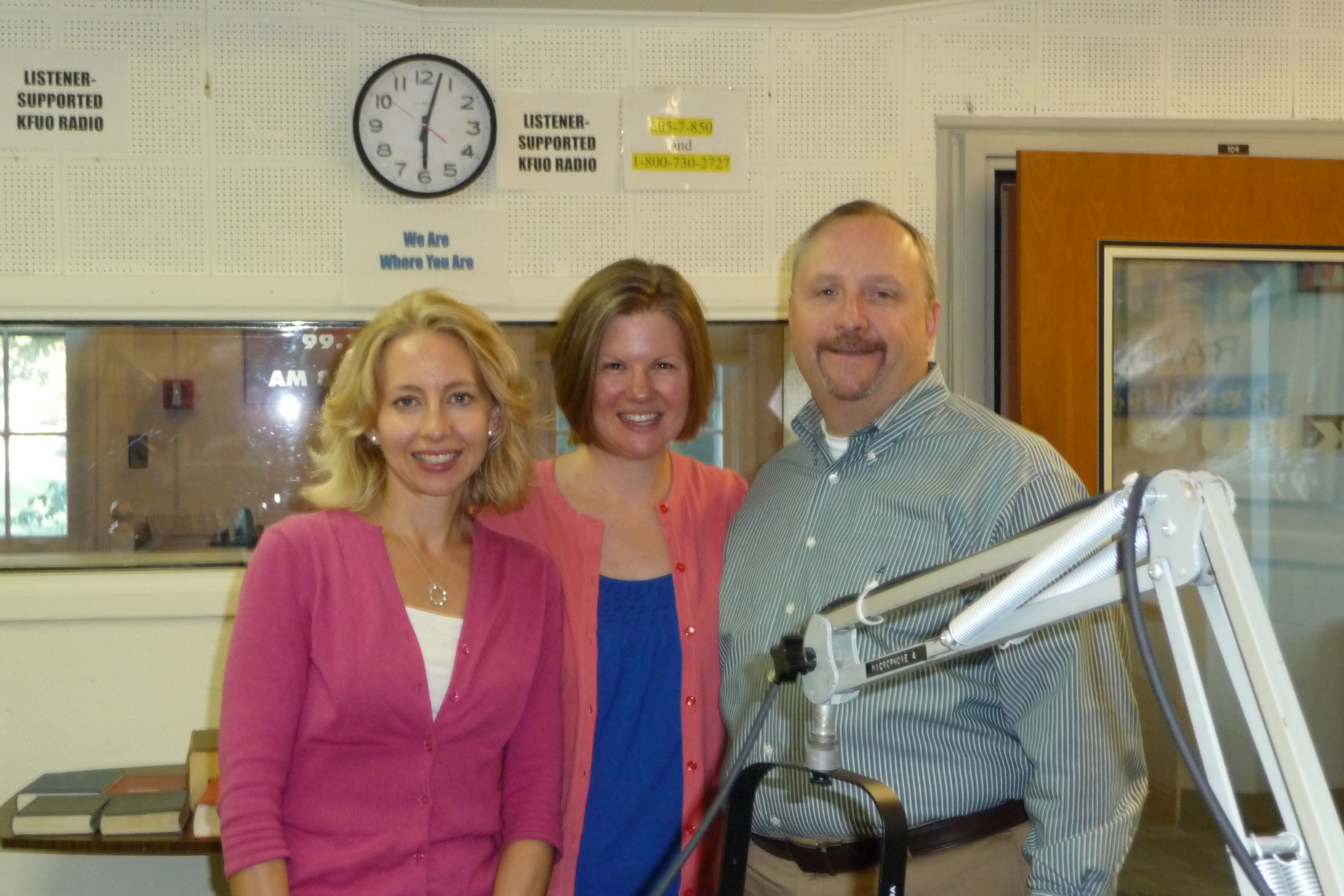
Thank you to KFUO Radio and Roland Lettner for interviewing two of our site hosts on the “Studio A” program yesterday afternoon. We hope you’ll have a listen, too.

Click here for a direct link to the program’s MP3 file. (Our interview begins at 29:10.)

Or, if you would like to learn more about KFUO Radio and the “Studio A” program, click here. (To listen to our interview from this link, click on the hour 2 MP3 file of the Wednesday, September 7th broadcast. Our interview starts at 29:10.)

The IVF Question

Well, it’s time. You knew this would come up sooner or later. It’s just something that can’t be avoided when discussing infertility in the 21st century. Maybe you’re considering the procedure yourself with the encouragement of your physician, family and friends. Maybe you’re tired of hearing about other couples who have successfully conceived by means of IVF while you and your spouse have decided that it’s not an option. Either way, this post is for you.

It wouldn’t be appropriate to dive into this sticky subject without making sure that we define what we’re talking about (courtesy of the Word English Dictionary):

IVF=A technique enabling some women who are unable to conceive to bear children. Egg cells removed from a woman’s ovary are fertilized by sperm in vitro; some of the resulting fertilized egg cells are incubated until the blastocyst stage, which are then implanted into her uterus.

 Merriam-Webster defines it similarly. These definitions are medical definitions using medical terminology. What would it look like if we used non-medical English and a biblical understanding of the life process?

IVF=A technique enabling some women who are unable to conceive to bear children. Egg cells surgically removed from a woman’s ovary are fertilized by sperm in a glass dish; some of the tiny human beings who are conceived are kept [in a laboratory] under the proper conditions for development until these children have grown a bit stronger, and they are then implanted into her uterus.

 After reading this through again, there is one word that should be jumping out at you as the most important word of all. Did you catch it? Some. It’s so small you almost don’t realize it’s of any significance and yet it changes everything. Some of the tiny humans have a chance at life and therefore some do not. What is implied but not explained is the fact that some of the tiny humans are not needed. They are of no value to the new parents and are therefore destroyed or frozen. If we believe that human life begins at conception, then it’s clear that IVF, as defined here, makes some tiny human lives and then destroys or freezes many of those human beings. That is the main problem.

We know the Bible speaks to this point. The Fifth Commandment, “You shall not murder,” applies to life at all ages and stages. Martin Luther’s explanation to this commandment makes it clear that we have broken this law whenever we employ any procedure that hurts or harms our neighbor in his body and fails to help and support him in every physical need.  Christians believe, and now science has acknowledged, that life begins at conception, whether in the womb or in a dish. And all life is precious and worthy of our compassion and protection.

Though difficult to admit, the couple who emerges from a “successful” IVF procedure does so as the parents of both living and dead (or frozen) children. There’s much rejoicing and congratulations exchanged, but no acknowledgement of what’s been lost. Is it ignorance? Or is it apathy? In both cases we have to admit that it is sin. There’s no getting around it.

At this point, let me remind you of the life-changing words from the apostle John: “If we say we have no sin we deceive ourselves and the truth is not in us. But if we confess our sins, God, who is faithful and just will forgive our sins and cleanse us from all unrightousness” (1 John 1:8-9). Yes, that means you, too, who are sitting there perhaps without the burden of IVF in your past but plenty of self-rightousness, jealousy, and distrust in your heart to even out the scales. The call to repentance and the promise of forgiveness is yours as well. Christ’s payment for sin was necessary not just for some, but for all. Humility before God and the desire to live and walk under His law in all things prepares the heart to receive the cleansing blood of Christ and the joyous proclamation of forgiveness in the Gospel, both preached and applied individually. Repent, confess, receive, and then put the past behind you. Believe our Lord when He says, “I, I am He who blots out your transgressions for my own sake, and I will not remember your sins” (Isaiah 43:25).

So then, how are we to view the children who survive the IVF procedure and come to full-term, knowing that they were conceived in sin? My friend Katie has the answer: “We can know with certainty that all children are exactly what God tells us they are in His Word: a heritage from Him.  Whatever controversies surround in vitro fertilization, the children that are conceived and born to us through such procedures are still a heritage from the Lord.  God’s love is what makes any and every child valuable in this life, not the means of parentage.”

Here’s a similar example: Many children adopted into Christian families were conceived outside of marriage. This behavior is not part of God’s plan for procreation. And yet the result of that act is a precious child of God, baptized into His name and living a life under His care and protection, graciously placed within a Christian family. God takes an evil situation and turns it into good, as He has done repeatedly throughout history.

Despite the fact that I desperately want more children, I still could never condone or encourage anyone to engage in immoral behavior that would result in conception, birth, and a potential adoption for me or any other woman. Likewise, we can treasure and be thankful for those children who came to us through IVF, even though the process was not at all how God intended to create families, and even though we hope and pray that others will avoid IVF.

Does Jesus love the children conceived through IVF? He most certainly does. In fact, He’s on their side. He says, “As you did it to one of the least of these my brothers, you did it to Me” (Matt. 25:40). But Jesus says this not only about the IVF children who survive, but also about those who are intentionally allowed to die or are frozen. “As you did it to one of the least of these my brothers, you did it to Me.” Since life begins at conception, let us never think that IVF, as defined above, is a permissible option for Christians.

For more information on this topic, please check out the following resources:

http://issuesetc.org/archives/nov08/nov19.html (Dr. Kevin Voss of the Concordia Bioethics Institute on Issues, Etc.)

In Vitro Fertilization: Moral or Immoral?

What Are We to Do with the Embryos?

A Review of Reproductive Technologies