Marriage

A Wanting Prayer-Life

by Katie Schuermann


By the world’s standards, Michael and I are utter, complete failures at manifesting our own destiny as parents. There are probably even some church bodies who are ashamed to claim us as believing Christians, seeing as our hands remain empty after years of petitioning God for the gift of children. For with God, nothing is impossible (Luke 1:37). Surely our faith must be the problem. Surely our prayers are found to be wanting.

Honestly, I’ve always taken issue with this accusation. It’s as old as my wedding vows, and I’ve received it from church members, family, strangers, readers, employers, movie scripts, false prophets, podcasts, and countless blogs and books over the years.

I don’t mean to suggest that I deserve better than barrenness. No, I can easily imagine why someone would look at me and think my faith little, my prayer-life wanting, my heart undeserving of children, for that is all true.

But such an attack on my own faith does not take into account the faith of the thousands of kind, loving people who have prayed for me all of these years. What about my sweet mama? my self-sacrificing dad? my grandparents and sisters and nieces and nephews? What about all of my godchildren and my church family and my friends and pastors and even the compassionate strangers who read this blog? Do all of their (your) prayers count for nothing? Is God punishing all of us through my barren womb?

Or could it be that God’s good answer to all of our prayers is my barrenness?

Here is what I can tell you with assurance.

I am barren, and that is always bad. But miraculously, God works my barrenness for good, both for me and for you (Rom. 8:28). Barrenness continually calls me to repentance of my sins (Luke 13:1-4), and that is good. God’s persistent withholding of the gift of children from me repeatedly turns me toward Him for help, reminding me that He is my Father (Heb. 12:5-11), and that also is very good. And I maintain hope that my barrenness is something through which God’s works can be made manifest (John 9:1-3). Again, very, very good.

Maybe it would be helpful to consider my daily reality in this particular matter.

If, indeed, my prayer-life is found wanting, then everyone can rest assured. God is tending to this public concern very nicely, for in His wisdom, He continues to make me barren. And I promise you, barrenness drives me to pray to God over and over and over again.

Lord, have mercy.

(Thankfully, He does.)

HRTB Reflections: An Ides of Marching Forward

By Melissa DeGroot


I can hardly believe fifteen years have passed since the beginning of He Remembers the Barren. When Katie contacted Kristi, Rebecca and me a couple months ago to commemorate this blog, it gave me pause to reflect on so many things. Looking back to where this all started, I remember how new, exciting, and nerve-wracking it all felt—the blogging world itself, wondering how people would receive what we were writing, and hoping that ultimately in the midst of it all there would be real talk, real comfort and faithful theological grounding for people who were suffering. 

I can also look back at myself and cringe a little. Okay, maybe a lot.

I’m sure most writers (a title I hold very loosely) feel that way when they look at their early work. I was in my early thirties then. I was definitely more immature than I realized. I had professional, diaconal and mental health training and, if I’m being fair to my younger self, some good theology. But I was also a little zealous. Overconfident, even. Ego and pride were mixed in there, too. 

Seemingly an Old Eve disease that I am still getting medicine for each Lord’s Day. 

The chronology is a little muddled in my head (thank you, perimenopause!) – though I recall talking to Katie about this topic well before the blog took shape and before my son was born.  After a miscarriage early in my marriage, I recall having the fear that I was going to be barren, too. Like it was somehow contagious? There was this superstitious, self-fulfilling prophecy of sorts in my head that if I kept talking about barrenness, it was going to be my “fate.” 

So much for good theology.

Then, right around the time this blog started, my husband and I had been blessed with a son. Parts of me thought this conversation wasn’t really for me at that point, even though I knew it was still good to spiritually comfort those who were suffering with it.   

However, not too long after that, my husband, Adam, and I began walking through secondary infertility. It was a decades-long trek of fear, prayer and wondering whether we would have more children. I spent so many years worrying about it. I put so much pressure on myself.

HRTB hit me from a different angle, and it was one that I needed.

You see, I had high hopes of being a large, Lutheran family. I came from a larger family myself. Bring on the multi-passenger van transporting a gaggle of homeschooled, slightly-nerdy-but-athletic DeGroots! 

It was the dream. 

It never became a reality. 

And here is what made the conversations surrounding He Remembers the Barren so important to me.

During the fretting and faithful reckoning throughout my thirties, I felt this was a conversation our church body needed to have more openly anyway. Within the Lutheran Church—Missouri Synod, I was seeing a renewed appreciation for our confessional and liturgical heritage. There was much good in that. Along with it came a strong and thoroughly biblical affirmation of marriage, children, and family.

Thanks be to God for that.

But I felt pressure, too. It was compelling at times – yet not always in the best way: like there existed a stress to have “all the kids” to not only grow the church but have more joy in your life. I had pious people say some well-meaning yet off-putting things to me (“Just stop working and go have kids,” “Relax, and it will happen”) that simply didn’t fully align with what God says and our good understanding of the doctrine of vocation. I don’t begrudge them or hold any resentments. I certainly held some of those beliefs, too. It just didn’t happen for us that way.

Singleness. Barrenness. Miscarraige. Secondary Infertilty. Adoption. Families that don’t look the way we imagined they would. Our doctrine of vocation is beautifully spacious precisely because the Lord is the One who gives and takes away our callings.  

Those were some of the conversations Katie and I began having all those years ago. I was (and still am) grateful to be a cheerleader and small contributor in the arena—to encourage the conversation, to have seen this blog created, and the book published.

And then there were Kristi and Rebecca, whose experiences helped fill in still more of the picture. Different women. Different stories. Different kinds of suffering connected to barrenness and their own way of articulating it. Yet the same need for substance.

Fifteen years later, I think that is what I appreciate most.

Barrenness has a way of confronting us with just how little control any of us actually have. We can enjoy the intimacy of marriage. Make appointments. Try treatments. Change diets. Track, plan, pray and de-stress! Those things can be good and worthwhile. But eventually, we run into the limits of our own ability to make life happen according to our plans.

Which can be terrifying, but also expose some of the false gods we didn’t realize we were carrying.

For me, one of them was the idea that my family needed to look or be a certain way for me to feel that I had somehow measured up. “Image Manager” was a false calling that I created to feel valuable and worthy. I put pressure on myself that God simply had not put on me. Perhaps I even put that pressure on others, too.

And suffering has a way of bringing those things into the light.

I’m 47 years old now. My perspective has definitely changed over the past fifteen years. Marriage, motherhood, ministry, friendships, disappointments, and simply getting older have shaped and refined how I think, speak and serve. As a result, I have let go of so many things. But acceptance of what is doesn’t require me to pretend that all my thoughts, hopes and feelings weren’t somehow real, unholy or unwarranted. 

The longing for a child is real. The disappointment is real.

Yet Christ is just as real yesterday, today and forever.

That is where I hope this conversation continues to lead.

Christ does not meet us merely as an idea or a theological explanation for why suffering exists. He comes to us in the flesh. He comes every time His Word is preached and His Sacraments are administered. He surrounds us with sisters and brothers in Christ, with pastors, deaconesses, pious friends, and the whole family of God. Because we still need forgiveness and the Church, no matter what stage of life we’re in.

And sometimes, through those people, He even gives us the gift of feeling some (or a lot) of the comfort He has already promised to us.

What a gift it is when a sister in Christ sits beside me and says, “I know this hurts.” What a gift when a pastor speaks Christ’s promises into suffering. What a gift when another woman’s story reminds me that I’m not alone.

Though, whether we feel it or not, assurance is based on the truth of God’s Word. We are redeemed, precious, and loved. Christ’s death and resurrection has power, even now, to bring us faith to trust that no matter the trial, He is still with us.

So fifteen years later, I’m grateful to contribute to this conversation again. I’m grateful for Katie, Kristi, and Rebecca, and the many women and men who have been willing to speak honestly about barrenness, infertility, miscarriage, adoption and a host of other life issues. I’m grateful that He Remembers the Barren became a place where these conversations could happen.

And I’m curious about where it goes from here.

Maybe fifteen years have given us a little more perspective. Maybe we can speak about these things with greater spiritual maturity—without minimizing suffering, but also without allowing suffering to have the final word.

Because while it’s real, Christ is more real still.

And He has not forgotten us.

Looking back and moving forward, God is always remembering us, even when our memories fail and fade.

God continue to bless and strengthen us as we seek to share our unique experiences, strength, and hope in Him now in our midlife years. Perhaps this blog commemoration is a connection point to a new generation who are walking through these hardships, a generation who may be seeking a sisterly, motherly (gosh, some might even say, grandmotherly), ear to listen, receive love and care with greater understanding and grace. I hope so.

Because while striving to serve each other well, to care for and raise faithful children, God reminds us Christ crucified and risen for us is the only Way, Truth and Life certain in this world.

Ides years later, God continue to bless these conversations and this blog as He sees fit.
(Still) The Barren Woman

by Katie Schuermann


I’ve never liked the word barren.

To be known as the barren woman is terrible, because it is true. I am barren, because I am “fruitless, lacking, producing no offspring,” as the dictionary bluntly and boorishly declares to everyone in the room.

I call myself barren, because I am.

I also call myself barren, because God has made me so.

It is that last sentence that really preaches to me. Allow me to explain.

While the word barren chafes my pride, I see it in the Bible and remember that being a barren woman is not unprecedented in the story of God’s salvation of mankind. Sarah, Rachel, Hannah, Elizabeth, Anna … so many of my mothers in the faith also were barren, and it comforts me not to be so special.

Also, when I see the word barren in the Bible, I remember that it is God Himself who makes people barren. He is the Creator, and He sees fit both to give and to withhold the gift of children in the Old Testament, the New Testament, and even today. He is the Author of life, and He works the horrible plot-point of barrenness for good for His People. Surely He will work my own little barren story for good, as well.

This is why I am bold to continue speaking and writing a word that has gone out of fashion in the infertility industry. When I admit to being barren, I am confessing both to myself and to you the truth about my womb as well as my Lord’s will. I am daily exercising my faith under its banner, being humbled under the will of God, trusting that the Creator’s merciful blessings extend even to those whom He disciplines, all the while prayerfully waiting and watching to see if the Man who raised Lazarus from the dead might also raise my barrenness to new life.

By the way, when I call myself barren, I am not confessing to you my eternal state of being. I am confessing to you merely the reality of my today. Today, my womb is closed. Today, God in His wisdom continues to withhold the gift of children from me and my husband.

But calling myself barren today communicates absolutely nothing to you about my tomorrow. God has my tomorrow in His hands, and I fall asleep each sunset trusting that He will give me what is best with the next sunrise.

In the meantime, I wait and I hope and I pray and I look for the good works God has prepared for me to do as a barren woman right now.

This is how I can smile for pictures taken with other peoples’ children. This is how I can write books for other peoples’ grandchildren to read. This is how I can laugh during podcast interviews about being childless. This is how I can sing for joy about my loss and your gain. I am a barren woman, yes, but I am a woman made barren by God. And since the Creator deems it best for me to be barren today, then I am not ashamed in being so.

Though I still dislike the word.

What Did I Do?

It is our honor to share with you, in no particular order, three honorable mentions selected from the bounty of our Lenten writing contest submissions. We simply could not let these treasures go unread.

This first selection written by Katie Fischer features a line that I wish I had written myself. I’ll leave it to you to figure out which one it is.


iu-3 2“What did I do to deserve this, Lord?”

Even at the time I knew it was my doubts and unbelieving sinful nature that gave me those words to say, but I was sad and angry and I didn’t care. I had been praying for years for my husband’s faith and yet on that day he was still off, joining another denomination. Finalizing the break in our Communion fellowship. 

I had pleaded my cause in prayer for so long I felt I had nothing to pray that day – only despair.

Unheard, unloved, a woman thrust into a position I never wanted to be in. My number one requirement for marriage was a man who could be my spiritual head, to lead our family in the faith, and who would train our children in the words of the catechism. And yet here I was: unequally yoked and having to take up the headship not intended for me.

I knew the world was broken by sin and we are supposed to do the best with what we have, but I didn’t want that for me. I had prayed for unity of confession within our family countless times, a good gift to desire, and it was like my prayers had fallen on deaf ears. 

The years kept passing. I couldn’t change the situation, but I also wouldn’t accept it. In waves the frustrations would resurface to bring a full renewal of the grief.

Usually when my children practice their choir music I don’t purposefully listen in. Not that it’s bad, much to the contrary, I know I’m going to be steeped in it for the next month or two and can take my time to enjoy it. But one day I heard their little voices working on the antiphon, “Delight yourself in the Lord, and He will give to you the desires of your heart” (Psalm 37:4).

I immediately tuned in. I’d heard the verse before. It usually hurt because the desire of my heart received a “no” day after day, year after year. Whether it was due to the recent sermon or the Bible study, I can’t remember which, but that day was different. Instead of hearing it as a rule to follow to get my reward, it was a promise. If my delight is in the Lord He will be my desire and I know He Himself – His mercy and forgiveness flowing from His death on the cross – is what He has promised to give me.

It may not be Law, but it was convicting all the same. I, a poor miserable sinner, was not delighting in the Lord. The desires I prayed for were not for the certain promises given in my baptism. I wanted to twist God’s ear to what I decided was most important. I had made an idol and a god out of having a Lutheran husband, thought of it as necessary to my faith, and was still clinging to that idol even after it had been torn away. I had been focusing on the hearts of others and neglecting my own.

When I cried out He had heard; when I prayed He had answered. It was not the answer I expected (or thought I needed) so I turned away and was blind to it. The circumstances that I wanted bent to my own will didn’t change, but through the preaching of the Word my prayers were changed. A good gift can still be an idol, and by keeping my eyes on the one gift I didn’t have I even robbed joy from the good I did have: a loving husband who works hard for his family. There is much more peace in praying for what God has promised than in pleading to keep an idol of my own building. 

That verse, Psalm 37:4, is written on the front page of my hymnal as a reminder, for I certainly need plenty of reminders to lead me back to repentance. For in His mercy He hears and washes me anew every day, even before I cry out for it.

By Katie Fischer

The Death I Deserved

iuCongratulations to our Lenten writing contest runner-up, Megan Davis, whose poignant artistry in applying Psalm 40 to her own life remains unparalleled!


In the dark, I silently cried out to any god who might listen, “Let me succeed at this.” I snuggled my teddy bear close to me and quickly fell into a deep sleep. It was not until the next afternoon I realized that I had failed yet again. I had failed my family. I had failed my friends. I had failed too many classes to get a diploma. I had failed my gods. And now I had even failed to die. 

“My iniquities have overtaken me,
and I cannot see;
they are more than the hairs of my head;
my heart fails me.”

Why had the death I deserved not been granted to me? All the things I had done, all the things I had left undone still needed paid for. I had tried to pay for it in my own blood, but there had never been enough.

And so days passed on. The debt still had to be paid, how could I pay it? Scenarios flashed through my mind, each one quickly answered with how they would also fail.

One morning, a thought suddenly split open my mind like a single brilliant flash of lightning crossing a dark sky: “It’s not up to you if you live or die. It’s up to God. Father, Son, and Holy Spirit, just like Mr. Redding taught you softmore year.” This new thought poured through my body. That God? The real God? Not up to me? 

“Be pleased, O Lord, to deliver me!
O Lord, make haste to help me!”

Suddenly a little bit lighter, I walked up to my room. I sat on my bed and pondered what this meant. I still deserved to die, but it wasn’t my responsibility. I cried, “Please Lord, send a bus hurtling my direction,” but began to make some plans just in case I had to live. 

“You are my help and my deliverer;
do not delay, O my God!”

Thus I went to community college, made up the credits to get my diploma, and began work on an Associates. I applied myself to therapy. I got a job. Months later, in a writing class I met a kind and intelligent young man. We fell in love, and he asked me to marry him. Immediately, I started imagining our wedding. Would it be on the beach, or maybe the mountain? I asked my fiancé where he thought we should have the wedding. Suddenly looking a bit bashful he replied, “Well I always thought I would get married in my church.”

“You go to church?”

I had been in churches a handful of times as a girl and to the liturgies of my Catholic high school, but I wanted to know about the faith that had helped form my soon-to-be husband. He was Lutheran, and his church’s liturgy was very similar to those of my school days. The hymns and preaching were deep and interesting. So when the pastor offered new member classes, I was eager to learn more but had no intention of becoming a member or even being baptized.

Twelve weeks of classes took about six months to get through. I loved the deep respect and logic the Lutherans gave to the Bible and appreciated their well-thought-out doctrine.

Then one day, I discovered that I believed it. 

So I asked to be baptized.

Nearly two-and-a-half years after that dark night, I stood in the light of morning in front of an eight-sided wooden font. Guided from an old red hymnal, I declared my faith and my desire to be baptized. 

“I have told the glad news of deliverance
in the great congregation;
behold, I have not restrained my lips,
as you know, O Lord.
I have not hidden your deliverance within my heart;
I have spoken of your faithfulness and your salvation;”

The sign of the cross was made over my head and chest declaring Christ’s death for me. I bent over the font, and water was dribbled over my head in His name, Father, Son, and Holy Spirit. The death that I knew I deserved was finally given to me, the debt was paid in full. 

“He drew me up from the pit of destruction,
out of the miry bog,
and set my feet upon a rock,
making my steps secure.
He put a new song in my mouth,
a song of praise to our God.”

I stood up. The weight I had carried so long was gone. And in its place was something new. For He gave me what I had not dreamt to ask for. He gave me life. He gave me His resurrection. 

“I waited patiently for the Lord;
He inclined to me and heard my cry.”

By Megan Davis

“He Will Return” – Contest Winner

Alleluia! Christ is Risen!returnofchristicon

On this blessed Easter Day, it is our pleasure to share with you the winning submission to our Lenten writing contest.

We asked all of you to reflect on the prompt, “I waited patiently for the LORD; He inclined to me and heard my cry” (Psalm 40:1), and your responses were overwhelmingly rich in wisdom and that special brand of perspective that comes from personal experience. You gave us much to ponder and contemplate this holy season, and we are so grateful for the opportunity to learn from all of you.

When it came down to the actual judging, it took two rounds of sorting and ranking for us to narrow down the entirety of the submissions to a final five. “This is hard!” was a constant refrain from those doing the reading and sorting. Thank you to everyone who participated and made the judging so difficult.

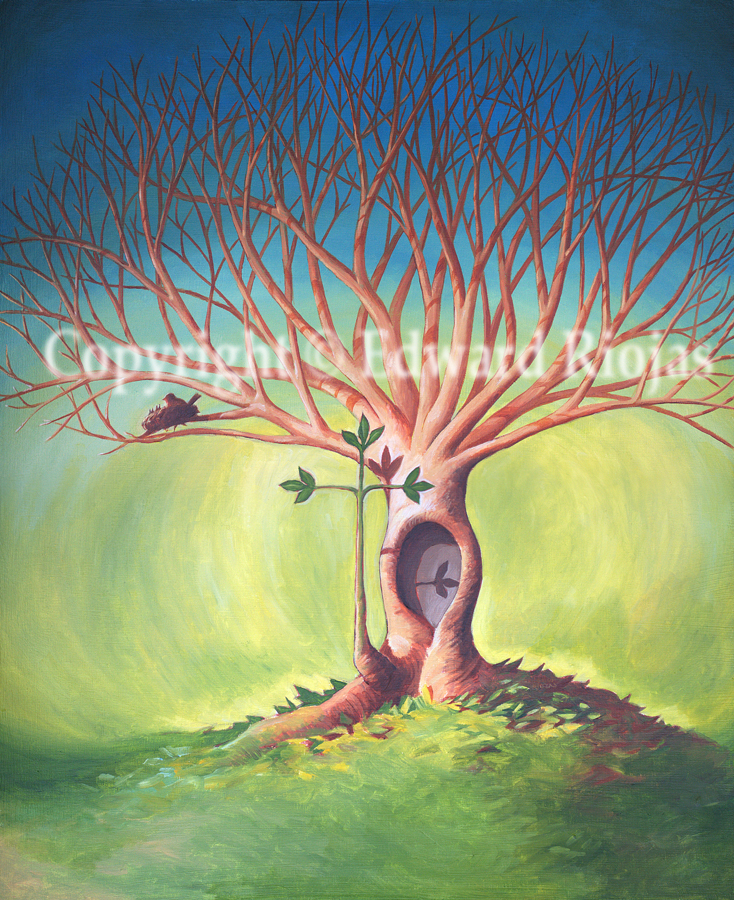
It is our joy to share with you our five favorite submissions over the next several weeks, starting with our contest winner, Emily Olson. Congratulations, Emily, on winning a museum-quality giclée print of artist Edward Riojas’ cover art for the second edition of He Remembers the Barren, and thank you for reminding all of us that, whatever our station in life, we are all waiting for the same, certain thing: Christ’s returning to us.

Come quickly, Lord Jesus!


I am not a patient woman.

I am impatient in my daily vocations. I drum my fingers on the steering wheel at stoplights. My frustration rises when my children ploddingly put on their shoes before school. I shift from one foot to another when my son prattles on about superhero plots and I need to make some calls. My temper grows short when dinner isn’t coming together quickly enough for my taste. I frustratedly text my husband “ETA?” when he’s two minutes past his expected arrival home.

And my impatience seeps past the everyday struggles to keep schedules and order. The relentless passage of time presses upon my flesh and my heart. I want our financial goals met now. I want sick and despondent friends and relatives healed and soothed immediately. I want to know my marriage will last and thrive for many decades and our children will grow to faithful and joyful adulthood. I want to know that I matter and those that I love matter. I want to know that we are not forgotten. Too often, this means I reach for my gleaming phone, impatient for another hit of dopamine, desiring connectivity amidst the gaping hole of mortality that hovers over us all.* Too often, this means I am angry and irritable, eating my bread anxiously and toiling miserably, fallibly trying to make this world and us and me matter.

So I sit in the pew, cognizant of the nervous flit of my thoughts, the selfish grasping of my desires, and the ultimate hardness of my heart. I am like Jonah, huddled in the back of a boat, trying in vain to hide from God.  I am like the citizens of Babel, mucking about in the mud of my own internal universe, enthralled at my own dirty and miniscule tower. I am like Pharaoh, obstinate and brittle, trapped in my pride. I do not deserve Christ. Yet here I am, unworthy and hopeless. I am seeking the only salvation possible.

Jesus comes to me.

“I have not come to call the righteous but sinners to repentance” (Luke 5:32).

The pastor speaks His forgiveness.

“In the stead and by the command of my Lord Jesus Christ I forgive you all your sins in the name of the Father and of the Son and of the Holy Spirit.”

The faith granted at my baptism hears the name of the triune God and listens.

“What man of you, having a hundred sheep, if he has lost one of them, does not leave the ninety-nine in the open country, and go after the one that is lost, until he finds it?”

The Word enters my frail ears and kindles my weak faith.

“And when he has found it, he lays it on his shoulders, rejoicing. And when he comes home, he calls together his friends and his neighbors, saying to them, ‘Rejoice with me, for I have found my sheep that was lost’” (Luke 15:4-6).

Jesus enables my quivering voice, and I sing, my heart breaking. Jesus has done what I never could.

“Yes, Father, yes, most willingly
I’ll bear what You command Me.
My will conforms to Your decree,
I’ll do what You have asked Me.”
O wondrous Love, what have You done!
The Father offers up His Son,
Desiring our salvation.
O Love, how strong You are to save!
You lay the One into the grave
Who built the earth’s foundation. (LSB 438:3)

I stand and file out into the aisle, and I step, haltingly, toward the altar.

Let all mortal flesh keep silence
And with fear and trembling stand;
Ponder nothing earthly minded,
For with blessing in His hand
Christ our God to earth descending
Comes our homage to demand. (LSB 621:1)

Jesus comes right to my mouth, my tainted, impatient, sinful mouth. His scarred body touches my tongue, and I swallow. His blood spilled for the world splashes down my throat. I am cleansed and forgiven, again. I am restored and made new.

From the moment water and the Word combined to make me God’s child, He has relentlessly pursued me. Hopeless and impatient me falls away and falls apart again and again. And over and over, Christ inclines His loving ear to me and hears my desperate cry (Psalm 40:1). I know that the One thing needful will never leave me nor forsake me (Luke 10:42, Hebrews 13:5). Christ has promised, and He is faithful (Hebrews 10:23). He never fails. Amidst all of life’s incompletes and suffering, He remains, the Eternal Rock.

In the Word and in the Sacrament, I am immediately, and right now, with Christ.

I am not a patient woman. But Christ is patient and persistent, forgiving and loving. He will return to me again. I believe this. And so I wait.

By Emily Olson


* Idea acknowledgment to Peter Kreeft, quoted in 12 Ways Your Phone is Changing You by Tony Reinke (p.46).

Contest Details

Andy Bates and Sarah Gulseth of KFUO Radio’s “The Coffee Hour” chatted with us last week about our Lenten writing contest.

Listen here for details on what we’re looking for in your submission on the prompt, “I waited patiently for the LORD; He inclined to me and heard my cry” (Psalm 40:1).

Remember, this contest is for anyone who breathes, has chromosomes, and reads the Bible.

Submit your entries to katie@katieschuermann.com by noon on March 25th to be considered for the grand prize: a museum-quality giclée print (14.7″ x 18″) of artist Edward Riojas’ cover art for the second edition of He Remembers the Barren.

Happy pondering and writing!

BARREN giclee image

Jewelry Box

iurHe snuck up to my table when no one else was there.
“I know a bit of what you talk about.”

He paused, so I waited. I wasn’t quite certain what part of my presentation had resounded with him, and I didn’t want to assume.

“My only daughter was stillborn.”

Ah.

Something happens in my cheeks whenever someone tells me this. I don’t know what it looks like from the outside, but from the inside, it feels as if my skin releases from my muscles, as if my cheeks — in dutiful obedience to the speaker’s command — move into proper riverbed formation to direct the flow of any incoming tears.

“What was — is — your daughter’s name?”

“Sarah. She was born in 19 _ _.”

My breath caught in my throat. We looked at each other, and I debated whether or not to say it. What if I made things worse?

“That’s the year I was born. I am the age of your Sarah.”

He smiled and wiped a lone tear from one of his own riverbeds.

Then he told me stories. Stories about his work, about the many miscarriages his wife suffered after Sarah, about the way the children in his church would come up and start talking to him — “It hasn’t all been bad,” he assured. — about his love of working with wood, about how he made his wife’s casket when she died.

“She was the jewel of my life,” he said, “so I made a jewelry box to hold her.”

I don’t know how that gentleman felt when he eventually walked away from me, but I felt thankful that Sarah had — has — a father such as him to remember her and miss her and love her still.


Unto Us

IMG_4333

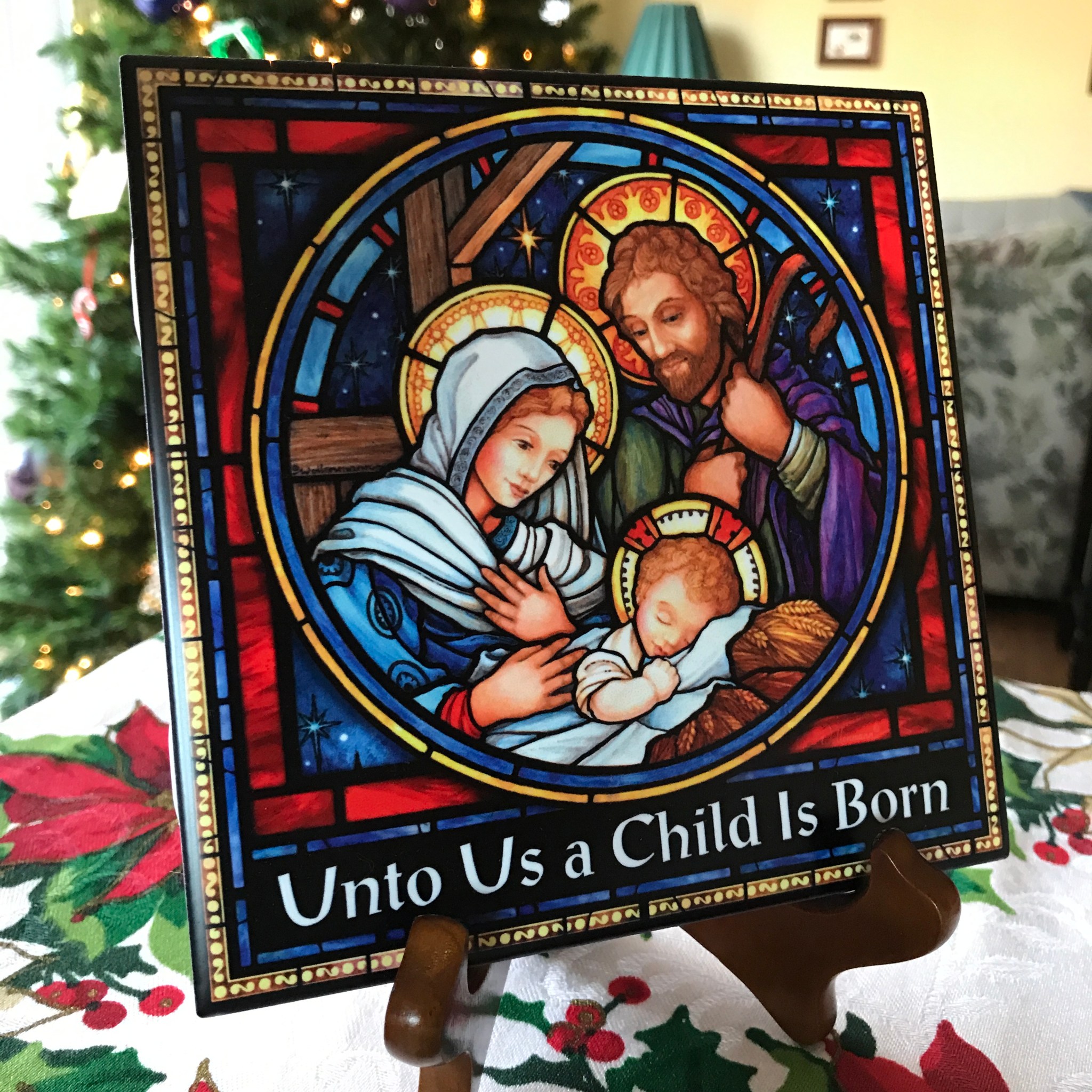
Two years ago, my husband gave me this icon for my birthday. At the time, I thought it a sweet gift but highly unseasonal. I’m a summer baby, after all, and it would be a full four months before Christmas came around again.

Still, I displayed the gift on our dining room buffet all through autumn, and I am so glad I did. Because one blustery day, I glanced up from my supper plate and saw the icon with eyes afresh. I looked past the star of wonder and the Christmas red and the Marian blue and saw only the words,

Unto Us a Child Is Born.

I couldn’t swallow my food for the lump in my throat.

I have read those words a hundred times and not just on the icon. All my Baptized life, I have known Isaiah‘s prophecy, and I am blessed to believe it. But not always have I known the prophecy as a barren woman.

Unto us.

Not just unto Mary and Joseph and Bethlehem and Israel, but unto us — me and my husband. A Child is born unto us, the barren couple.

The thing we’ve never known — the happy news we’ve never been able to trumpet to our family and friends — has been ours to share all along: Unto us a child is born! It’s a boy, and His name is Jesus. And He is born unto you, as well.

I now proudly display our happy birth announcement all year round.

Yes. No. Wait.

“Does God answer prayers? Does He really? I’ve been praying for many years for a child, and it’s taking FOREVER. I’m trusting you, God, and I’m ready for children. Please, Lord, if it be Your will.”img_8280

Dear sister in Christ, I’ve been there. For many-a-year I prayed and prayed that God would give children to my husband and me. In my sin-sick mind, I just knew that His answer would be YES…immediately. That was not to be the case. With the help of some medication to boost the proper hormones, our daughter was born. Thanks be to God! He had given a YES to our prayers.

A couple of years later we hoped to add to our little family again. This was not to be the case, though. After multiple appointments, my doctor suggested IVF. I was firmly against the procedure. That seemed like a strong NO to our prayer. It took some time for my husband and me to pursue adoption. There was so much to consider: change in family structure, the wait-time, the finances for adoption, the mental adjustments for everybody. After much prayer, we decided to try the adoption process, even though there were no guarantees.

The paperwork was huge, but we pressed on. We were told that the entire process for adopting a child from China would last 13-14 months. Hooray! We could wait that amount of time. Perhaps this was another YES to prayers. The process would take much longer than 14 months. The months stretched to years, many years. Could this be a WAIT from God? During the interim, we were given permission to try a domestic adoption as well. This seemed agreeable to us. After completing even more paperwork, our profile was circulated among pregnant moms. Nobody seemed interested in us. Was this to be another NO to our prayers? Our two-year commitment to that program expired, and we did not renew our file. Still we waited.

After seven long years of praying and mourning, God answered our prayers with a YES. On this day, five years ago, we received our referral for our second daughter! Prayers of thanksgiving and tears abounded!

We were informed that we would be traveling a few short months later. Due to several hiccups, our trip to receive our little girl occurred more like five months later. It turned out to be a time of more waiting. God used this time to prepare ourselves, our families, and our church family for the joys that were to come.

Dear sister, I share these things with you, not to teach you that God will answer your prayers in the way that you want. Rather, I want you to know that God answers your prayers in the way that He deems best. Our desires do not always line up with God’s plans for us, and we desperately would like to be the ones who run the show. Not so. God knows our needs and provides in the best ways possible. He really does.

During our family prayer time this morning, we sang the hymn “What God Ordains Is Always Good.” The words are comforting and encouraging. I commend them to you this day.

What God ordains is always good:
His will is just and holy.
As He directs my life for me,
I follow meek and lowly.
My God indeed In every need
Knows well how He will shield me;
To Him, then, I will yield me.

Lutheran Service Book 760:1