Suffering

How Hannah Prayed

Holy BibleThe opening chapter of 1 Samuel begins with the birth of Samuel. His mother Hannah had been married to Elkanah, a Levite priest, for a number of years. It was hoped that Elkanah’s son would someday perform the sacrificial rites that were associated with the priests. Hannah went to the temple and prayed that the Lord might open her womb and give to her a child. She prayed so emphatically that Eli the priest thought her to be drunk. Hannah answered confidently that she was not drunk, but rather troubled in spirit. She had been pouring out her soul before the Lord.

Scripture does not tell us the specific words of Hannah’s prayer, but we do know that she was praying fervently. 1 Samuel 1:15 quotes Hannah as saying, “I am a woman troubled in spirit… I have been pouring out my soul before the Lord.” She had endured mockery by another woman for her barrenness. She was in danger of being unable to continue her husband’s priestly line. She knew that the Lord was capable of giving her a son. She didn’t know if that would happen, but she took her prayer to the Lord anyway. She did not tell herself, “I’m gonna get myself a baby.” She didn’t have to consider “which doctor can ‘make’ a baby for me.” Rather, she prayed the prayer of a believer in Christ, “Thy will be done, Lord.” She trusted that the Lord would grant to her those things that were best for her, and in His timing.

May each of us pray similarly, “Thy will be done, Lord.”

Brave Warriors

There is empathy from all different walks of life.

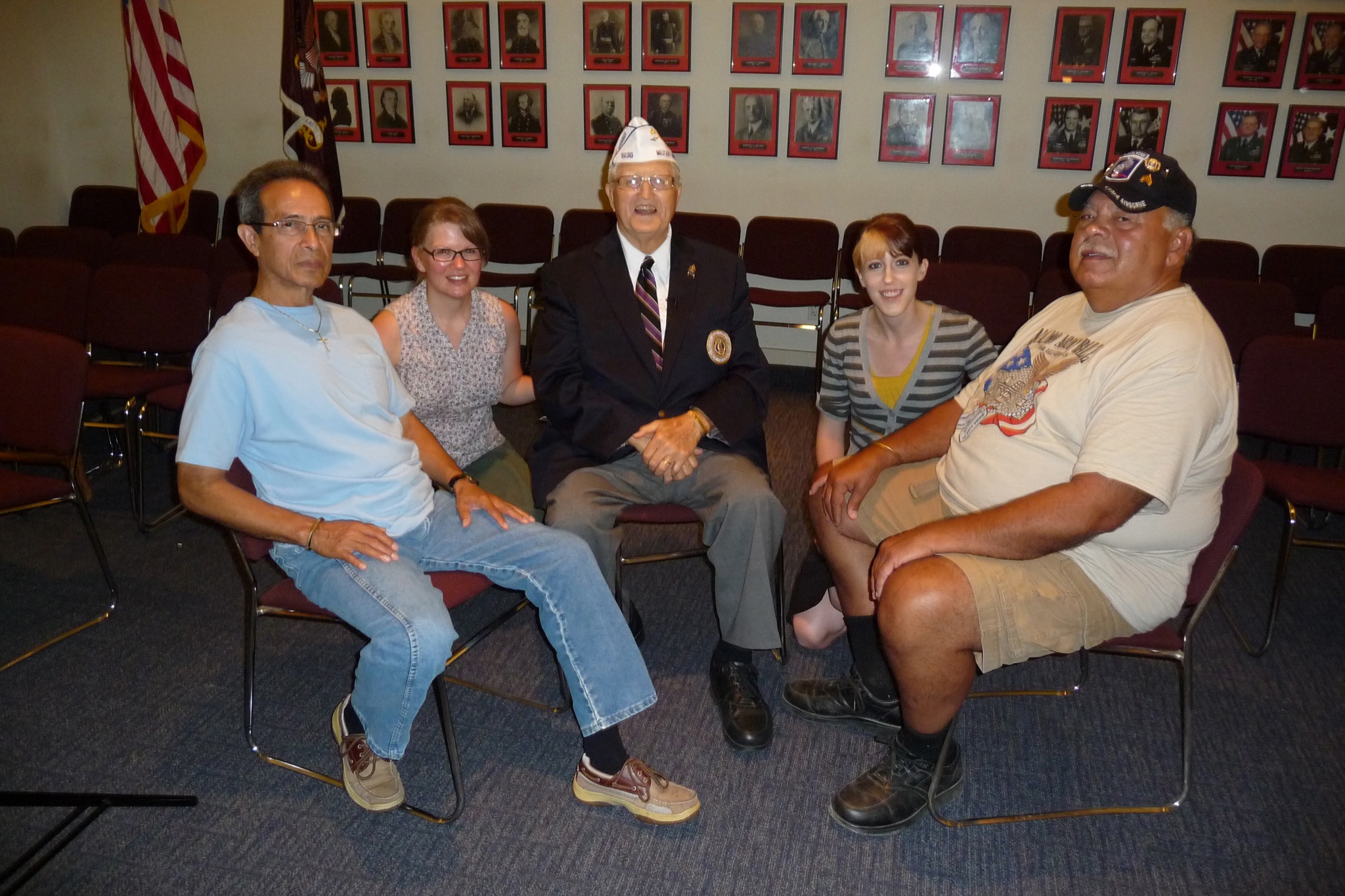
Last summer, my husband and I travelled with a communications team for The Lutheran Witness down to San Antonio, Texas, to learn more about the U.S. Army’s chaplaincy program. We visited Fort Sam Houston, Brooke Army Medical Center, Camp Bullis, and other significant military establishments to talk with chaplains, medics, apache pilots, wounded warriors, purple heart awardees, and hero after hero after hero.

P1070283 copy

I learned that there are brave men and women who risk their lives every day to protect me and the freedoms I enjoy in this country; I learned that there are faithful chaplains and their assistants who rush towards the boom of every battle to give the gifts of Word and Sacrament to the wounded and dying; I learned that there are many things I can do to support the families of military personnel; I learned that thousands of our nation’s warriors suffer from post traumatic stress disorder (PTSD) and struggle transitioning back into civilian life; and I learned that those who struggle with post traumatic stress speak my language.

For example, in High Ground (2012), a recent documentary on recovering warriors training and attempting a therapeutic climb of a peak in the Himalayas, a master at arms canine handler in the U.S. Navy admits, “Injuries are a very personal experience. I don’t like to talk about what happened. One of my main obstacles when I came back and was in a wheelchair for 3 1/2 years is [that] everybody looked at me as broken, and, um, they missed who I was. And so that became my identity…it was always about the injury, not about me.”

Yes. I resound with that. My identity to most of the world is not “Katie, that baptized Christian who loves people, music, words, herbs, mountains, and running pants” but “Katie, that barren woman.”

Another soldier in the documentary admits before the camera, “I have more in common, I feel sometimes, with an old man on his deathbed than I do with people my own age, emotionally, you know…I just feel like…I’ve lived out my life…like the tank is empty.”

Yes. I feel the life-sucking tentacles of grief wrapped around my bloodline, and I tend to gravitate towards friendships with people who are several generations older than me. We have a lot in common.

The same soldier elaborates, “You just see people enjoying life and being alive and you’re like, why don’t I feel that? I’ve had so many near-death experiences, shouldn’t I be happy to be alive?…It’s really hard to, like, reestablish yourself, I guess, in society because it’s just so different…Everybody looks at us weird. ‘Thanks for your service…Stay away. Keep your distance from me.’”

Yes. My suffering and grief and pain often ostracize me from the party of life.

Another soldier suffering from a traumatic brain injury (TBI) discloses, “People still don’t get it that not all pain is physical.”

Yes. Coping with life-altering circumstances and chronic health problems brings with it an invisible but all-consuming pain that really, really hurts.

So, because there are only so many of you courageous warriors in uniform and veterans’ caps that I meet gassing up at my local Casey’s or walking down the fruit aisle at my Wal-Mart on Dirksen, please allow me to thank you on this little blog. Thank you, not just for your brave service to our country on the battlefield but also for your brave face-off with the enemy of post traumatic stress off of the battlefield. I cannot fully understand the traumas you have experienced in trying to protect me, but I relate to the internal battle you so eloquently describe. I find comfort in your empathy.

God bless you.

P1070192 copy

Helpful

At our recent pastors’ roundtable in St. Louis, an attending pastor drew our attention to the following quote from Martin Luther’s lectures on Genesis Chapters 21-25:

And it seems that God wanted to teach and attest that the begetting of children is wonderfully pleasing to Him, in order that we might realize that He upholds and defends His Word when He says: “Be fruitful.” He is not hostile to children, as we are. Many of us do not seek to have offspring. But God emphasizes His Word to such an extent that He sometimes gives offspring even to those who do not desire it, yes, even hate it. Occasionally, of course, He does not give it to some who earnestly desire it. It is His purpose to test them. And, what is more, He seems to emphasize procreation to such an extent that children are born even to adulterers and fornicators contrary to their wish. How great, therefore, the wickedness of human nature is! How many girls there are who prevent conception and kill and expel tender fetuses, although procreation is the work of God! (Luther, 304)*

I don’t know why God tests us in our barrenness, but the mystery of God’s wisdom comforts me as much as it confounds me. We can rest in the knowledge that God loves the begetting of children enough to give the gift of them abundantly, even when He does not give them to us.

Belly of pregnant woman with pink bow

* Pelikan, Jaroslav, and Walter A. Hansen, eds. Luther’s WorksVol. 4. St. Louis: Concordia Publishing House, 1964.

Get Ready to GETAWAY!

The Great Getaway is approaching fast, and registration for on-sight attendees is now filled and closed. However, we do have room left for commuting attendees.

Do you crave fellowship with other women who understand what it’s like to be childless or to lose a child? Do you have ethical questions about infertility medicine you’d like to ask a pro-life doctor? Would you enjoy eating decadent desserts prepared by a loving pastor and his wife who just want to spoil you rotten? Do you need a retreat in a beautiful house near a scenic park in historic St. Louis?

Then, you might want to join us this summer for the The Great Getaway on Friday, July 26th through Sunday, July 28th. Retreat details and registration information can be found here.

Children at Birthday Party

“You do all things well.”

Another golden nugget from Joanna:

After attending the sunrise Divine Service on Easter, I prayed through some Psalms in Reading the Psalms with Luther and came across this little prayer of Luther’s from his commentary on Psalm 73: 

“Lord, the only wise God, whose thoughts and ways are as high above ours as the heavens are high above the earth, hidden are Your ways, and Your guidance often beyond our searching out. Work in us such hearts that do not murmur against Your judgments, but are always ready to say: you are the Lord, my God, and You do all things well. Amen.”

Christ is risen!!! 

He is risen, indeed. Alleluia!

Crucifix on a Wall

Mother’s Day: A Pastoral Plea

MP900341759Thank you, Pastor Schuermann.

This Sunday is Mother’s Day. For the barren woman, attending church on this particular Sunday is often an exercise in frustration, woe, even great shame brought on by the absence of longed-for children. Far too often, we pastors help amplify these feelings in her.

This is a pastoral plea. Brothers, I beg you, remember every Sunday your entire flock. But especially this Sunday, remember all the faithful women who Christ has entrusted to your care.

Remember that a part of your flock have received from the Lord the blessed vocation of motherhood, whether their children are biological or adopted. In the prayers of the church rejoice with them, give thanks to God for them, and ask God to help them faithfully raise up these gifts from Him.

But remember, too, that many in your flock – whom you may or may not be aware of – have not received the gift of children from God. And they may be longing for that gift. Please be sensitive to them. Recall that the natural inclination of sinful man towards a theology of glory has resulted in them receiving countless, “helpful” comments and encouragements that are nothing but empty promises and legalistic claptrap. Pray for these women, too, that they would receive what they long for: the gift of a child, biological or adopted. But also do not fail to pray on their behalf that God would give them the faith and trust to contentedly rejoice in what He ultimately does give to them. It may not be a child. In other words, help them to pray, “Nevertheless, Lord, Thy will be done.”

And also remember the sheep of Christ’s flock who are past the time of having any expectation of receiving the gift of a child. Please don’t leave them out. Pray for them, too, that they would recognize in their lives all the good gifts the Lord has given to them. 

Please don’t parade them in front of the congregation in order to offer up prayers on their behalf. Please don’t draw unneeded attention to them by giving flowers or some other admittedly well-intentioned gift only to those in the congregation who have children. Allow the barren to sit and grieve, to receive from their Lord, and to pray along with you. That’s your God-given task in the Divine Service, anyway: to lead them in prayer and to care for them with Christ’s true, comforting Word and Sacrament.

In fact, my encouragement would be, if at all possible, to limit your Mother’s Day references in the service to the prayers. Keep your whole flock focused on Jesus and His forgiveness present there for them today. But in the prayers do indeed pray, praise, and give thanks for the mothers, mothers-to-be, and all those who desire motherhood but have not or will not receive that gift from God.

I think these words, included in this year’s “Let Us Pray” for Easter 7 from the LC-MS, fit the bill nicely:

“Father of glory, Your Son, our Lord Jesus, in His incarnation, took on our created human flesh and was born of the Virgin Mary. He submitted to His mother, honoring and obeying her, so fulfilling the commandment where we have not. On this Mothers’ Day, graciously accept our thanksgiving for our mothers, whom you have given to us. Teach us to honor them aright — loving, obeying and giving thanks for them, as is fitting in Your sight. Strengthen all women with child and protect them in their deliverance. Comfort all women who long to have children, but cannot, that they may find their consolation in You and Your unfailing love. Lord, in Your mercy, hear our prayer.”

Rev. Michael P. Schuermann

Discrimination

Newborn babyWe discriminate, even in our suffering.

Many church women’s organizations have said to me in response to an invitation to attend a talk on barrenness, “Oh, we don’t want to hear a talk on barrenness. We’ve already had our children. That issue doesn’t affect us.”

And my heart breaks.

Not just because these women are turning a blind eye to the women in their own groups who have never had children (and to those whose children or nieces or sisters or aunts or friends have not had children), but because they would never say to a sister in Christ, “Oh, we don’t want to hear a talk on cancer. We don’t have it. That issue doesn’t affect us.”

Because, deep down inside, they know it does. Whether they personally have cancer or not, they know cancer affects someone who sits in their pew.

The same is true of all suffering. When one member of the body suffers, the whole body is affected. When the little toe is stubbed against an oak dining room chair, the face flinches, the eyes close, the fists clench, the stomach churns, the knees bend, and the larynx howls, all because a tiny member of the body is in pain.

That is, unless we remove that tiny member from the body and pretend she doesn’t exist.