Author: Katie Schuermann

I believe the Holy Scriptures to be the inerrant Word of God, inspired by the Holy Spirit and fulfilled in Christ Jesus, our risen Lord and Savior. Therefore, I have faith that children are exactly what God tells us they are in His Word: a heritage to receive from Him. Children are not a prize for me to earn, a commodity for me to demand, nor an idol for me to worship. They are a gift which my Heavenly Father only has the privilege to bestow and to withhold. If God makes me a mother, then I can receive His good gift of a child with all joy and confidence in His love for me. If God does not make me a mother, then I can still know with all joy and confidence that God loves me completely in His perfect gift of the Child Jesus whose sacrifice on the cross atoned for my sin and reconciled me to my Heavenly Father. I am God’s own child, purchased and won by the blood of Jesus, and God promises in His Word that He will work all things - even my barrenness - for my eternal good. For this reason, I can in faith confess that my barrenness is a blessing.

A Spoonful of Sugar

I was Mary Poppins for a week.

I blew into town on a nor’easter to care for two children. I pulled excessive items out of my bag. I administered spoonfuls of sweet stuff. I rode on a carousel. I drank tea amidst lots of laughter. I sang songs with a British accent. I even said supercalifragilisticexpialidocious backwards.

(Oh, yes. I did.)

What a blessing and joy to be able to fly in at the drop of a hat to help out other parents in their vocations, to laugh and spin and jump and sing with little people, to hug and console and discipline in the stead of others, and to fly back out on a swift wind towards another adventure.

I always wanted to be Mary Poppins, and God, in making me barren, made it so. That definitely helps the medicine go down.

Dirty Laundry

This year, it is easy to rejoice.

I may have been jealous – even angry – in the past, but this year is different. It is remarkably easy to rejoice in the gift of children you all have been given.

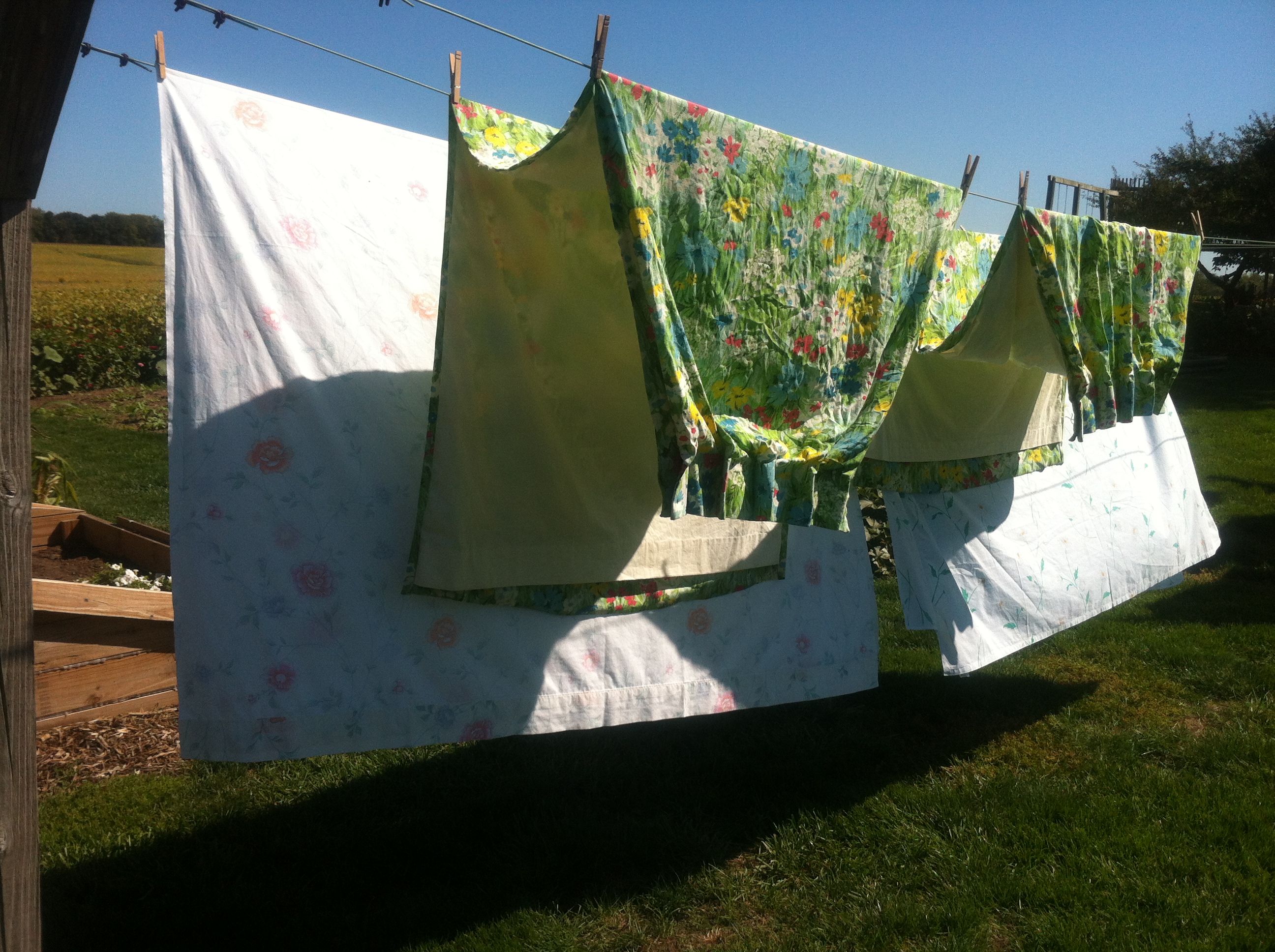
Maybe it is because I wrote a book. Maybe it is because I said my piece. Maybe it is because my dirty laundry has been aired in the bright sunshine of confession and absolution. Maybe it is because you all have been so kind and sensitive and generous and inclusive in sharing the news of your gift-children with me.

Most likely, though, it is because God has given me good gifts of my own: the gifts of peace, understanding, and faith in His salutary Word that children – even the children born to and adopted by others – are truly gifts from Him.

So, bring on the birth announcements. Shower me with news of adoption referrals. You can even use one of the four baby names I have zealously hoarded in my heart for my own dream children.

Your children are gifts from God, and I get to rejoice in them.

We Must Wait

From yesterday’s reading in the Treasury of Daily Prayer:

Christ is risen from the dead, has ascended to heaven, and sits at the right of God in divine power and honor. Nevertheless, He is hiding His greatness, glory, majesty, and power. He allows His prophets and apostles to be expelled and murdered…He allows His Christians to suffer want, trouble, and misfortune in the world. He acts as He did in the days of His flesh, when John the Baptist had to lose his head for the sake of a desperate harlot, while He, the Savior and Helper, said nothing about it, departed thence in a ship and withdrew to the solitude of the wilderness (Matt. 14:10ff, Mark 6:17, 32). Is He not a petty, childish God, who does not save Himself and allows His children to suffer as if He did not see how badly they were faring?…[I]f He sees and knows but cannot help, then He has no hands that are able to do anything, nor does He have power to enable Him to save.

Hence the prophet Isaiah correctly says of God: “Verily Thou art a God that hidest Thyself, O God of Israel, the Savior” (45:15)…Now He lets our adversaries treat His Word, Sacraments, and Christians as they please. He lets us call and cry and says nothing, as though He were deep in thought or were busy or were out in the field or asleep and heard nothing as Elijah says of Baal (I Kings 18:27)…

Meanwhile Christians, baptized in His name, must hold still, must permit people to walk over them and must have patience. For in the Kingdom of faith God wants to be small, but in the (future) kingdom of sight He will not be small but great. Then He will show that He saw the misery of His people and heard their crying and had a will inclined to help them, also power to help them…For this appearance of the glory of the great God we must wait.

Martin Luther

Wherefore Art Thou, Lupron?

What William Shakespeare meant to write before his editor gave all of the lines to Romeo:

[Juliet is visible at her window, amazed that a cool breeze actually makes her feel cool.]

Juliet

But soft, what light through yonder window breaks?
It is the east, and Estrogen is the sun.
Arise, fair sun, and kill the envious Lupron moon, 
Who is already sick and pale with grief
That thou her maid art far more cool than she.
Be not her maid, since she is envious;
Her vestal livery is but hot and sweaty
And none but chemically-induced menopausal women do wear it. Cast it off.

[Juliet turns and walks to her bedroom thermostat, happily turning it up from 68 to 78.]

O, Estrogen doth teach the torches to burn a little less brightly!
It seems she brushes upon the cheek of night
As a cool breeze upon a parched Dallasite’s visage.

[Juliet turns out the light and goes to bed. All is well again in the house of Capulet.] 

The end.

Family Grief

Sometimes I forget that my barrenness affects more than just me and my husband.

My nephew stood at my elbow in Chick Fil-A last week, holding out a Berenstain Bears book that had come with his meal deal.

“In case you have a child someday,” he said.

There was a momentary, esophageal struggle between the bite I was trying to swallow and the wave of emotion that suddenly rushed up my throat.

“Thank you, B,” I managed, trying to play it cool. My nephew could have no idea that he had just shined a bright beam of sunlight across my insides. This book was more than just a gift. It was hope. “Do you think Uncle Michael and I will have a child someday?”

“Uh, huh.”

“A boy or a girl?”

“A boy.”

“Will you mind that he will be so much younger than you?”

“Na, I’ll let him ride on my back.” B smiled, and I suddenly realized that this dreamchild lives in more than just my own heart. My nephew, too, yearns for a boy cousin, a playmate, and a friend. “He’ll probably follow me around the yard. I’ll teach him to wrestle.”

You know, I think he probably will.


The Hunger Games

I finally did it. I read The Hunger Games trilogy.

The youth at our church have been clamoring for me to read Suzanne Collins’ series for years, but the waiting list at the Dallas Public Library for these books is perpetually so long I keep wadding up my interest and tossing it in the nearest trashcan.

However, my eldest niece showed up to our shared vacation spot this past week with all three books in hand. She was gracious to loan everything hungry, on fire, and flying to me for a few days so that I can now hold my head high in the youth room.

Everyone was right. The books are hard to put down once you start reading them, but I won’t opine on dystopian fantasy nor bore you with my impressions of Katniss and Panem and everything in between. I also refuse to comment on the plot, because, if you are anything like me, you don’t want to know what’s going to happen in a story until it unfolds on the pages before you. Part of the fun of reading a new story and immersing yourself in an alternate reality is playing cat and mouse with the author’s foreshadowing.

I will, however, draw your attention to one line of societal commentary which is revealed through the conscience of the story’s protagonist:

I no longer feel any allegiance to these monsters called human beings, despise being one myself…Because something is significantly wrong with a creature that sacrifices its children’s lives to settle its differences…who does it benefit? No one.” (Mockingjay, 377)

I don’t think anyone in our own nation today would argue with the protagonist.

Except when it comes to abortion.

Because, in our own dystopian world, it is okay to sacrifice a child’s life, period. No unsettled differences need even apply.

The Frenchman

My friend Nancy and I do a little musical act at The Forum, a nursing home and assisted living facility just down the street from our church. We pull out every Reader’s Digest songbook we own and have a heyday singing and playing the golden oldies from yesteryear. It is a joy to see dim eyes light up at the sound of a familiar Rodgers and Hammerstein song or tired heads begin to bob knowingly at a particularly witty Ira Gershwin lyric.

Sometimes, a tired hand magically lifts from a wheelchair and begins directing an imaginary orchestra. At other times, a pair of eyes flutter open for an entire song before shutting closed to the world again. Inevitably, whenever I hold out a long note and let it waver with full vibrato, one gentleman in particular sitting right next to the piano opens his mouth and sings the note with me, belting out a voice that sounds fifty years his younger.

I love it.

This last time, the nurses wheeled a new guy into the room. His eyes were bright, and he looked right at me with a special knowing and understanding. This man didn’t just know the music. He knew the music. I felt like he was giving me permission to sing, not just the song, but the way I know how to sing, and I suddenly felt transported back to my jazz club days. I could almost smell the cigar smoke and hear the ice tinkling in their tumblers. As if on cue, I started changing the sensibilities of my phrasing.

“Belle, belle, belle!” the man cried mid song, clapping his hands. The nurses quickly shushed him so as not to interrupt the music, but I didn’t mind. The man’s behavior was good, right, and salutary in my eyes. Jazz is not a passive sport, and cheering on a musician mid song is the best of compliments.

When the song was over, the man looked me in the eye and quietly crooned, “C’est magnifique!”

“Merci beaucoup,” I bowed my head.

His eyes lit up. “Parlez-vous Francais?”

“Anglais, Anglais,” I apologized, shaking my head.

He nodded. It was okay. We would just speak to each other through the music. He leaned back in his seat for the next song.

In moments like these, I don’t mind being barren. In fact, I forget all about it.

Misery

From our dear Joanna

Today I had a lovely conversation with one of our church’s homebound members. This dear lady in her late eighties is widowed and mostly homebound due to severe chronic pain. Despite the suffering she endures each day, she is one of the most joyful and encouraging Christians I’ve ever met. As we got off the phone, I told how much I admire her and the beautiful, grace-filled woman that God has made her to be. It was then that she said something profound, something that I think is key to getting through the difficult days that all of us encounter: “Misery,” she said “is optional.”

As a barren women who’s now past the age of childbearing, I can tell you that this is true — misery is indeed optional. God’s mercy and goodness have been present every day of my life, but there were days when I opted for misery — opted to wallow, opted to feel sorry for myself, opted to push the limits of legitimate grief past its boundaries to the place of selfishness and self-pity. I wanted to feel sorry for myself, I wanted others to feel sorry for me, and most of all, I wanted God to feel sorry for me. In the end, the only person I made miserable was myself. 

I think that as I go through my days, I will remember what my dear friend told me. Grief and pain are legitimate, but misery is optional. I opt for Christ’s joy and His peace that passes all understanding.