How to Care for the Barren

Reasons We Never Used IVF – #7

by Katie Schuermann


In all my years of barrenness, I knew never to enter my doctor’s office alone. Jesus always came with me, and so I never bore the pain nor the panic nor the problems apart from His wisdom and support. Always, His wise Word was at hand to guide me and to bless me.

If ever I was unsure of what to think of any particular assisted reproductive technology offered to me by my doctor, I knew that I didn’t need come to a conclusion about it that same minute. In fact, rushing any big decision into a 15-minute time slot seemed unwise. Surely, Christ’s wisdom in praying “not my will, but Yours, be done” shapes my own understanding of the importance of pausing and praying and considering God’s role in all matters concerning life and death.

And so, I would tell the doctor, “Thank you for caring for me. I know you are giving me your best advice. I would like to take a few days to talk to my husband and think about it and pray about it. I will call you soon.”

Then, Jesus and I would walk out of the doctor’s office together.

The moment we were safe behind the locked door of my car, I would lament aloud to Him. I would confess and complain and cry, pouring my grief into His ear.

For that is what barren women do when they are given hard choices. They grieve their hard lot. They sweat and weep with Christ in the Garden of Gethsemane, praying, “Father, if You are willing, remove this cup from me” (Luke 22:42).

Or, specific to my situation, “Father, if You are willing, heal me through this technology offered to me by the doctor.”

The thing is, whenever I prayed that prayer, I was immediately reminded that there was one more question in need of answering first: “Father, is this technology even healing medicine?”

For if it is, then — Rejoice, O daughter of Zion! — it is part of the daily bread God provides to support my body and life. I am free to use it!

But if it is not …

The trouble is, IVF is not healing medicine, for it heals nothing. It only separates and puts asunder the parts of our bodies God created and joined together in marriage. It bypasses the very procreative act God designed for bringing children into the world, and it does so never minding our health. It does so never intending to heal any disease.

In fact, IVF not only doesn’t heal any disease, it does harm to others. The very children we wish to create must suffer isolation from their parents and the indignity of being judged worthy or unworthy of life by sight and statistics alone. They also can be subjected to physical abuses such as enduring genetic testing, being withheld from their parents’ physical, emotional, and spritual care, and being frozen and stored in liquid nitrogen indefinitely, all without their consent. Some children are even disposed of in the clinic or selectively terminated in the womb.

No, IVF is not healing medicine.

Understanding this, I knew all of those years ago and still today that IVF was and is not for me to use.


If your conscience is burdened because you used IVF, know that you are not alone in your regrets. The apostle Paul teaches us in his letter to the Romans that “none is righteous, no, not one” (Rom. 3:10). He also writes that “there is therefore now no condemnation for those who are in Christ Jesus” (Rom. 8:1). Please, talk to your pastor or a trusted Christian friend about your regrets, and put your faith in Jesus’ words from the cross about His work of salvation on our behalf: “It is finished” (John 19:30). Because of Christ’s mercy, we can live our lives looking backward in repentance yet forward in hope.


Reasons We Never Used IVF – #6

by Katie Schuermann


While our hearts grieved at not being given the gift of children by God, our consciences were burdened at the thought of manufacturing children for ourselves. To utilize IVF would be taking matters into our own hands, quite literally. We would be trying to promote ourselves from mere creatures to creators of life, and such an action stank heavily of mutiny against the Creator.

All we needed to consider was the harm that came to the world from Adam and Eve’s own self-promoting in order to be convinced of the wisdom in waiting on the Lord for all good things, even children.

And in waiting on the Lord in this particular matter, we knew that He would never leave us nor forsake us (Hebrews 13:5), even if He never gave us children.

Put another way, our unimaginable pain would be met by His unimaginable comfort, always.


If your conscience is burdened because you used IVF, know that you are not alone in your regrets. The apostle Paul teaches us in his letter to the Romans that “none is righteous, no, not one” (Rom. 3:10). He also writes that “there is therefore now no condemnation for those who are in Christ Jesus” (Rom. 8:1). Please, talk to your pastor or a trusted Christian friend about your regrets, and put your faith in Jesus’ words from the cross about His work of salvation on our behalf: “It is finished” (John 19:30). Because of Christ’s mercy, we can live our lives looking backward in repentance yet forward in hope.
Reasons We Never Used IVF – #5

by Katie Schuermann


When I imagined the joy of announcing to my parents that they had become grandparents, I could not also imagine joy in explaining to them that their grandbabies were being kept in a clinic until further notice.

The very thought of such an exchange checked my ambition, for it drove home the point to me that children belong with their parents. To try explaining anything otherwise highlighted the absurdity of IVF.

Put another way, parents cannot parent children stored in a clinic, and grandparents cannot help raise grandchildren they never see nor touch. No-one in the family can live out their God-given vocations in IVF, for creating children apart from their parents stunts and disorders basic human vocations.


If your conscience is burdened because you used IVF, know that you are not alone in your regrets. The apostle Paul teaches us in his letter to the Romans that “none is righteous, no, not one” (Rom. 3:10). He also writes that “there is therefore now no condemnation for those who are in Christ Jesus” (Rom. 8:1). Please, talk to your pastor or a trusted Christian friend about your regrets, and put your faith in Jesus’ words from the cross about His work of salvation on our behalf: “It is finished” (John 19:30). Because of Christ’s mercy, we can live our lives looking backward in repentance yet forward in hope.
The Sisterhood of Suffering

by Kristi Leckband


The apostle Paul writes these words in 1 Corinthians 12:26 — “And if one member suffers, all the members suffer with it; or if one member is honored, all the members rejoice with it.”

There is so much suffering in this world. We, the members of the body of Christ have suffered much. We have not suffered all, for Christ took that upon Himself for us. We should have suffered death, eternal death. God, in His mercy, sacrificed His own beloved Son, so that we might not suffer eternal death. God is gracious!

And now, dear friends, we can help carry the burden of suffering with our sisters in the faith. It’s sad to hear that a friend’s pregnancy has failed. Your sister in Christ tries to be strong, but it hurts so much. The birth mother chose to care for her child rather than place the little one in your dear friend’s arms. Your friend’s arms are heavy with sorrow but empty of children. Your friend’s children despise her as a parent. She questions where she went wrong.

What, as the Body of Christ, can we do? What can happen within the sisterhood of suffering? I have some ideas.

The sisterhood of suffering is one where you can…

  • NOT offer her false promises.
  • NOT tell her to simply “get over it.”
  • NOT dismiss her pain.
  • NOT ignore her tears.
  • NOT judge her sorrow.
  • NOT look the other way.
  • NOT leave her to drown in her despair.

The sisterhood of suffering is one where you can…

  • spend time with her.
  • hug her.
  • sit quietly beside her.
  • cry with her.
  • acknowledge her pain.
  • speak truthfully to her.
  • pray for her.
  • share God’s Word with her.

We are called to care for one another, and I’ve listed only a handful of ways we can do this. When one sister suffers, many suffer. We can only help bear the burden when we KNOW one another. Thus, we spend time together. We ask questions. We listen to one another. By the grace of God, He will help us share the suffering of a hurting sister. Can we take the hurt away? No, but perhaps we can be the hand of God to hug her. Perhaps we can be the voice who reminds her that God loves her and does not forsake her. Perhaps we can hand that pens a note of encouragement to her.

St. Paul exhorts us with these words from Romans 12:15 — “Rejoice with those who rejoice; weep with those who weep.”

Dear sisters, let us love one another in the sisterhood of suffering.

Reasons We Never Used IVF – #4

by Katie Schuermann


I could not fathom asking my children to spend their earliest days away from the warmth and safety of my womb’s embrace.

To be created in a petri dish means living in an environment that cannot sustain life. If I used IVF to create my children, then their first home would be in that unsustainable, dangerous environment. They would be far away from me, and I would be unable to protect, defend, or nurture them at their weakest and most vulnerable state. I would be unable to mother them.

It would be a hired clinician, not me, overseeing my children’s initial cell-division. This means that my children’s earliest caretaker in life would be a stranger tasked with grading them by sight alone for their viability, determining which of them should be transferred to my womb and allowed an attempt at implantation, and, if any remained behind in the petri dish, which of them should be frozen and stored at the clinic in liquid nitrogen.

Subjecting my children to such indignities and clinical abuses seemed the very opposite of parental love to me.


If your conscience is burdened because you used IVF, know that you are not alone in your regrets. The apostle Paul teaches us in his letter to the Romans that “none is righteous, no, not one” (Rom. 3:10). He also writes that “there is therefore now no condemnation for those who are in Christ Jesus” (Rom. 8:1). Please, talk to your pastor or a trusted Christian friend about your regrets, and put your faith in Jesus’ words from the cross about His work of salvation on our behalf: “It is finished” (John 19:30). Because of Christ’s mercy, we can live our lives looking backward in repentance yet forward in hope.
A Bit of Hosting

by Kristi Leckband


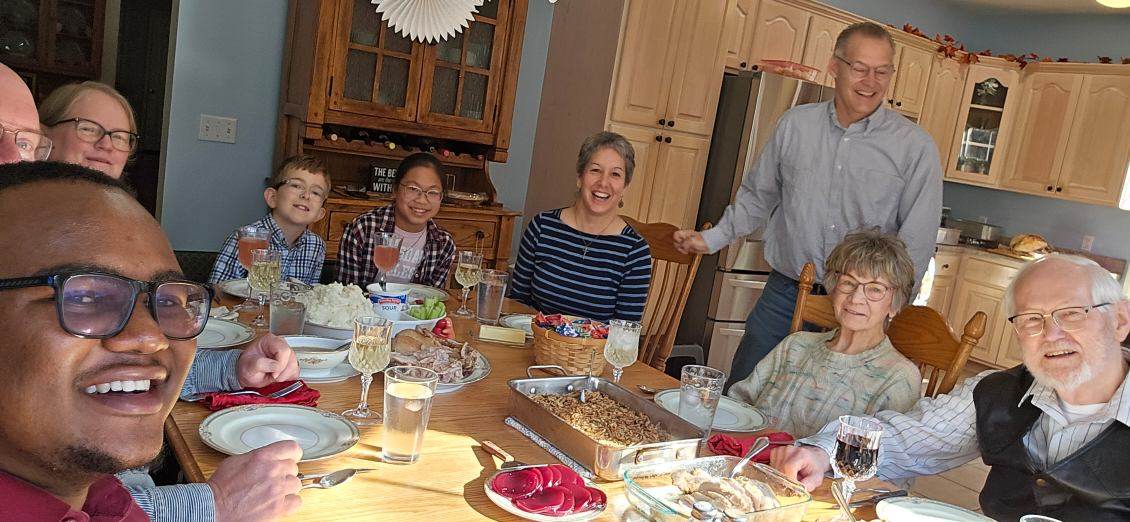
For years, I prayed that my table would seat a gaggle of children. However, the Lord did not fill my table with children. Rather, He taught me that my table can seat people of all ages, and they do not have to be born of my womb.

Upon our move into this house, we have hosted many people in our home. Some come for a meal. Some stay for several days. One even stayed for a couple of months.

And we LOVE it. We share holiday meals with college students and friends who are not able to see family. We host evening gatherings for friends. While we did some hosting in our first home in Nebraska (many nights of cards), we do even more of it here. Part of that is the result of more space in our house. Part of it is because our children are old enough to handle a break from the home routine. Part of it is they can handle a later bedtime. Our dining table does not seat just five of us anymore. We have the privilege of welcoming others to a meal around our table, and it is delightful.

When you open your home to others, you invite them to share community with you. It tells your guests that you want to know more about them. It shows them that you care.

Hosting doesn’t have to be a big, fancy meal. It can be something as simple as dessert one evening. Perhaps you have young children at home. You can be the one to arrange a playdate for others; that’s hosting. Maybe your home seems too small to have a lot of people in it. Invite a small group or just one or two others. Hosting doesn’t mean you have to put on a big party. If your friend asks what she can bring, let her. Keep it small and simple. Ask her to bring some crackers or some fruit or some wine. Invite a friend over to play a game. Share a cup of tea.

The purpose of hospitality is to spend time together. True friends are not coming to inspect the cleanliness of your home. (Please make sure your bathroom is clean, though.) They are coming to be with you. The Lord desires us to be in fellowship with one another. He invites us to befriend our neighbors. We value people, and we want to support them in good and bad times. We can do this better when we actually KNOW them. When you share your table with others, you share yourself. That, in turn, invites others to share of themselves with you.

I taught my children that family doesn’t just have to be your blood relation. They learned that through adoption. I also wanted them to see that the people with whom we share time can become our family. This includes the older woman who treats my children as her grandchildren. This includes the unmarried college man who desires a spouse. This includes the young couple who await children of their own. This includes the high school students who need to see a stable family in action. All are important, and all need our love.

When we’re hosting people, my children get excited. They want to help get ready for our friends. In younger years, they would make name cards for everyone. Now they help set the table. They help prepare the meal. They pour drinks. They clear the table. They sit and listen to adult conversation. They laugh, and they ponder. It’s the blessing of community.

Our Lord creates the perfect community in the Lord’s Supper. He is the ultimate Host. He spreads a table before us and gives us to eat and drink of His very own Body and Blood. His is the perfect meal, and we are His guests.

It is now our privilege to extend that kindness to others. Perhaps you’ve wanted to host people in your home but just aren’t sure what to do. Know that you can do it. Maybe you start by meeting somebody at a coffee shop. Go for a walk with someone. Get together for appetizers one evening. Hosting doesn’t have to be a big production. Find what you can manage and start there. It’s really about treating others with loving care.

I’d love to host you in my home sometime.

Reasons We Never Used IVF – #3

by Katie Schuermann


For IVF to work, my husband would need to collect his own sperm and hand it over to a stranger for handling.

The primary means of collecting sperm in IVF is for a man to masturbate1 in a clinic while looking at images of women other than his wife. There are other options for collecting a man’s sperm (surgical removal, Onan’s method, etc.), but none of these options are good for my husband, nor are they beneficial to our marriage.

I just asked my husband if he has any regrets about never masturbating all of those years ago, though we still have no children today. He says no.


1 “The usual way to collect sperm is to masturbate into a cup.” WebMD.com

If your conscience is burdened because you used IVF, know that you are not alone in your regrets. The apostle Paul teaches us in his letter to the Romans that “none is righteous, no, not one” (Rom. 3:10). He also writes that “there is therefore now no condemnation for those who are in Christ Jesus” (Rom. 8:1). Please, talk to your pastor or a trusted Christian friend about your regrets, and put your faith in Jesus’ words from the cross about His work of salvation on our behalf: “It is finished” (John 19:30). Because of Christ’s mercy, we can live our lives looking backward in repentance yet forward in hope.

She Has Her Hands Full

by Katie Schuermann


In twenty-four years of marriage, I have never been pregnant. In that same amount of time, my husband and I have received at least a dozen private adoption queries from five different states, and not a single one has worked out in such a way as to make us parents. And in spite of our multiple foster parent training sessions completed through the states of Texas and Illinois, no child ever has been placed in our home by the government.

Which means, in twenty-four years of marriage, no one has ever said of me, “She has her hands full.”

But do you know what people can say of me? that is, if they are looking closely?

“She has her stairwell and kitchen full.”

For in a plot twist no one saw coming, God called my husband seven years ago to serve as pastor of University Lutheran Church in Champaign, Illinois. “UniLu,” as everyone in the community fondly calls the congregation, is a campus ministry located just one block off the main quad of the University of Illinois, and it exists primarily to serve undergraduate and graduate students attending the University of Illinois.

This means that Michael and I are finally, joyfully foster parents, though not through state certification like we originally thought. Instead, the church equips us to take into our little family of two around sixty children every year, all of them grown-up and sojourning away from home. We get to shelter them, feed them, teach them, sing with them, play with them, love them, and try to assist their parents in raising them in the faith, all the while knowing that these foster children will not be staying with us, that in the end, it is good — best, even — when they return to the families from which they came.

One of these precious foster children said to me the other day, “I could never do what you do.”

She was referring to the fact that every year our family changes. Every semester, we welcome new students into the church and launch graduating students into the world.

As I reflected further upon her comment, I realized something remarkable about our little story of barrenness.

Michael and I are able to endure this kind of transient family life. In fact, we expect it. We thrive in it.

The primary reason for our endurance, I believe, is because God equips us to serve where He sends us and whom He sends us. He prepares specific good works for us to do, and He completes these specific good works in us. It’s that simple.

But something a little less simple and a little less obvious …

When I view our present vocation through the lens of our barren years, I see plainly that God has been training Michael and me for this kind of transient family life our entire marriage. Never have we ever been able to keep the children who come into our home. Always, we must return those we cradle to another’s arms. Every single child we meet and love and welcome into our hearts belongs to some other family. Every single child who loves us calls other people “Dad” and “Mom” and some other house “home.”

What I am trying to confess is that our barren marriage has served as the perfect training ground for being foster parents at UniLu. Welcoming student after student and then blessing each on his way is simply a continuation of the kind of love and care we have always known and shown to other people’s children in our barrenness.

To think that this strange vocation might have been God’s intention all along — “It is high; I cannot attain it” (Psalm 139)!

And here is what really blows my mind.

In making us foster parents to so many college-aged children, God is filling not only our hands but also our hearts and our prayers and our hours and our table and our stairwell and our kitchen.

Never in my wildest dreams did I imagine such a big, beautiful family, one so plainly created by a God.

All I know to do in response to God’s gift of family life is to thank Him for His abundant mercy and sing a psalm: “Blessed is the man and woman who fill their quiver with college students!”

Reasons We Never Used IVF – #2

by Katie Schuermann


Though it was confusing — even embarrassing — in our marriage to be one flesh year after year but never pregnant, we understood that it went against God’s will to separate what He joined together (Matthew 19:6) in our one-flesh union.

For to force humans into existence outside of God’s procreative design of coitus would require harvesting and handing over our gametes (sperm and eggs) to a clinician who would then mix them in a petri dish in a cold room away from us. This separates what God has joined together in our marriage bed, and that goes against our religion.


If your conscience is burdened because you used IVF, know that you are not alone in your regrets. The apostle Paul teaches us in his letter to the Romans that “none is righteous, no, not one” (Rom. 3:10). He also writes that “there is therefore now no condemnation for those who are in Christ Jesus” (Rom. 8:1). Please, talk to your pastor or a trusted Christian friend about your regrets, and put your faith in Jesus’ words from the cross about His work of salvation on our behalf: “It is finished” (John 19:30). Because of Christ’s mercy, we can live our lives looking backward in repentance yet forward in hope.

Reasons We Never Used IVF – #1

by Katie Schuermann


Though having no children felt like we were already dying, my husband and I could think of no situation in which it was ethically acceptable for us to try to make children in a petri dish and risk their lives simply to fulfill our own wishes and desires.

Put another way, it would be wrong to ask our children to suffer in our place.

We know from the Bible that it is the strong who are called to protect and defend the weak (Micah 6:8, Psalm 82:3, Isaiah 1:17, Philippians 2:4, Zechariah 7:10, Proverbs 31:8-9). It is parents who are tasked with providing for their children, not vice versa, and the inherent disordering of human vocations in IVF alarmed us.

Therefore, we understood that it would be wrong to force the creation of our children in an environment that would put them at such a high risk of dying, simply to make us feel better.


If your conscience is burdened because you used IVF, know that you are not alone in your regrets. The apostle Paul teaches us in his letter to the Romans that “none is righteous, no, not one” (Rom. 3:10). He also writes that “there is therefore now no condemnation for those who are in Christ Jesus” (Rom. 8:1). Please, talk to your pastor or a trusted Christian friend about your regrets, and put your faith in Jesus’ words from the cross about His work of salvation on our behalf: “It is finished” (John 19:30). Because of Christ’s mercy, we can live our lives looking backward in repentance yet forward in hope.