Infertility

Am I Disobeying God?

Judge Shaking FingerQuestion Submitted: I read your posts on to adopt or not to adopt and fake laws. My husband and I are barren but have so far decided not to pursue adoption or doctoring. We are usually content in the callings God has given us in which we serve other people’s children. In spite of this, I sometimes have a gnawing fear that we are disobeying God by not pursuing the good work of parenting. Perhaps God wants to use the adoption agencies or medical doctors to make us parents and we aren’t letting that happen. We are sinners so all our decisions are tainted by sin. Is it really true that “you must try to adopt or seek ethical medical help,” is a fake law?

God does instruct us in His Word to care specifically for the needs of widows and orphans (James 1:27), but that instruction is for all of the Church, not just for the barren.

Still, it is often the consciences of the barren which are burdened by this instruction, so let me take a shot at defining some of the fear and tension you might personally be feeling surrounding the question of whether or not to adopt: You know from God’s Word that He wills for us in marriage to be fruitful and to multiply (Genesis 1:27-8). You know that children are the blessed fruit of the one-flesh union between a husband and wife (Psalm 127:3). And, you also know that, for whatever reason, you and your husband have been unable to conceive and bring a child to full health and vitality outside of the womb. So, what now? Is having children a law from God you must obey? Are you obligated to find an alternative method of having and raising children? Do you need to adopt a child to please God?

No.

Adoption is not intrinsic in God’s design of procreation. Adoption is a matter of free will. When a husband and wife are unable to conceive in the one-flesh union, God does not require them by law to adopt children into their family. We know that, in Christ, we are to serve and care for orphans, but adoption is not the only way to care for their needs. In other words, we do not necessarily need to adopt an orphan in order to serve him. There are many ways to serve, even mother, orphans without signing legal paperwork in front of a judge. We can faithfully pray for these children; we can raise awareness and money to help fund their adoptions; we can give clothes, food, and shelter to those who have none; we can serve as foster parents to children waiting to be matched with their forever families; we can be active supporters in the lives of the families in our congregation and community who have already adopted; we can encourage parents to rescue their children currently frozen in fertility clinics; we can lobby for the rights of these children in the political arena; and the list goes on and on. Think about your specific talents and gifts. How can you use those gifts to serve your neighbor?

Adoption is a good thing. The reality is that there are plenty of children who need parents to love them and bring them up in the Faith. Yet, not everyone is called to be parents through adoption, just as not everyone is called to be parents through conception. If you and your husband come to the conclusion that adoption is not the right path for your family, then commend your fear and guilt to Christ’s mercy and pray that God would provide parents for all children in need. Then, go out and serve your neighbor in all peace, joy, and in the full knowledge that Christ has perfectly served you on the cross.

In regards to whether or not to seek more medical attention for your barrenness, you are not required by any law of God to undergo medical treatments in order to conceive a child, and there is no sin in being content with the quiver God has given you today.

A Quandary

IMG_1508Question Submitted: This past fall my son’s kindergarten teacher and fellow military wife (my husband is an LC-MS Navy chaplain) shared with me their many years-long wait for a child which includes fertility treatment and heartbreaking disappointments of domestic adoption. The down right awfulness of the Fall is evident in the fact that this wonderful woman has no child of her own. I cannot tell you how much this grieves me. I sob on a regular basis, and I do not think it would have hit me as hard had I not been familiar with your blog. I am a mom of three including one who is a baby. In fact, I nursed my newborn as she told me her story. 

She is such a fantastic teacher, and I can see by the way she teaches and interacts with children that she will be a wonderful mother, given the chance. She shares in my joy of my children, eagerly hearing my stories of all the funny things they say.

So here we are on the eve of Mother’s Day. For a few weeks, as I saw MD coming, I wondered if I should give her a card telling her that I remember her on MD. I knew my son would be coming home with a hand-made MD present that she would have planned weeks in advance and lovingly helped him make. I thought about asking you what you thought. I’ve read your posts about people saying what makes THEM feel better rather than what makes the barren woman feel better, and I do not want to make my grief hers. I want to tell her that I know MD is hard while you are still waiting and that scarcely a day goes by that I do not pray for her and her husband that they might be given the gift of parenthood. There was a beautiful and ridiculously expensive card at Target, blank inside where I could say what I want. BUT, I chickened out at the last minute. I was afraid that instead of offering comfort, I would be pouring salt in her wounds. 

My son forgot something in her classroom on Friday, so he and I and the baby went back in to get it. We chatted for a few minutes as we always do, and then as we were leaving I said, “Have a good weekend,” and she said with a smile, “Have a good Sunday.” It’s been killing me all weekend. I knew what she meant. She meant “Have a good Mother’s Day,” but she said Sunday instead. 

So, should I write her that card? Should I say something in person or just keep praying?

Yes to all three!

Your even asking this question highlights the awkward, social conundrum of Mother’s Day. No matter how much we want to turn the Woodrow Wilson-endorsed holiday into a politically correct celebration of all women, Mother’s Day really is intended just for the celebration of mothers. No matter how beautiful and sincere our intentions, sending cards, flowers, and greetings to barren women on the second Sunday of May is a clunky piece of work. It points out the obvious, and the obvious is painful.

Still, ignore the junkyard of discomfiture and celebrate your son’s teacher! Will your gifts of encouragement cause her more grief? Possibly. Will she grow stiff under your hugs and stone-faced before your compliments? Maybe. Will opening a flowery card cause her to cry? Most likely. But, no matter her immediate reactions, be assured that your caring, merciful action is a blessed calvary sent in to rescue her from a war zone of sorrow and shame.

You are wise to want to avoid adding to your friend’s grief, so I recommend focusing on celebrating the ways you appreciate her instead of dwelling on that which she doesn’t have. Tell her how much she means to you and your son. Don’t be afraid to point out the gifts God has given to her and how she uses them in service to you and your family. It doesn’t even have to be Mother’s Day for you to celebrate her.

Personally, my own grief is opened afresh every time I read a Mother’s Day card which celebrates me in my childlessness, but that is not necessarily a bad thing. I still would rather have those mementos of encouragement than not be acknowledged at all in my barrenness.

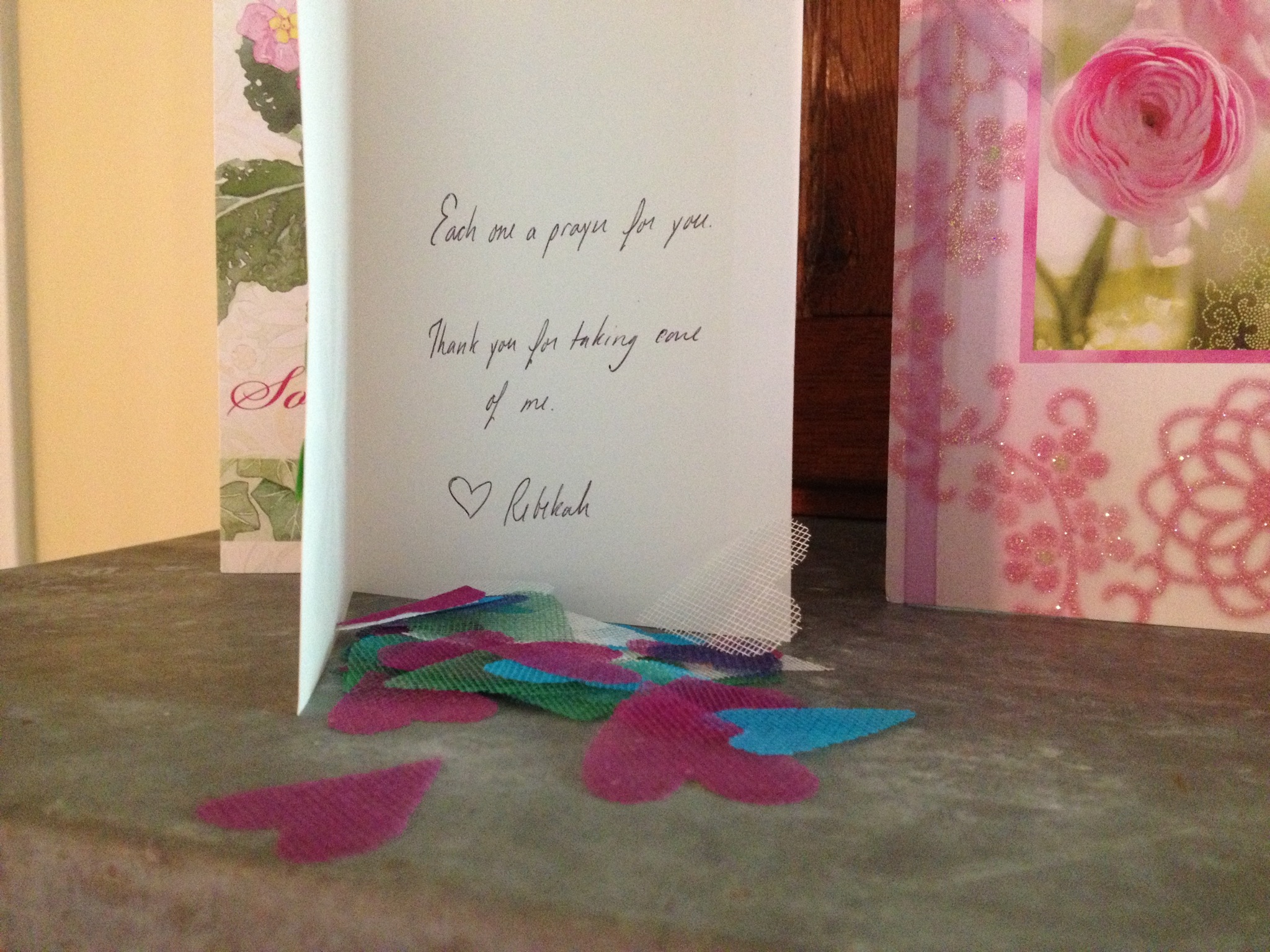
In fact, those mementos help me grieve more healthily. The handprints from my godchildren remind me that I am not childless in my life; the poems from my nieces remind me that I am loved; the card from my mama reminds me that I am blessed to have a mother; the fierce hug and empathetic tears from a sister in Christ in the narthex remind me that I am not alone; the handmade chocolates from a father-figure in my church remind me that I am special; the picnic in the park with my husband reminds me that I am loved and needed just as I am; and the card that spills cut-out hearts onto my countertop reminds me that I am appreciated and remembered in prayer by a loving friend.

Yes, please write her a card, say something to her in person, and pray for her!

(And, on her behalf, I thank you.) xo

To Know and Accept

Pink PlumeriaI KNOW that my life may be a cross of barrenness. It is quite another to ACCEPT that knowledge and live under the cross of Christ.

I KNOW that anything that is mine comes to me as a gift through Christ. It is quite another for me to remember that they do not come through any merit of my own.

Dear Jesus, I know that you are always with me. Teach me to accept your good will for my life. Amen.

First Mother’s Day

Mother Watching BabyA Mother’s Day reflection from a sister in Christ:

“How exciting, your first Mother’s Day,” they say.  After many years of hoping for children, we welcomed our daughter last summer.  We are grateful for this new life given to us.  So why do I have a similar anxiety about this upcoming holiday that I had during all those years we struggled to conceive?  Afterall, our baby girl is now here.  It’s now my turn to celebrate, right?

I started to look at the print, television, and radio advertisements for Mother’s Day, and it doesn’t take long to add it all up. Take a look…

“Save on what Mom really needs.”

“Make it about Mom.”

“Give her what she deserves.”

“How to love yourself on Mother’s Day.”

“Say ‘I love mom’ with these items.”

“It’s all about Mom.”

Aha, the wordly trinity of me, Me, and ME!  A celebration without Christ is a celebration that fades with all things of this world.  The devil would prefer that I personally take credit for all of the good gifts God has given me.  This includes a child and the abilities God has given me to care for her.  It is not on account of my ability that I have these gifts, but God’s grace.  He works all things for the good of His kingdom, and we thank You, Lord, for this vocation of motherhood.

Thank you, Lord, for the sacrifice of your son Jesus Christ that we may not boast in our abilities, but in all things recognize You are the great provider humbly working in and through us.

Adrienne Rasmussen
Wife, mother, daughter, and your sister in Christ

Mother’s Day: A Pastoral Plea

MP900341759Thank you, Pastor Schuermann.

This Sunday is Mother’s Day. For the barren woman, attending church on this particular Sunday is often an exercise in frustration, woe, even great shame brought on by the absence of longed-for children. Far too often, we pastors help amplify these feelings in her.

This is a pastoral plea. Brothers, I beg you, remember every Sunday your entire flock. But especially this Sunday, remember all the faithful women who Christ has entrusted to your care.

Remember that a part of your flock have received from the Lord the blessed vocation of motherhood, whether their children are biological or adopted. In the prayers of the church rejoice with them, give thanks to God for them, and ask God to help them faithfully raise up these gifts from Him.

But remember, too, that many in your flock – whom you may or may not be aware of – have not received the gift of children from God. And they may be longing for that gift. Please be sensitive to them. Recall that the natural inclination of sinful man towards a theology of glory has resulted in them receiving countless, “helpful” comments and encouragements that are nothing but empty promises and legalistic claptrap. Pray for these women, too, that they would receive what they long for: the gift of a child, biological or adopted. But also do not fail to pray on their behalf that God would give them the faith and trust to contentedly rejoice in what He ultimately does give to them. It may not be a child. In other words, help them to pray, “Nevertheless, Lord, Thy will be done.”

And also remember the sheep of Christ’s flock who are past the time of having any expectation of receiving the gift of a child. Please don’t leave them out. Pray for them, too, that they would recognize in their lives all the good gifts the Lord has given to them. 

Please don’t parade them in front of the congregation in order to offer up prayers on their behalf. Please don’t draw unneeded attention to them by giving flowers or some other admittedly well-intentioned gift only to those in the congregation who have children. Allow the barren to sit and grieve, to receive from their Lord, and to pray along with you. That’s your God-given task in the Divine Service, anyway: to lead them in prayer and to care for them with Christ’s true, comforting Word and Sacrament.

In fact, my encouragement would be, if at all possible, to limit your Mother’s Day references in the service to the prayers. Keep your whole flock focused on Jesus and His forgiveness present there for them today. But in the prayers do indeed pray, praise, and give thanks for the mothers, mothers-to-be, and all those who desire motherhood but have not or will not receive that gift from God.

I think these words, included in this year’s “Let Us Pray” for Easter 7 from the LC-MS, fit the bill nicely:

“Father of glory, Your Son, our Lord Jesus, in His incarnation, took on our created human flesh and was born of the Virgin Mary. He submitted to His mother, honoring and obeying her, so fulfilling the commandment where we have not. On this Mothers’ Day, graciously accept our thanksgiving for our mothers, whom you have given to us. Teach us to honor them aright — loving, obeying and giving thanks for them, as is fitting in Your sight. Strengthen all women with child and protect them in their deliverance. Comfort all women who long to have children, but cannot, that they may find their consolation in You and Your unfailing love. Lord, in Your mercy, hear our prayer.”

Rev. Michael P. Schuermann

True Help

MP900446584

I know there is a woman in your church who watches you like a mother hen. I know she gets her feathers ruffled every time she sees you talk to a child or openly admire someone’s baby or quietly tear up at a baptism. I know she corners you in the narthex before the service and coos and clucks about this chick-producing fertility treatment and that miracle doctor. I know she pecks at your nerves with stories of distant cousins who get pregnant at 43 and petty assurances that you will, too.

I also know she cares for you.

So, don’t be a chicken. Take a risk and be vulnerable. Say the hard words.

“I can tell that you care for me and that you want to help me. Do you know what would really help? Pray for me and help me be content with the person God has made me today. Even if that means I am barren.”

You never know. With a little, loving guidance, this mother hen might end up becoming your fiercest ally in the coop.

Identity

Who? Are? You?“Identify who you are and what you can do.”

The Rev. Dr. Arthur A. Just shared those words with a group of pastors’ wives this past week. That sentence struck me on a variety of levels. It especially rang true for me regarding my barrenness. Our culture tends to identify people in regards to who they are. Are you married? Do you have children? Who are your parents? This same culture wants to know what people can do. Can you bear children? Can you prevent the birth of children? Can you control the number of children you’re having?

For so many years, I have identified myself by what I CANNOT do. I cannot produce children upon demand. I cannot choose when to have a child. I shamefully acknowledge that I am a product of a sinful world. Any children that come to me are purely received as gifts from our Heavenly Father.

So – Who am I? I am God’s child. My true identity is found in Jesus Christ. He is my Lord and Savior, and He died to make me whole. If I am barren, what can I do? I can receive God’s good gifts when they are given to me. Those gifts are found in His Word and Holy Sacraments. To receive is exactly what I can do. I can serve my neighbor in love.

In Christ, I know who I am and what I can do. I can love my neighbor, even if that neighbor is not born of my own flesh.

A Bunch of Garbage

MP900405360“How old are you?” the woman with the hot pink lipstick asks.

I don’t like that question. No matter what number I give, I am either too young or too old in the eyes of the interrogator. I’m never just the age I should be.

“I’m old enough,” I answer.

“Well,” she says, simultaneously rubbing her hands up and down my arms as if she can polish my barrenness right off my skin, “you can still have a child. My son is forty-one, and he and his wife just had their first child. They used IVF. It went so well, they probably even have some children in the trash.”

I’m speechless. I don’t know what to say.

“There are some frozen embryos, too, or something like that,” she keeps rubbing, “but at least they have one that’s alive, now.”

I know what to say to this. “Those embryos are alive, too.”

She stops rubbing. Her eyes flicker. There is knowledge in her eyes. Conviction. She knows, and I can tell she is bothered. “I know. I don’t know what to think about all of that.”

And I am sad for her. She is a grandma many times over through IVF, and she is confused. I realize I misjudged her. She wasn’t being flippant about the children in the trash. She was confessing. She couldn’t stop herself from telling me. She just needed someone to know.

Please help, dear Church. Tell the truth about IVF before more children are created in glass to be tossed out with the trash.

Babies are not garbage.

Discrimination

Newborn babyWe discriminate, even in our suffering.

Many church women’s organizations have said to me in response to an invitation to attend a talk on barrenness, “Oh, we don’t want to hear a talk on barrenness. We’ve already had our children. That issue doesn’t affect us.”

And my heart breaks.

Not just because these women are turning a blind eye to the women in their own groups who have never had children (and to those whose children or nieces or sisters or aunts or friends have not had children), but because they would never say to a sister in Christ, “Oh, we don’t want to hear a talk on cancer. We don’t have it. That issue doesn’t affect us.”

Because, deep down inside, they know it does. Whether they personally have cancer or not, they know cancer affects someone who sits in their pew.

The same is true of all suffering. When one member of the body suffers, the whole body is affected. When the little toe is stubbed against an oak dining room chair, the face flinches, the eyes close, the fists clench, the stomach churns, the knees bend, and the larynx howls, all because a tiny member of the body is in pain.

That is, unless we remove that tiny member from the body and pretend she doesn’t exist.