IVF

More than That

So many people say to us, “How dare you speak out against IVF! I have two children/grandchildren today thanks to IVF.”

The difficult truth is that, actually, you probably have many more than that.

We just don’t see these children. We don’t hear of them, speak of them, or even know about them. They are either currently frozen in liquid nitrogen at -321 degrees Fahrenheit, or they have already died from the thawing process, from failed implantation, or from being rejected and discarded for their perceived lack of viability or their perceived genetic “flaws.”

Did you know that there are currently an estimated 600,000 of these children frozen in time? And these children have no legal rights. Well, they have the legal right to be made but not the legal right to keep living.

Lord, have mercy and forgive us.

MP900341633

What’s Wrong?

Male Doctor Talking with PatientI enjoyed your “Best Weapon against Temptation” post. It’s as if you read my mind, as usual. My husband and I ask ourselves those same questions among others each time we go to some doctor or specialist. We even left a wonderful doctor who was very knowledgeable about PCOS as her main goal was to “get me pregnant as quick as possible.” Granted, I think IVF was even against her particular beliefs, but pregnancy still wasn’t my only goal. My husband and I have always sought a general well-being of my whole body instead of narrowly focusing on just my reproductive health.

Even with keeping that in mind, I find myself tempted to wonder why the doctors haven’t been able to find out what’s wrong, yet. Why can’t they tell me why I’m tired all the time, etc.? Then I realize that even with good intentions it’s easy for me to focus on healing coming from the doctors themselves or to be driven by a desire to figure out all the answers. It leads to nothing but frustration when one looks to doctors alone for healing and answers. As Rev. Petersen alludes to in his sermon, faith built on such “things” instead of God’s Word won’t last. Certainly there’s no comfort in putting one’s trust in things that will pass away. I’m so thankful that we have God’s Word to turn to in such times. The devil sure does know our weaknesses, and I’m even more thankful to have a Savior who has overcome such temptations for me, as I fail pretty miserably on my own!

L. Meyer

Amen, sister. Amen.

The Best Weapon against Temptation

There are reasons for seeking medical attention for infertility that can lead to sin. Answer these questions:

  • Do you wish to “make a baby” at the risk of hurting, even killing, your neighbor?
  • Do you think that having a baby is the only thing in life that can make you happy?
  • Do you put your identity in motherhood rather than in your Baptism?
  • Will your faith in God’s goodness to you in Christ Jesus be upset if you do not conceive?

These reasons for seeking medical intervention for infertility are temptations from the devil. These reasons entice us to serve our own desires and wishes, even when it means trusting the words of our doctors over the words of our Creator. We should be wary of these emotional snares that would bind our faith to things temporal rather than to things eternal.

What is our best weapon against such temptations and snares?

Rev. David H. Petersen gives us the answer in his sermon for the First Sunday in Lent – Invocabit (Genesis 3:1-21; 2 Corinthians 6:1-10; St. Matthew 4:1-11) as it appears in Thy Kingdom Come from Emmanuel Press:

All the temptations [of Jesus in the wilderness] show us something of the character of sin and the character of the God who overcomes sin. But the Lord’s response also shows us the best weapon we have against temptation and the only weapon we need. He says, again and again, “It is written.”

The strategy of the devil against our first parents, and then against our Savior, was to plant doubt. He wants us to place ourselves into the role of judge. We will decide what is good for food, pleasing to the eye, and capable of making us wise. We will decide if He is worthy of being our God. This is what we do when we declare, “My God would’t do this or say that.” But, in fact, we don’t get to decide who God is or what He should do. He tells us who He is and what He does in His Word. Faith built on emotions and feelings or our own reason and goodness is like seed sown on rocky ground. It has no root. In time of temptation, it withers and dies.

The answer to doubt is God’s Word. It is written. It is not fleeting, corruptible, or changing. It is solid, lasting, eternal. All things pass away, but the Word of God does not pass away. It is written, in the first place, on the page, not in our hearts. Even the Lord Himself, in the desert, submits to the written Word. It is the written, objective, unchanging Word. (Petersen, 29-30)

MP900314217

Embryonic Adoption

Question Submitted: What do you think of embryonic adoption?

Rebecca and I have spent hours on the phone, on the road, and over our dinner plates talking about this, and here is what we think:

Before we engage in a conversation about embryonic adoption in the Church, we first need to come to an agreement in the Church that embryos should cease being produced and frozen through the procedure of IVF.

In an effort to get that conversation on IVF rolling, we are engaging various LCMS pastors across the Midwest in a series of roundtable discussions on the topic. We’ll check in with you later about embryonic adoption once we’ve listened to what our pastors have to say.

In the meantime, let’s continue to pray for our littlest neighbors frozen in time. Lord, have mercy.

MP900321169

Train Up a Child

photo[84]I have childhood memories of helping my parents set up chairs for the annual life rally at a local school. That was back in the day when public schools still encouraged nonprofit organizations to use their facilities to educate youth on such topics as (Gasp!) respecting each others’ bodies and valuing life at all stages.

I was only in third or fourth grade at the time, but my parents encouraged me to tag along for this day-long event of speakers, food, and fellowship for teenagers. My parents were members of our local Lutherans For Life chapter which supported the event, and together we set up the display of fetal models for viewing, hung signs to direct students to various rooms for breakaway sessions, and decorated the cafeteria with helium balloons. At the time, I was more interested in the balloons than the speakers, but over the years I was exposed to such life issues as human sexuality, caregiving, unplanned pregnancies, abortion, and adoption.

An accident? I think it was intentional parenting. Not only were my dad and mom modeling for me the act of service to my community, but they were also exposing me to the likes of Molly Kelly and Jim Lamb. Formative influences, for sure.

My parents did not stop there. In junior high, they brought me to life chains, conferences, prayer vigils, and pro-life fundraisers such as banquets and community breakfasts. In high school, my mom took me to two national life marches in D.C., and she encouraged me to start a local Teens For Life group at my school. Over the years, my parents showed me how to give of my time, talents, and resources to support local crisis pregnancy centers and other pro-life organizations. They taught me early on my responsibility to my littlest neighbors and showed me ways to advocate for their right to life.

No doubt, my parents’ example lit a fire under me in my childhood that continues to burn into my adult years.P1050860

How can we expect our youth today to defend the right to life if we do not teach them what that means? How can we expect them to advocate for the least in the world if we do not show them how?

My parents did that for me. God help us to do that for the next generation.

A Bit of Overdue Recognition

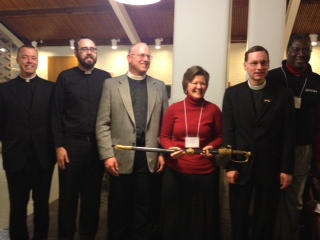
Sabre of BoldnessThis evening, at the annual Gottesdienst party that took place as part of symposia week at Concordia Theological Seminary in Fort Wayne, Ind., our very own Katie Schuermann received the Sabre of Boldness award. She is the first woman and first layperson to ever win the award. Here is the reason she was nominated:

Mrs. Schuermann is author of the book He Remembers the Barren, and had spoken to groups of women burdened like her with the affliction of barrenness. In the course of these meetings she soon found herself hearing from women who had turned to in vitro fertilization as a last resort to ease their pain. In spite of the sensitive nature of the matter, she felt constrained to tell the truth in love about the unacceptability of in vitro fertilization. For us who know that life begins at conception, there is really no ethical alternative than to reject in vitro fertilization, in whose process fertilized embryos are always discarded. For her to have the courage to say so in such circumstances, and to speak up for life, for which she has endured much grief and rejection, is commendable.

The award was presented by the Rev. Chaplain Jonathan Shaw and the Rev. Dr. Burnell Eckardt, editors of Gottesdienst: The Journal of the Lutheran Liturgy.

Congratulations Katie!! I’m sure your readers would like to give you a standing ovation to further honor your work. Thank you for all you do!

The Downton Abbey Dilemma

Downton AbbeyI’m a Downton Abbey addict. I don’t really watch prime time television at all, you see, except that someone turned me onto this PBS Masterpiece series from Great Britain a few years ago and I just love, love, love it. But there wasn’t really ever a good reason to blog about this passion on a site about barrenness–until now.

This past week’s episode included a scene where Lady Mary is discussing how to change the home’s old nursery into a sitting room for herself and her new husband Matthew. Matthew, who heard that Lady Mary had been to see the doctor recently, gently touches his wife’s arm and, with a twinkle in his eye, wants to know when they should possibly be thinking about using the nursery as a nursery (as if she had some kind of control over this in 1920). Lady Mary nervously shrugs off his comment and casually replies, “Oh, there will be time enough for that later.” In true Downton Abbey form, this brief exchange foreshadows a new storyline that will inevitably take more shape in upcoming episodes. The audience is left to ponder these two questions: 1) Is Lady Mary embarrassed that she is not yet pregnant after being married for several months now? or 2) Is Lady Mary not particularly interested in having children and knows that this attitude will not sit well with her husband?

The dilemma that I face is that I may never know the answers. This is a difficult pill for an addict to swallow.

Why can’t I just tune in next week and the week after to find out? No, my TV is not broken, nor do I have any social responsibilities scheduled for Sunday nights. It’s because the producers of the show have decided to reintroduce the fact that one of the servants is gay, and his sexuality (which was implied but rather brushed over at the beginning of the series) is now going to be featured as a storyline. In watching some interviews with the cast on YouTube I discovered a little more about what’s to come, seeing as how there is a new and rather attractive footman who’s joined the show who has caught the eye of more than just the housemaids. There won’t just be talk anymore about homosexuality. There will be scenes. Downton Abbey is about to join the rest of prime time’s sleazy line-up.

The thing that gets me is that one of the main reasons I adored the show was because it takes place during an era where honor, integrity, and morality were thought of highly. Of course it wouldn’t be modern television if some of the characters didn’t fall from grace, but these indiscretions were not shown, and there was regret and embarrassment after the fact. There was confession and forgiveness demonstrated within the family. I found that refreshing. So refreshing, in fact, that the disgust over the upcoming storyline is not enough to make me truly want to wash my hands of the whole program. I keep pondering the other storylines and it kills me when I think about not being able to follow them. This is what addiction means.

I’m finding that these kinds of dilemmas are becoming more common for the modern Christian, and because there is so much good wrapped up with a little bit of filth, we often feel it’s ridiculous to make such a fuss. Take for instance a mother of an only son who loves him so dearly and wants so desperately to keep peace within her family that she bites her tongue when he announces that he is living with his girlfriend. It’s not what she would have wanted and she knows it’s not right, but he’s such a good son and a responsible young man, etc. They’ll probably get married anyway.  Or what about the father whose daughter has suffered for so long with barrenness that he sees no point in asking too many questions when she announces that she is pregnant following an IVF procedure. He wouldn’t have recommended this procedure, but she hadn’t asked for his advice and the procedure is over so why bring it up? Afterall, a child is on the way!

Living the Christian life is hard. Having an active conscience is stressful. It makes you unpopular and you often feel like you’re missing out on the fun. Don’t think I haven’t tried to find ways around this problem. It’s very possible that Downton Abbey may not focus on the gay servant next week. I don’t know when this is going to happen. I might be able to get a few more episodes in. I could find a friend whose conscience is not so burdened and ask for the summaries after each episode to make sure I know what’s going on. Or I could find the summaries online somewhere, I’m sure.

Such are the musings of an addict.

As obedient children, do not be conformed to the passions (addictions??) of your former ignorance, but as he who called you is holy, you also be holy in all your conduct, since it is written, “You shall be holy, for I am holy.” And if you call on him as Father who judges impartially according to each one’s deeds, conduct yourselves with fear throughout the time of your exile, knowing that you were ransomed from the futile ways inherited from your forefathers, not with perishable things such as silver or gold, but with the precious blood of Christ, like that of a lamb without blemish or spot. 1 Peter 1:14-19 ESV

Wow. I’ve been “ransomed from the futile ways” of my forefathers “with the precious blood of Christ.” This is vivid imagery. And speaking of imagery, I know that, just as I ponder all the possible outcomes of the innocent storylines of Downton, if I keep watching this show I will be thinking about all the storylines, and those scenes that are inevitably coming will be imprinted on my mind. Do I want to be thinking about these things?

Finally, brothers, whatever is true, whatever is honorable, whatever is just, whatever is pure, whatever is lovely, whatever is commendable, if there is any excellence, if there is anything worthy of praise, think about these things. Philippians 4:8 ESV

If I find out that the offending storyline ends at some point soon, I may make my way back to the Abbey. I know there is a season 4 coming up. Perhaps there’s still hope. In the meantime, I’ll have more time to read on Sunday evenings I guess. Oh, but how I will miss them all!

The Sarah Syndrome

God promised childless Abraham that He would provide him an heir, a son of his own, and that Abraham’s offspring would number as many as the stars in the heaven. Abraham believed the promise of the LORD, and God counted it to him as righteousness.

Sarah, on the other hand, struggled to believe the promise.

She looked at her eighty-plus-year-old husband and her own, barren womb and saw only impossibility. How could God provide an heir through their cockamamie, one-flesh union? No, if they were going to have offspring that numbered as many as the stars in the heaven, they were going to need to take matters into their own hands. They were going to need to find a solution outside of their marriage union – outside of God’s promise.

But, what to do? IVF was not an option then. There were no fertility specialists to whom she could submit her husband’s semen for analysis. Plastic hadn’t been invented, yet, let alone those syringe-y thingies that could shoot Abraham’s seed closer to the target. There were no sperm banks she could consult for finding a tall, dark, and handsome brain surgeon to father her children. Nope, surrogacy was the best answer she could devise, so Sarah gave Hagar, her Egyptian slave, to her husband for impregnating.

And, he did.

The result? Marital trouble, broken relationships, agony, chaos, suffering, grief, and Ishmael, a wild donkey of a man who would beget a whole people born into slavery.

That’s what happens when we believe in the work of our own hands rather than in the promises of God. We create more slavery – slavery to sin, slavery to self, slavery to idols, slavery to the consequences of our actions, and, in Sarah’s case, literally more slaves.

I think we all suffer from Sarah Syndrome to some degree. When we grow restless in our barrenness, when we wait on the LORD for deliverance from our affliction, that is when the symptoms begin to show. The anxiety. The coveting. The self-entitlement. The spouse-loathing. The disbelief. We start visiting doctors who advocate for practices that break commandments of the LORD. We succumb to the advice of the roaring women around us and try to be fruitful and multiply outside of the one-flesh union God designed for procreation. We start looking around for some Hagars to give us the children we want and think we deserve.

And then, like Sarah, we despair when the work of our hands comes to fruition. For, we the baptized know deep down inside that God will give us a child if it be according to His will – not from a petri dish, not from a surrogate, not from the work of our own hands, but from the mysterious, one-flesh union God designed from the beginning of time or from the gift of adoption He so perfectly demonstrates for us in His Word. If God does not give us the gift of children through these blessed means, then we can be assured that it is for the best. He is working our childlessness for our good, and we can confidently rest in God’s guarantee of that goodness as He proclaims it in Scripture. “The Lord giveth, and the Lord taketh away. Blessed be the the name of the Lord.”

Maybe you have already acted out on your Sarah Syndrome and feel ashamed. In Christ, sister, be at peace and take joy in this good news:

In spite of all of Sarah’s disbelief, in spite of her meddling, in spite of her laughing and lying, God still kept His promise to her and to Abraham. God visited Sarah years later, long after her menses had ceased, and she finally conceived and bore Isaac, a son and heir from whose family line would eventually come Jesus, the Savior of the world.

In keeping His promise to Sarah, God was actually keeping His promise to save you; and, in believing this promise, God counts it to you as righteousness.

reg_1024.newnormal.mh.072312

Not a blessed, one-flesh union in the bunch.

Campaigning

I am on a campaign to reclaim the words which have been abandoned in our present society’s fertility lexicon.

Even when it makes people uncomfortable, even when it sets me apart from the world, I am going to continue using the word barren in place of infertile, child in place of embryo, and blessing in place of burden

Why? Because these are the words God uses in Holy Scripture when talking about procreation. These words mean something to me as a baptized Christian. They communicate the truth about life and death in Christ, and they acknowledge the Creator who wonderfully formed me in my mother’s womb. These words even work a miracle in me: they preserve and sustain my faith in the One who has closed my own womb when the world’s lexicon would have me despair.

So, I am going to speak and write these words frequently, even if they seem archaic or naive or politically incorrect or whatever.

I am Katie Schuermann, and I approve this message.