 Emmanuel Press has graciously allowed us to make available for you on this site, “Admonition and Comfort for the Barren,” an excerpt from Starck’s Motherhood Prayers for All Occasions. Thank you, Emmanuel Press!
“Admonition and Comfort for the Barren” is an excerpt from Starck’s Motherhood Prayers for All Occasions, which was originally published in the English edition of Starck’s Prayer Book in 1921. Johann Friedrich Starck was an 18th century Lutheran pastor, devotional writer, and poet in Frankfurt, Germany. He and his wife, Katharina, gave birth to seven children, of whom two survived.
Admonition and Comfort for the Barren
When God withholds children from married people, so that they say with Abraham: “Lord God, what wilt Thou give me, seeing I go childless?” Gen. 15:2, they should:
1. Reflect that in either spouse there may be natural causes of barrenness; for God does not bestow on all men the same qualities nor the same fruitfulness. If God has not placed this gift in them, they should be content with their condition, and believe that He is nevertheless their gracious God who loves them and is well-disposed towards them. Though a tulip has not as many flowers as a rose bush, it is nevertheless a pleasant plant to the gardener and the proprietor of the garden. How many shrubs adorn a garden, without bearing fruit, and yet we are glad to have them in our gardens. Thus barren spouses are also dear children of God, though He has not made them equal to others as regards fruitfulness.
2. They should remember that children are a gift of the Lord. If He withholds this gift from anyone, that person should not on that account murmur against God, nor grow envious when he sees that God gives to some more than to others. God is the Lord in His house: He dispenses His gifts according to His good pleasure. God has reserved for Himself three keys: the key to the grave, for nobody except God can raise the dead; the key that unlocks the rain in the clouds, for no false god can give rain, and no human being can cause rain; and the key to the womb, which nobody can open when the Lord has locked it, nor lock when the Lord opens it. However, if it is God’s gracious will to withhold from married persons the blessing of children, such spouses must give proof of their patience, resignation, and hope in their childless state.
3. Barrenness is not a sign of God’s wrath; for that God is not angry with them the barren may gather from the fact that God does not suffer them to lack other blessings: He bestows on them temporal gifts, such as health, daily bread, prosperity, and other blessings, which He does not give so lavishly to others who have children and whom He frequently visits with much sickness, sorrow over their children, and other afflictions. Moreover, God gives to the childless heavenly blessings, such as joy in God, peace with God, the righteousness of Jesus Christ, comfort, and spiritual delights. By all of these blessings He proves to them again that He is not angry with them; for a person who is in a state of wrath and disfavor with God must certainly go without these heavenly blessings.
4. Barren spouses should also consider that God is showing them a special favor by their very barrenness, because He knows the condition of their body and mind better than they do themselves. For although many married wives love children, God may know that they would be too feeble to give birth to a child, or to raise children, or to endure the cross of seeing their children go astray. The child might cause to the husband and to the wife much vexation and worry that might hinder them in their private and public devotions; yea, if God in His counsel should let the child die, that might cause the parents much grief. Therefore, since God knows the strength and weakness of men better than they do themselves, He shows them a special favor by leaving them go childless, although in their ignorance they may not regard it as a favor.
5. In particular, married persons should beware of trying to force God to give them children by their murmuring, dissatisfaction, and their importunate prayers; for in that case God may give them children in His anger. Either the mother who had murmured will lose her life or health through giving birth to a child, or if this does not happen, the child given her may turn out so ill that it causes its parents innumerable alarms, sorrows, and griefs, and puts them for the rest of their lives in a state of perpetual fear, sadness, and melancholy, all of which would be the results of their unreasonable petitions. May a son who had been obtained thus from God by unreasonable prayer afterwards became the cause of the father’s death and a scourge to his mother.
6. Godly wives should not misapply the saying of Paul in 1 Tim. 2:15, where we read: “The woman shall be saved in childbearing, if she continue in faith and charity and holiness with sobriety.” For in this passage Paul does not say that wives shall be saved on account of childbearing. For we are made righteous before God and saved by the merit of Jesus Christ and for the sake of the blood which He shed for us, Rom. 3:28 and 5:1, and not by childbearing. For, if the latter were true, no maiden could be saved, which is contrary to God and His holy Word. But Paul has made this statement to comfort married women, telling them, namely, that although God has laid on them great pains in childbearing, because the woman suffered herself to be led astray in Paradise, and thus brought into the world transgression and sin, nevertheless God will aid and help them in childbearing; they are to be saved despite the fact that in the pangs of labor they feel God’s anger, provided in their condition they continue in faith in the Lord Jesus, in love towards God and men, in sanctification of life, self-discipline, and a Christian conversation. Accordingly, this passage speaks comfort to women in labor, and conveys to those who die during childbearing the assurance that notwithstanding the pains which have been laid upon them on account of sin they shall be saved. But this passage does not declare any cause for the salvation of women.
7. Married persons, moreover, should abide God’s time and persevere in prayer. Some trees bear fruit for the first year, others after several years. Accordingly, godly spouses should not abandon all hope. “Cast not away your confidence, which hath great recompense of reward” Heb. 10:35. Now, as God does not bestow temporal blessings on all men at the same time, so also with regard to this blessing.
8. In the connection married people should diligently beware of conceiving a dislike of their spouses, the wife blaming the husband, or the husband the wife; but they should reflect that it is God who withholds from them the fruit of the womb. Gen. 30:1. Accordingly, they should nevertheless love each other cordially and be content in God, because neither of them can alter matters without the favor, blessing, and will of God. Particularly they should beware of suspicion, jealousy, and disfavor, for instance, when friends, brothers, and sisters are beginning to make inquiries concerning the disposition of the property of childless spouses. But they should continue sincerely loving each other, and whenever this has to be done, dispose of their earthly possessions according to equity and charity.
9. If God withholds children from godly spouses, they should increase the more in the love of Jesus. While those who have children are often hindered by their children in their devotions, church attendance, and their spiritual edification, the childless can attend to the service of God unhindered and undisturbed.
10. Christians whose marriage God does not bless with children should regard the poor as committed to their special care: they should do good to godly children, clothe them, send them to school, and aid in their education. Such children will on the last day bless them as their fathers and mothers, and praise them before God, saying: These have clothed us, and given us food and drink. Matt. 25.
11. Sometimes God, out of love and mercy, does not bless the marriage of Christians with children because he foreknows terrible national calamities and visitations which are to overwhelm a city or country. He removes the godly before such calamities come, and puts His dear children to rest before the storms of affliction begin to blow, as He promised to do for Hezekiah, and as He did for St. Augustine. Now, if this is indeed a great mercy of God, it is also a merciful providence, if God does not give married people any children, in order that they may not behold the misery that is to come upon the world, as happened in the Flood.
12. Finally, married people may reflect whether they regard children as a natural gift or as a gift of God, which children, in fact, are. If they think that children are a natural gift which they can produce themselves, they are very much mistaken; and by withholding the blessing of wedlock from them, God wants to show to such married persons that it is not left to their choice whether they will have children, but that children are a gift of God, for which He wants us to pray. If Christian husbands and wives should here raise the objection that whoremongers and whores do not ask for children, and yet beget them, I answer: In that case God lets nature take its course to reveal the depravity of men, because such people do not unite for the purpose of begetting children for the glory of God, but to gratify their evil lust. Accordingly, godly wives should follow the example of Isaac, of whom it is written: “And Isaac entreated the Lord for his wife, because she was barren.” Hence Isaac understood quite well that children are not in every case a product of nature, but a gracious gift of God. Accordingly, the text continues: “And the Lord was entreated of him, and Rebekah, his wife, conceived.” Gen. 25:21.
On all these facts Christian spouses should diligently reflect, and thus guard against impatience and disquietude of mind. They should consider that, though their home is lonely and childless, they will, after their happy departure from this life, be received into the company of many thousands of holy angels, with whom they will rejoice forever at the throne of the Triune God.
Prayer
Lord God, what wilt Thou give me, seeing I go childless? O my God, I see that Thou bestowest on others the blessing of wedlock in abundant measure, but from me Thou hast hitherto withheld it. Lord, Lord, let me bear this with Christian resignation; let me accept it in patience as Thy gracious will. I know that Thou art an almighty God; Thou canst, if Thou wilt, easily give me children, and make me fruitful. I also know that Thou art gracious to me, that Thou lovest me, and hast never yet denied me Thy grace. Therefore I shall patiently submit to Thy will in this matter: Thou knowest best why Thou hast not yet bestowed this blessing on me. If I am too feeble for child-bearing, too negligent in the training of children, or too readily cast down by afflictions caused by children, I acknowledge Thy goodness, which wishes to spare me and not suffer me to be tempted above that I am able.
But if Thou dost not give me the joy which children bring, let me rejoice the more in Thee, loving Thee from the heart, and finding my pleasure and delight in Thee. Meanwhile, O Triune God, let me continue in faith toward Thee, in love toward my neighbor, and in the sanctification of life; yea, let me walk before all men in decency and uprightness. Let Thy Holy Spirit convince my heart more and more that this is Thy gracious will concerning me, and I shall submit to it with all my heart.
Meanwhile guard my heart against envy, suspicion, impatience, and dislike of my spouse. Let me love him nevertheless, cherish him as I would my child, and love him more than I would ten sons and daughters. If it be Thy will that I should wait a while, and that Thou wilt yet make me a fruitful mother, and remember me as Thou didst Hannah, convince my heart of this Thy gracious good pleasure concerning me. If Thou wilt not give me an heir, Lord, this shall be my heritage, that I observe Thy ways. Jesus shall be the Strength of my heart and my Portion forever. Lord, Lord, Thou canst do all things: Thou didst make Sarah and Elizabeth to conceive beyond their natural time, and it is a little thing for Thee to bless my wedded estate that has hitherto been barren. Lord, let Thyself be entreated by me, and I shall thank Thee for Thy gift to the end of my life, and will raise my child for Thy honor and glory; by Holy Baptism I will give it back to Thee. Let me not grow envious when I see that Thou fillest other homes with children, but let me show the more love, grace, and mercy to poor and abandoned children, clothe them, provide for them, and take care of the
O Lord, let Thy mercy be upon us, according as we hope in Thee. Cause us to rejoice; comfort us, help us, and, if it please Thee, give us children; however, not in Thine anger, not for our punishment, not for our humiliation. If it is for my benefit, grant me my prayer according to Thy mercy. But if such is not Thy good pleasure, I shall not wrest the gift of a child from Thee; yea, I will do nothing contrary to Thy holy will; I will not have any children either. Lord, I have poured out my heart before Thee; oh, choose for me what is salutary for me and pleasing to Thee. Grant that I may possess my soul in patience until Thou wilt reveal Thy help to me.
The will of God shall be my pleasure
While here on earth is mine abode;
My will is wrong beyond all measure,
It doth not will what pleaseth God.
The Christian’s maxim e’er must be:
What pleaseth God, that pleaseth me. Amen.
Hymn
Come, ye disconsolate, where’er ye languish,
Come to the mercy-seat, fervently kneel;
Here bring your wounded hearts, here tell your anguish;
Earth has no sorrow that heaven cannot heal.
Joy of the desolate, light of the straying,
Hope of the penitent, fadeless and pure,
Here speaks the Comforter, tenderly saying,
Earth has no sorrow that heaven cannot cure.
Here see the Bread of Life, see water flowing
Forth from the throne of God, pure from above;
Come to the feast of love, come, ever knowing
Earth has no sorrow but Heaven can remove.
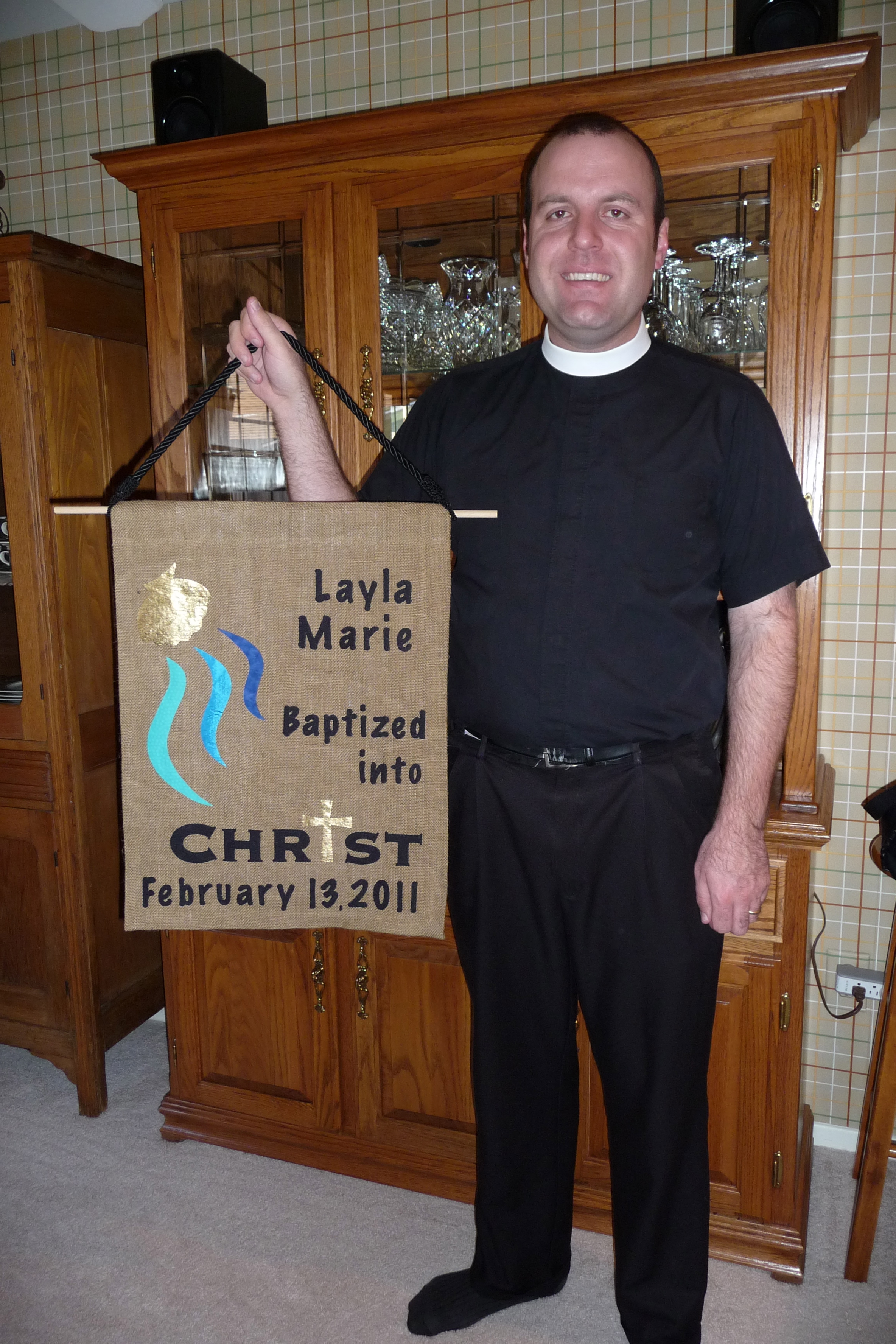 1. I grew up with a baptismal banner hanging in my bedroom. Every morning, noon, and night, I could look on my wall and be reminded of the day I was baptized into Christ. Because of this, I think it is important to make a baptismal banner (or some kind of commemorative item) for each godchild. Sometimes,
 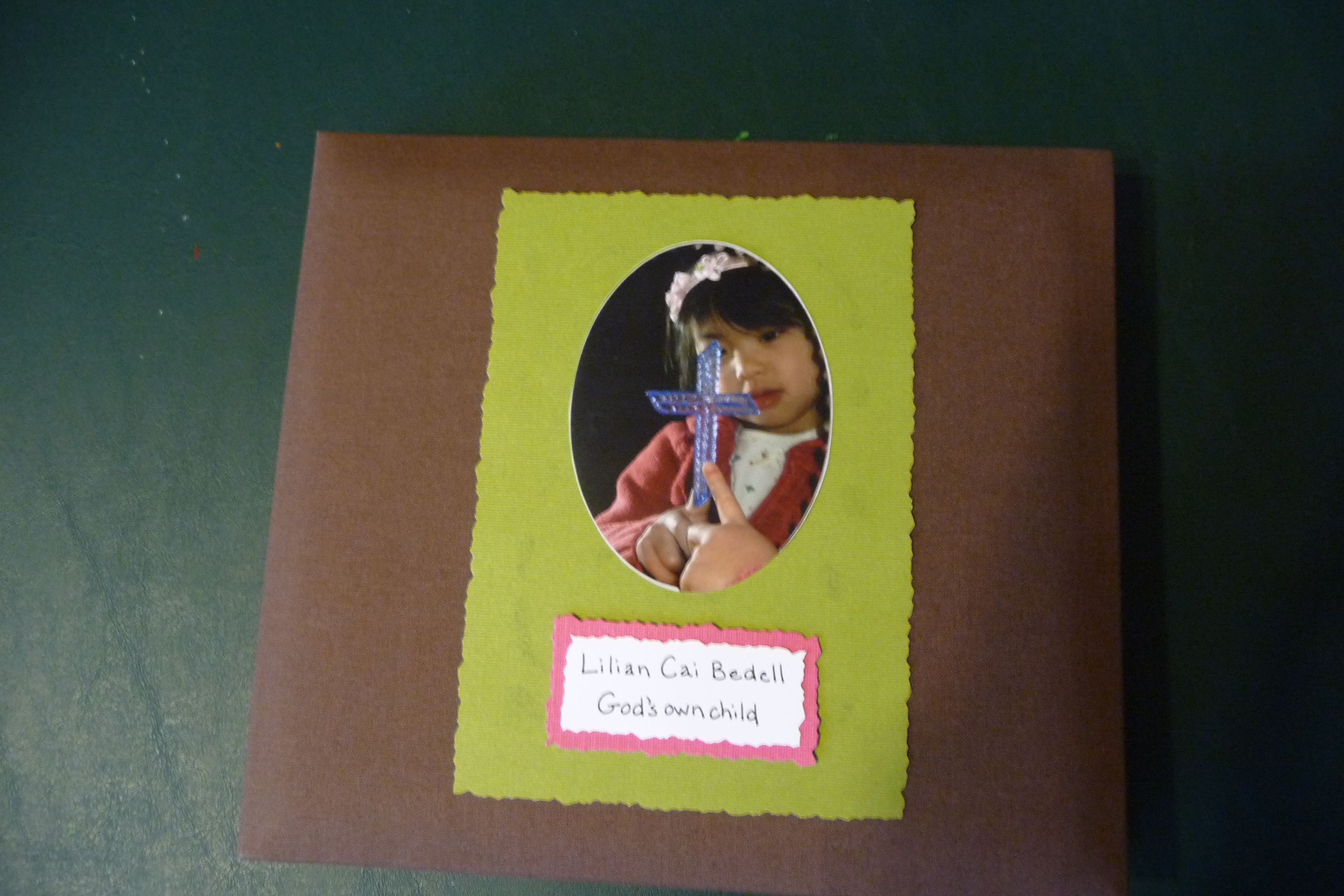 churches already have committees that make banners for their baptismal candidates. In these cases, you can make different things. I once made a candelabra to hold my godson’s baptismal candle, and on another occasion I made a mirror with a cross painted on it for my goddaughter to look in and see her cross-marked reflection.
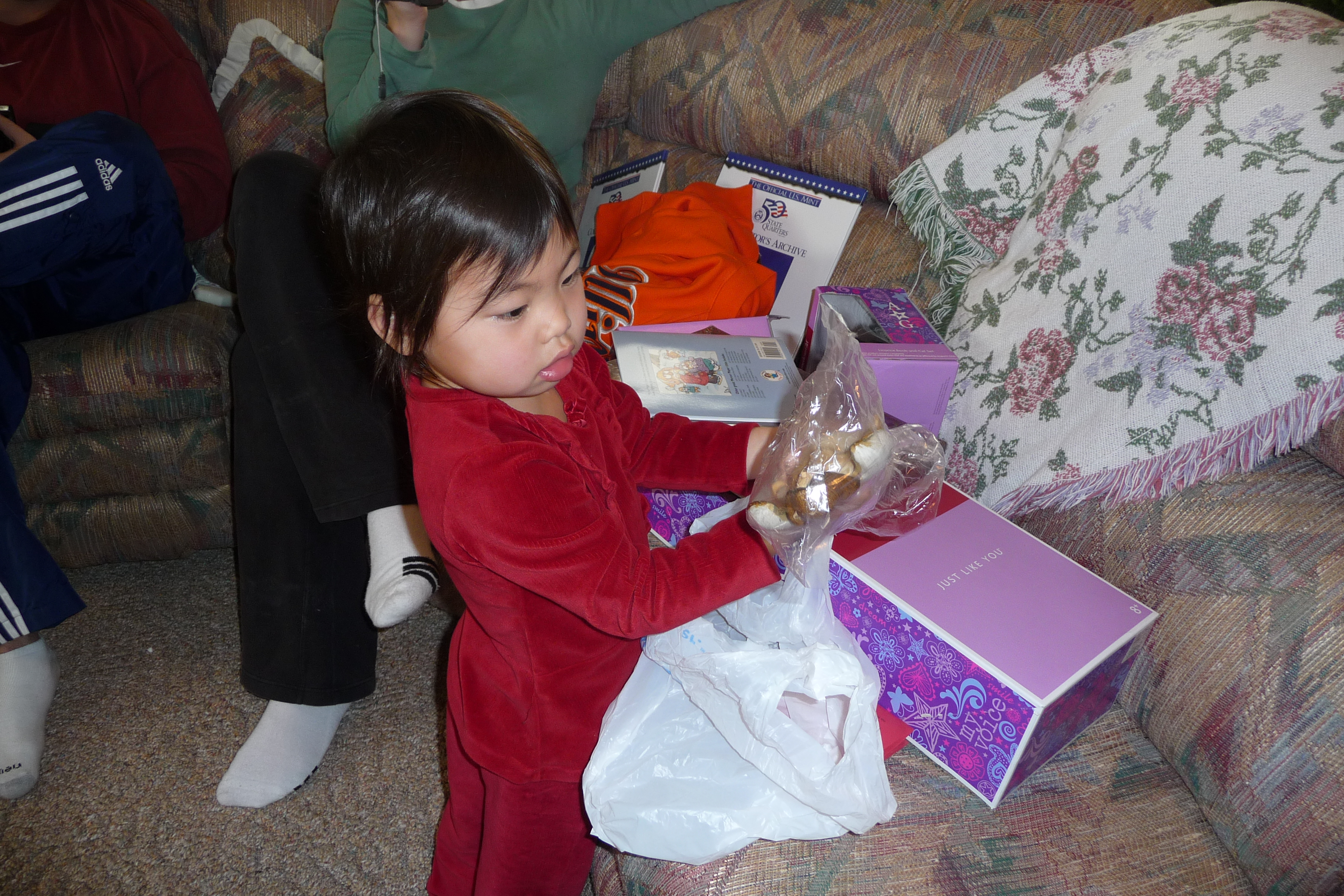 3. We buy them each their own nativity and give a new figurine from the set as a gift every Christmas (starting with Joseph, Mary, and Jesus the first Christmas). A lovely lady I met at seminary taught me this one. (Thank you, Elizabeth!)
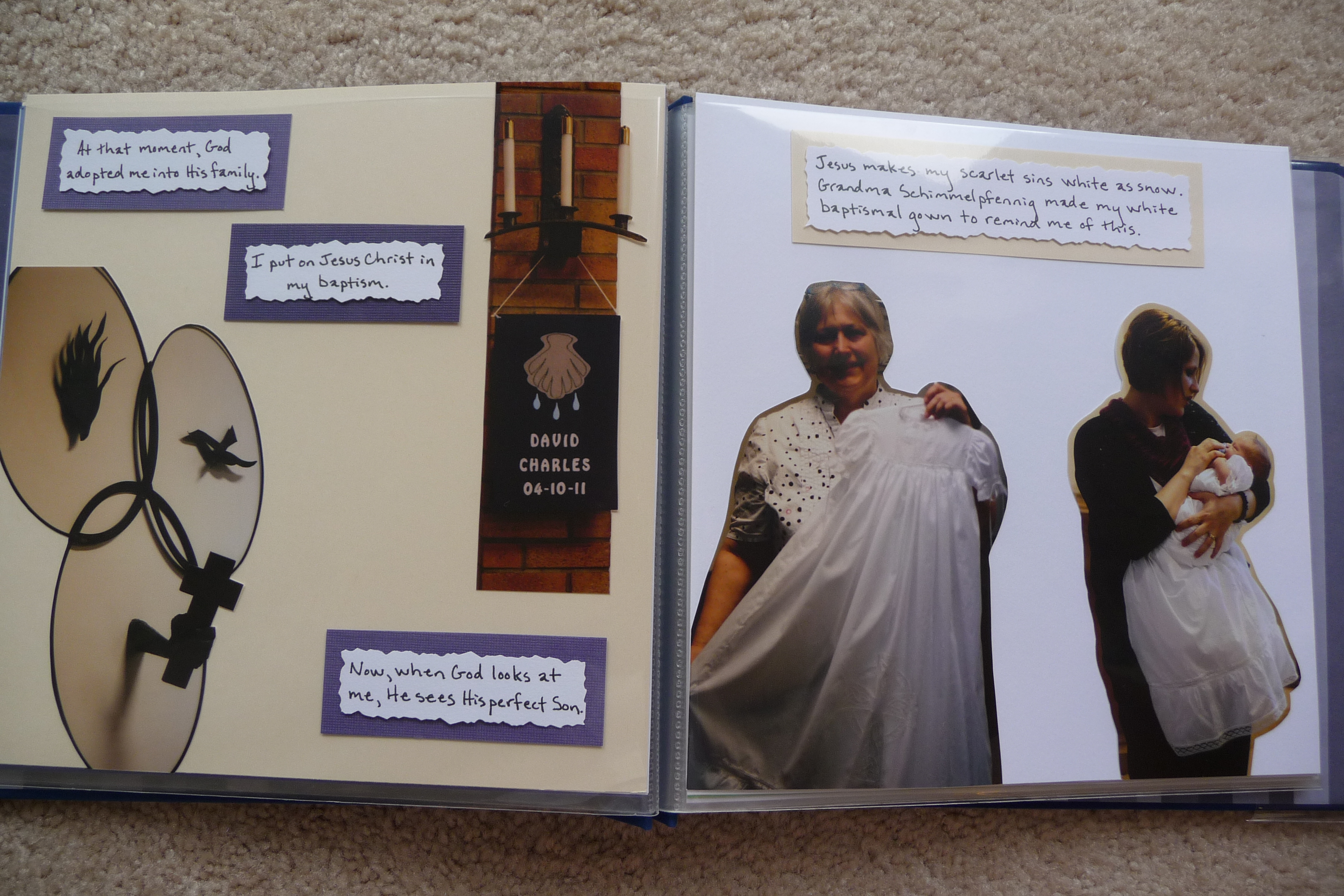 pictures and anecdotes from their baptism. It tells the story of their baptismal day and instructs them on what exactly happened when they were baptized. We like the idea of them looking at it throughout the years and growing up with the proper language of God’s free gift of salvation in their head and in their heart. It is also a great way to teach them the meanings of their white clothing, the candle, the sign of the cross, etc.
 5. We bribe them silly. We give them a quarter for every commandment they memorize. We take them out for ice cream when they memorize The Lord’s Prayer. We let them pick out three kinds of candy (one for each person in the Trinity) when they memorize The Apostles Creed. We also give them a quarter for every hymn stanza they learn, though we like to focus on The Ten Commandments, first. (Skype is a great tool for long distance catechismal questioning.)
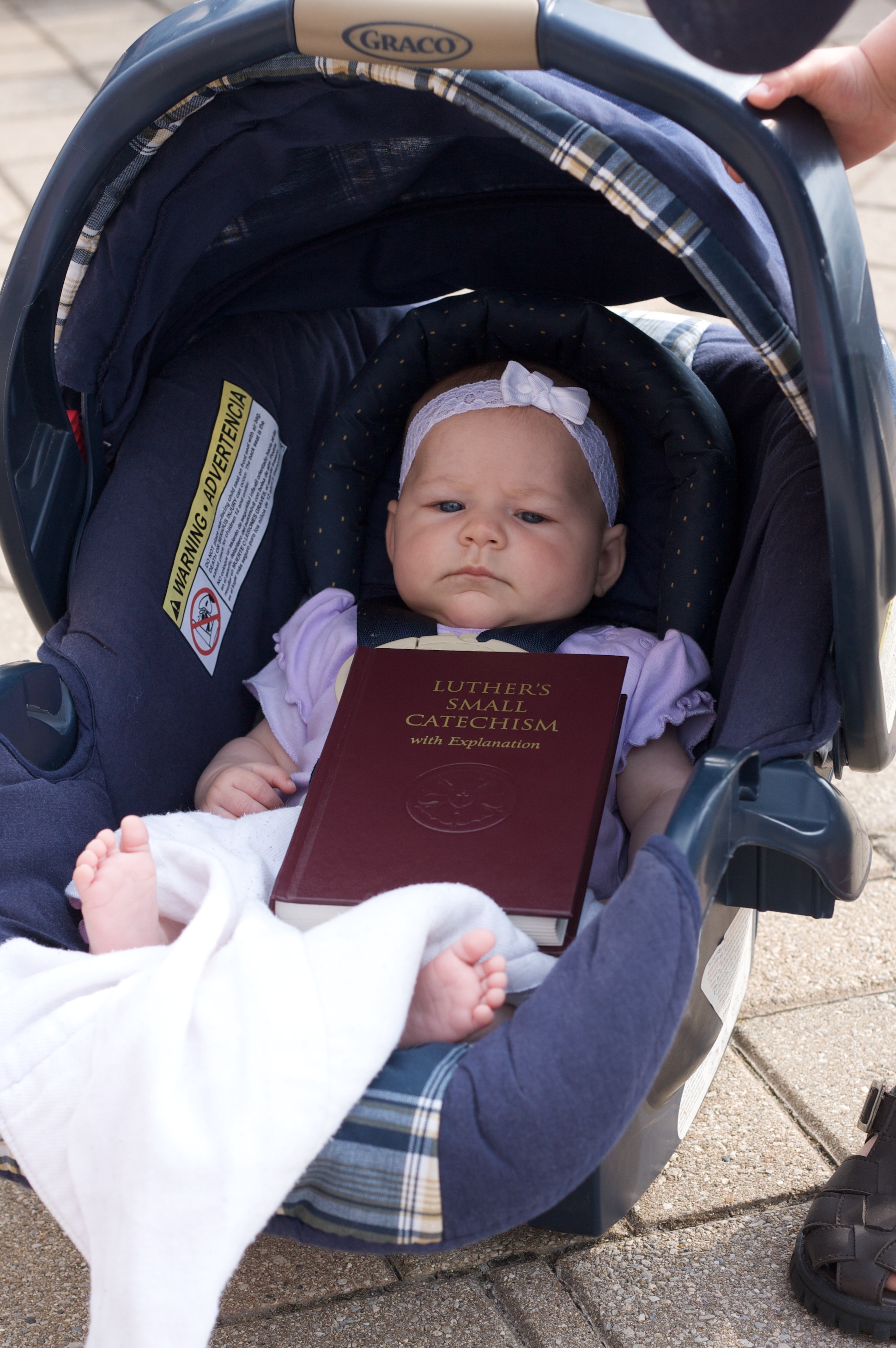 our godchildren over the years. Then, we try to supplement whatever they don’t have. If the family doesn’t already have a catechism or Bible, then we like to get them CPH’s The Story Bible and My First Catechism. We plan on giving our godchildren their own Lutheran Study Bible upon confirmation.
 8. I try to teach each of our godchildren the words and actions to both LSB 594 “God’s Own Child, I Gladly Say It” and the following baptismal song:







 He Remembers the Barren