Suffering

The Best Weapon against Temptation

There are reasons for seeking medical attention for infertility that can lead to sin. Answer these questions:

  • Do you wish to “make a baby” at the risk of hurting, even killing, your neighbor?
  • Do you think that having a baby is the only thing in life that can make you happy?
  • Do you put your identity in motherhood rather than in your Baptism?
  • Will your faith in God’s goodness to you in Christ Jesus be upset if you do not conceive?

These reasons for seeking medical intervention for infertility are temptations from the devil. These reasons entice us to serve our own desires and wishes, even when it means trusting the words of our doctors over the words of our Creator. We should be wary of these emotional snares that would bind our faith to things temporal rather than to things eternal.

What is our best weapon against such temptations and snares?

Rev. David H. Petersen gives us the answer in his sermon for the First Sunday in Lent – Invocabit (Genesis 3:1-21; 2 Corinthians 6:1-10; St. Matthew 4:1-11) as it appears in Thy Kingdom Come from Emmanuel Press:

All the temptations [of Jesus in the wilderness] show us something of the character of sin and the character of the God who overcomes sin. But the Lord’s response also shows us the best weapon we have against temptation and the only weapon we need. He says, again and again, “It is written.”

The strategy of the devil against our first parents, and then against our Savior, was to plant doubt. He wants us to place ourselves into the role of judge. We will decide what is good for food, pleasing to the eye, and capable of making us wise. We will decide if He is worthy of being our God. This is what we do when we declare, “My God would’t do this or say that.” But, in fact, we don’t get to decide who God is or what He should do. He tells us who He is and what He does in His Word. Faith built on emotions and feelings or our own reason and goodness is like seed sown on rocky ground. It has no root. In time of temptation, it withers and dies.

The answer to doubt is God’s Word. It is written. It is not fleeting, corruptible, or changing. It is solid, lasting, eternal. All things pass away, but the Word of God does not pass away. It is written, in the first place, on the page, not in our hearts. Even the Lord Himself, in the desert, submits to the written Word. It is the written, objective, unchanging Word. (Petersen, 29-30)

MP900314217

All Depends on Our Possessing

20091019-456

When with sorrow I am stricken,
Hope anew my heart will quicken;
All my longing shall be stilled.
To His lovingkindness tender
Soul and body I surrender,
For on God alone I build.

Well He knows what best to grant me;
All the longing hopes that haunt me,
Joy and sorrow, have their day.
I shall doubt His wisdom never;
As God wills, so be it ever;
I commit to Him my way.

If my days on earth He lengthen,
God my weary soul will strengthen;
All my trust in Him I place.
Earthly wealth is not abiding,
Like a stream away is gliding;
Safe I anchor in His grace.

“All Depends on Our Possessing,” Lutheran Service Book, 732 s.4-6

Wrestling With God, Against God

Sad Teenage GirlI remember hearing a sermon preached years ago that made such an impression on me that I have thought of it many times over the years and wished that I still had a copy of it. I believe it was called, “Wrestling With God, Against God,” with the corresponding lesson being Genesis 32 when Jacob wrestled with God incarnate. The message stayed with me because it was something I had never heard vocalized before, though I had felt it: sometimes in life we find ourselves in situations where God seems to be against us. No matter what we do we just can’t get a break. It’s as if we, like Jacob, were battling with a force who we thought wanted the best for us, but who won’t let us by to get to the destination that we seek. We are angry that we can’t proceed, we’re exhausted by the fight, and we are confused about who this contender really is: our friend or our foe?

My friend Sara, who lost her one-year-old daughter last May, has seemed a pillar of strength through these many years of dealing with serious health issues for two of her children. She has written beautiful posts that encourage and uplift her readers, even through her tragedies. She knows what Scripture has to say about God’s love and compassion. She can repeat it well to her readers. But in her recent post she confesses:

Round moons, and all the tulips in Holland couldn’t change the fact that this life of pain and sorrow was threatening to swallow me.  From where I sat, in the throes of depression, the truths I’d believed, rehearsed, written and proclaimed couldn’t gain traction.

Sara is wrestling with God, against God. Even she, who was and is a model to so many who are experiencing their own trials, has arrived at that point.

Jesus’ own cousin, the one of whom He said, “Among those born of women there has arisen no one greater than John the Baptist,” (Matt. 11:1), sent word through his disciples from his prison cell to find out from Jesus, “Are you the one who is to come, or shall we look for another?” (Matt. 11:3). Some commentaries say that John did this only to prove a point to his disciples; he never doubted Jesus’ mission. After all, he’d been at Jesus’ Baptism when the heavens had opened and the Father Himself had spoken. But some pastors I’ve talked to don’t buy this. John was in prison, suffering, and Jesus, his own relative who had proved to have power from on high, was apparently doing nothing. Is it possible that John, great as he was, reached a point where he, too, was wrestling with God, against God?

You can get to that point and still be a Christian. You can shake your fists and yell and feel forsaken and beaten down and still be “with God.” Because He isn’t going anywhere. In our frustration we can beg God to let us by and yet simultaneously we beg Him not to leave us. When your heart doesn’t feel the joy that was meant to accompany all of God’s promises to you in His Word, He doesn’t turn His back on you. When you demand answers for why this is happening to you, He may not give them to you, but He won’t plug His ears either. Rev. Bryan Wolfmueller made an excellent point in his Issues, Etc. radio interview following the shootings in Aurora, CO (paraphrasing): “Jesus doesn’t always give us the answers—but He always gives us Himself.” He gives us Himself sacramentally, when He is literally poured out for us into the chalice from which we drink. He gives us Himself through the absolution spoken by our pastors, “I forgive you all yours sins…” He gives us Himself through our fellow Christians, who reach out to us in love and concern.

Sometimes you just reach the bottom. All your efforts to feel better have failed. The hope is gone. And yet the Hope is not gone. Jesus is at the bottom, too. How you feel about His promises or the plans He may have for your life do not in any way change the validity of those promises, the efficacy of His Words, or His real and ever-present love for you. It’s easy to tell you to take comfort, to have faith, to “hold on.” It’s easy to tell you what to do or what to feel. But when you’re at the bottom, sometimes you can’t do or feel anything. And it’s OK to be honest with God about this.

Lord, I can’t wrestle anymore. I have nothing left. Dear Jesus, please carry me. Please give me the gifts You promise, even if I can’t receive them joyfully yet. Even if I don’t feel comforted. Keep giving me Yourself so that I may not drown in my sorrows in the bottom of this pit, but float to the top on all that You have poured out for me. Stay with me, even when I despair. Amen.

Compelling Distress

“But where there is to be a true prayer, there must be seriousness. People must feel their distress, and such distress presses them and compels them to call and cry out. Then prayer will be made willingly, as it ought to be. People will need no teaching about how to prepare for it and to reach the proper devotion. But the distress that ought to concern most (both for ourselves and everyone), you will find abundantly set forth in the Lord’s Prayer. Therefore, this prayer also serves as a reminder, so that we meditate on it and lay it to heart and do not fail to pray. For we all have enough things that we lack. The great problem is that we do not feel or recognize this. Therefore, God also requires that you weep and ask for such needs and wants, not because He does not know about them [Matthew 6:8], but so that you may kindle your heart to stronger and greater desires and make wide and open your cloak to receive much [Psalm 10:17].” Martin Luther, The Large Catechism, III: 26-27.*

* Concordia: The Lutheran Confessions (ed. Paul Timothy McCain; St. Louis, MO: Concordia Publishing House, 2005), 411.

The Great Getaway – IT’S A GO!

It’s official. The Great Getaway has been slotted for the last weekend in July.

Young Woman Sitting and Holding a Cup of Coffee

(contented sigh)

Who:  Any woman who suffers from barrenness, secondary infertility, or is grieving a recent miscarriage *

What: The Great Getaway retreat agenda

When: Friday, July 26th through Sunday, July 28th

Where: St. Louis, MO

Why: To getaway for a bit and relax in the company of your sisters in Christ

Interested in attending? Register online today and hightail it to St. Louis by 6:00 p.m. on Friday, July 26th. We’ll take care of the rest.

If you would like to attend the retreat but have trouble meeting the financial requirements, we HRTB hosts have penned a letter that can be sent to your family and/or friends asking for their sponsorship of your retreat attendance. Please do not hesitate to contact us if you need any help.

* Space is limited for this retreat. Women who have already contacted us expressing an interest in “The Great Getaway” get first dibs. After that, it is first come, first serve.

Unscripted

Life is unpredictable. (Isn’t that the understatement of the year?) Despite all of my organization, I’ll never be prepared for everything. If I could plan for every possible snag along the way, then I’d think pretty highly of myself.

However, I’ve experienced enough to know that there are plenty of unscripted moments. I couldn’t predict the trials that I have faced, and they have driven me to my knees in prayer. I have been reminded time and again to trust in the Triune God and His unfailing promises. God tells me that He will never leave me nor forsake me (Hebrews 13:5c). My times are in His hands (Psalm 31). He will never give me more than I can bear (1 Corinthians 10:13).

And so I offer a simple prayer: Thank you, God, for taking care of me. Amen.

Let Us Care for You!

A Middle Eastern woman with her daughter-in-lawI know one of the reasons you won’t confide in people about your barrenness. There are those who insist on fixing you. You know, the people who slip you a piece of paper with the name of a health book they think will cure your barrenness, or the people who tell you to relax or – my personal favorite – start the adoption process in order to get pregnant.

But not everyone wants to fix you. Some people just want to care for you. Leah Houghton, a mother and part-time social worker, is one of those people, and she has something she wants to say to you:

The journey to parenthood has certainly been very trying for my family. Just of few of these trials include a partial-miscarriage of my first pregnancy where I miscarried one of the twins with which I was pregnant. During a standard sonogram, our second child was diagnosed with a cleft lip and palate. We were told by doctors that he would be blind, deaf, and mentally delayed. We were also told he would have heart and lung problems and would be “grossly disfigured.” We would have to wait until his delivery to discover that none of these things were true about our son. Yet, we still faced (and are still facing) numerous surgeries, doctor’s visits, clinic appointments, speech therapy evaluations, etc.   

Just a little over a year after our son’s diagnosis, we experienced the miscarriage of our third pregnancy. I have also experienced moderate postpartum depression after the birth of my second child. Then, after I stopped nursing my daughter, I began experiencing severe anxiety and panic attacks (related to hormonal changes) that nearly incapacitated me for months. However, throughout all of these trials, the Lord has provided our daily bread and given us such grace and comfort. All these gifts truly surpass our understanding.

Sisters, I know from the outside that the woman who has a handful of young and energetic children may seem like the last person on earth to be able to provide you with any comfort when you are struggling with barrenness, and it is true that I cannot imagine the grief that an empty womb and an empty home must be. Yet, I encourage you to please tell your sisters in Christ your struggles. Let us care for you. Let us be a quiet ear to listen, a shoulder to cry on, and a comforting hand to hold. No, I don’t know what it is like to walk by empty nurseries that have been prayed over night after night with hopes that God would choose to fill that nursery in some way. No, I don’t know what it is like to have empty arms that so long to hold a child near. But, I do know what it is like to carry a child when you don’t know if you will ever get to bring that child home from the hospital; I know what it is like to grieve the loss of a child that you will never see on this earth; and I also know the strength and peace that can come from waiting on the Lord. And, sisters, I want to encourage you and carry that burden with you in prayer and love.

Please let us care for you!  Let us pray with and for each other and bear with one another in love!

Leah Houghton

I Just Can’t

LSome of you look at me like a deer in the headlights. You see the book I have in my extended hand. You see my intent to give it to you, and you flee.

“No,” you shake your head. Some of you even wave your hands. “No, I just can’t. I can’t read that.”

I am not into waterboarding, so I quickly slip the tool of torture back into my bag. Out of sight. “It’s okay. You don’t have to read it.”

This is usually when you start to cry. “I-I’m sorry. I’m sure it’s good. It’s just that…that…”

I know. I really do. You don’t want the word barren anywhere near you. You don’t want to read about someone else’s pain, because your own is already too much to bear. Your disappointment and fear and anger have all but extinguished the little flicker of child-fire inside of you, and you think this book is a swift wind that will snuff it out. You don’t want to be content in your childlessness. You want a child, and you will have one or go down fighting.

Most of us go down fighting, and that, dear sister, is why I wrote the book; not because I want your child-fire to die, but because I want you to be encouraged by the truth:

You are special, beloved by God, your Father. He has not forgotten you, nor has He forgotten that you want a child. Yet, children are not a prize for you to earn, a commodity for you to demand, nor an idol for you to worship. They are a gift which the Heavenly Father only has the privilege to bestow and to withhold. If God makes you a mother, then you can receive His good gift of a child with all joy and confidence in His love for you. If God does not make you a mother, then you can still know with all joy and confidence that God loves you completely in His perfect gift of the Child Jesus whose sacrifice on the cross atoned for your Sin and reconciled you to your Heavenly Father. You are God’s own child, purchased and won by the blood of Jesus, and God promises in His Word that He will work all things – even your barrenness – for your eternal good.

It’s okay to be sad. It’s okay to be okay. It’s even okay – Dare I write it? – to be content today without a child. His grace is sufficient for you. It really is.

Now, would you please go read the book? There are so many other comforting things I want to tell you.

Shifting My Focus

6903440032_ce4ef69a95Some words of wisdom from one of our readers:

I am reading The Spirituality of the Cross by Gene Veith Jr. and he quoted the following text by Richard Eyer (although it was written with euthanasia in mind, I find it still applies to the theme of “My Suffering Is a Blessing”):

Luther says, “Without the theology of the cross man misuses the best in the worst manner,” because the theology of the cross is the only way God works. “God wished to be recognized,” not in health, wealth, and success, but “in suffering.” As much as parishioners may want to see the hand of God in nature’s beautiful sunrises, moving stories of conversions, or success in parish programs, it is in the cross of Christ and in bearing their own crosses that God chooses to reveal His heart to them.

In speaking of the theology of glory Luther says, “A theology of glory calls evil good and good evil. A theology of the cross calls the thing what it actually is.”…

In short, the theology of the cross says that God comes to us through weakness and suffering, on the cross and in our own sufferings. The theology of the cross says, “My grace is sufficient for you, for my power is made perfect in weakness” The theology of glory on the other hand says that God is to be found, not in weakness but in power and strength and therefore we should look for him in signs of health, success, and outward victory over life’s ills. … All of us hold to a theology of glory at times, not wanting to surrender all to God, but holding out for how we want God to appear and do his magic in the midst of our troubles.

If we do not understand the distinction between the theology of the cross and the theology of glory, we will find ourselves drifting toward a theology of glory in which our culture believes God works though the self affirmation of pop psychology and instant gratification. We will begin to demand that God justify himself to us in our sufferings by giving us healing and success. We will demand a God who does what we want him to do and we will reject the way of the cross by which he comes to us. We will become fearful of suffering and preoccupied with its avoidance at the expense of truth and faithfulness, calling the evil of euthanasia “good” and the good of suffering “evil”.

Richard C. Eyer, Pastoral Care Under the Cross: God in the Midst of Suffering (St. Louis: Concordia Publishing House, 1994), 27-28.

Through our sufferings we are drawn closer to Christ and, more specifically, the cross. There we see God’s ultimate love and sacrifice for us undeserving sinners. We are reminded of the best gift we have through faith: the salvation that Jesus won for us through His perfect life, death, and resurrection. Even though I know this to be true, it helps to turn back to quotes like this one and remind my sinful nature to stop navel gazing in the midst of my suffering. Instead, I can shift my focus to the cross and what God has already done for me there.  

L. Meyer

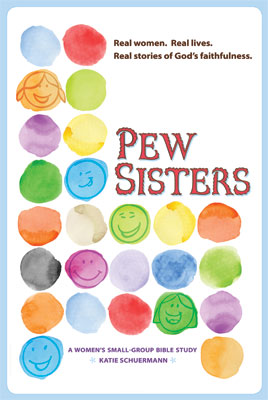
True Sisterhood is Pew Sisterhood: A Review of Katie’s Newest Book

204152The term “sisterhood” conjures up images of sororities, family gatherings, or that classic song from the movie White Christmas (“…there were never such devoted sisters”). Throughout a woman’s life she meets other females like her, women who are “in the same boat” at the time and can relate to what she’s going through in life. This blog is a prime example of a place where sisterhood is fostered and common experiences shared. Our readers feel a connection with one another and a sense of belonging.

This is a good thing, of course, but it’s important to realize the pitfalls of exclusive sisterhood. Katie Schuermann’s newest book, Pew Sisters, is a wake-up call to all of us who may be tempted to think only of the crosses that we bear and forget the battles that other women around us may be waging. Pew Sisters, which is arranged as a small group women’s Bible study, dives into the lives of twelve real women who experienced emotional, physical and spiritual trials in their pasts and were guided through these valleys by the loving hand of their Savior. This book is a reminder not only to open our eyes to those around us, but most importantly to fix our eyes “on Jesus, the founder and perfecter of our faith, who for the joy that was set before him endured the cross” (Heb. 12:2).

Pew Sisters exposes the secrets of the women you see each week in your own congregation. What often lies behind the practiced smiles and the “Oh, I’m fine” responses to your flippant “How are you?” are hardships. Katie so delicately reveals these hardships from the lives of women she has personally known at different times in her life. These women, who have so courageously allowed their stories to be told, do not hold back their faults or cover over poor decisions they may have made. Because of their honesty, Pew Sisters does not shy away from showing both saint and sinner. This realistic perspective helps the reader better identify with the woman who is highlighted in each session by bringing to the surface those sins and struggles that are common to so many of us—worry, regret, weariness, guilt, anger, doubt, despair—and documenting those specific ways in which the woman was comforted, found peace, or was encouraged. Sometimes the help came through her spouse, friend, or pastor, but it always came from the mercy and grace of Christ Jesus, revealed to her from His Holy Word.

This help comes to us, too, as we follow along with the study questions at the end of each story and eagerly turn to the study guide in the back to find out how Katie’s own pastors answered each question. The reader is not left to wonder if she is interpreting God’s Word correctly; she is coached by the professionals, those who have been trained and called to teach her what they have learned from years of study. This is an amazing addition to the Bible study: to be able to hear how two different theologians reflect upon those really tough questions about suffering and pain, forgiveness and hope.

What Pew Sisters will do for you, as a barren woman, is engage you in the very healthy practice of getting outside yourself and identifying with the sorrows of others. Maybe you’ve never been through a divorce, like Marianne, or dealt with the serious illness of a child, like Anna, or been diagnosed with cancer, like Christine. But you know some of the emotions they’ve experienced, and as a fellow member of the Body of Christ you have a connection with them—a sisterhood, if you will— that qualifies you to reach out in love. Katie even includes suggestions for how you can show this love to them in the “Moment in the Pew” sections that go along with each story.

It’s true that sharing in the suffering of another inevitably brings you both closer together. But Pew Sisters‘ intent is not to show the bond that exists between women who suffer in various ways. Rather it highlights the familial bond formed between us by our Baptisms and adoptions as daughters of our heavenly Father. This unity should motivate us to treasure each of those sisters in Christ who sit in front of, behind, or next to us on Sunday mornings. It should drive us to our knees in repentance for not caring for or about them, and in thanksgiving for those whom our Lord has sent to care for and about us.