For Better, For Worse

 Summer brings a host of weddings. How often, though, do you listen to the vows? I mean, really listen.

I, Andrea, take you, James, to be my wedded husband, to have and to hold, from this day forward, for better, for worse, for richer, for poorer, in sickness or in health, to love and to cherish ’till death do us part. And I pledge you my faithfulness.

The bride and groom promise to love each other through a variety of circumstances. I never stopped to think about all of the times that would be included in the phrase “for better, for worse.” I knew that there would be rough patches, but barrenness wasn’t even on the radar.

My husband and I desire to fill our home with joy and laughter, and if it God wills it, children. Unfortunately, sin is a part of marriage, too. Our bodies are sinful and broken. Multiple children have not been given to us. That definitely falls into the “for worse” category. Children are God’s gift to give. Is there a solution? How about some kind of medical procedure? Does that procedure follow God’s design for marriage and family, or does it compromise God’s plan for the one man-one woman union?

No matter if children are part of our family or not, God has brought me to my husband. Yes, there will be days that are worse than others. There will even be months and years that are terrible. Through it all, though, I am thankful that God provides comfort through my loving spouse. I never dreamed that barrenness would be part of my marriage. And still I am loved – by my husband, by my family, and by my church. I’ll file that in the “for better” category.

Is IVF Healing Medicine?

I am an advocate of healing medicine, both traditional and nontraditional.

I daily take prescription medication to keep my already overactive pancreas from kicking out more insulin into my bloodstream. I then supplement my medication with lots of exercise and a low-glucose diet.

My most recent venture into healing medicine involved a short round of hormone therapy to help my doctor properly diagnose several masses that were growing in my abdomen. I then underwent surgery to remove a batch of endometriomas and accompanying scar tissue from around my colon, bladder, and ovaries. Next, came a six-month regimen of Lupron shots to kill off the residual scar tissue my doctor had to leave behind, and, on top of that, I now eat a mostly pescetarian (vegan with fish) diet on top of my low-glucose fare to avoid environmental hormones, additives, preservatives, gluten, and nutrients which may cause inflammation in my body.

In other words, I prefer my medical cocktail as follows: one part traditional, two parts nontraditional, shaken with ice, and then straight down the hatch.

Why am I over-sharing all of this with you? I want to make it clear that I am a champion of healing medicine. I believe it is part of the daily bread God provides for us and that it is good and right to try to make the body whole. I believe that we are free in Christ to take medicine and to undergo diagnostic tests and to have surgeries and to train for triathlons and to sit for acupuncture treatments and to avoid dairy (Oh, wretched cross that I bear!) and to drink liquified kale for the healing purposes of our flesh.

However.

Like the Apostle Paul, I believe that my freedom in Christ, whether applied to medicine or to circumcision or to meat-eating or to whatever, is intended by God to serve my neighbor, not myself.

“For you were called to freedom, brothers. Only do not use your freedom as an opportunity for the flesh, but through love serve one another.” Galatians 5:13 (ESV)

We are totally free in Christ to seek healing medicine in our barrenness, but that freedom is still intended to serve our neighbor, even the little neighbor we hope to conceive in our womb. For this reason, I do not consider in vitro fertilization (IVF) to be healing medicine, nor do I consider it to rest safely within the realm of Christian freedom.

IVF does not simply seek to make the body whole, but it seeks to create children for our own purpose and use, whether that be cherishing, rejecting, discarding, freezing, or even killing. This is not using our Christian freedom to serve our neighbor. It is using our freedom to serve ourselves at the expense of our neighbor.

Let me draw a clear picture for you. When children are created in a petri dish during IVF, those children have no rights of their own. They, at the whim of the parent*, can be:

  • graded by appearance for their viability,
  • genetically tested for their sex, chromosomal abnormalities, and diseases,
  • discarded (in some cases, literally flushed down the drain) for their potential flaws,
  • put on ice to be stored, used, adopted, donated, tested, or killed at the parent’s leisure,
  • inserted into potentially inhospitable conditions in utero,
  • and, if part of a multiple pregnancy, selectively terminated and sacrificed for the vitality of a perceived stronger brother or sister in the womb.

IVF does not serve these children (our neighbors!) through love, but, at best, disrespects the personhood of the children created, and, at worst, serves as the concentration camp of the fertility industry.

Please be certain, it is the procedures surrounding IVF, not the children that result, that I am calling into question. As I wrote in my book, “Whatever sin and controversies may surround IVF, the children that are conceived and born to us through such procedures are still a heritage from the Lord. These children do not cease to be blessings and gifts from God simply because of the method by which they were conceived. We are not to think of these children as anything less than human beings who are wanted and cherished by our Lord. God’s love is what makes any and every child valuable in this life, not the means of parentage. Whatever decisions and actions parents may regret, the children that result from such decisions and actions are to be celebrated as the precious treasures that they are.” (He Remembers the Barren, 44-5)

Dear sisters, you may have already made use of IVF thinking that it was healing medicine. You may feel confused, angry, even guilty, right now. Do not despair! Your help is in the name of the Lord, who made heaven and earth. (Psalm 124:8) Christ, the Lamb of God, takes away the sin of the world. “Repent therefore, and turn again, that your sins may be blotted out, that times of refreshing may come from the presence of the Lord.” (Acts 3:19-20a ESV) Confess your regrets to your pastor to receive the peace of absolution, and let it be done to you as you believe.

* A frozen child’s right to life can also be at the whim of a government or a divorce court judge.

Those Awkward Pauses

There’s a situation that happens every so often and there just isn’t any way to avoid it. You run into a friend from the past and then you begin exchanging the customary greetings and pleasantries. The all too predictable questioning begins.

“How are you?”

“Where are you living now?”

“Are you still working in the same job?”

“How’s (fill in husband’s name)?”

And then (here it comes) the question you dread. Not that you mind answering it, but it’s what follows that is so painful. It’s the pause, the hesitation, the uncertainty of the other person in how to respond to your answer.

“So, how many kids do you have now?”

Whether you say, “We don’t have any children,” or “We still have just the one,” the awkward pause, or more likely the surprised “Oh…” that the other person uses to fill in the awkward pause, is still very uncomfortable. You know your friend is scrambling to try and find something to say in response, but she and the others before her have rarely done it gracefully. And come on, can you really blame them? The art of conversation in every culture has certain rules to it and you’ve just broken one. You’ve thrown off the other player and now she doesn’t know what move to make next.

A similar awkwardness happens to each of us when we are shocked to find out that an old aquaintence lost a husband or child or has cancer. But when I hear this news I am absolutely certain what my attitude should be. I should express sympathy and share how sorry I am. This is always the right move. But the thing that is different about sharing your barrenness is that others are not sure whether the news you are giving them is supposed to be good or bad .

You see, your old friend has other friends who have chosen to be childless. They dreaded the thought of a painful labor, whiny kids, and sleepless nights. Their unburdened lifestyle is carefree and spontaneous. They seem to be very happy. And in a split second your old friend has to try and figure out if you are one of them, too. Should she try and admire your freedom or pity your fruitlessness? She doesn’t know what is expected of her. And so she freezes.

So what’s the answer to this dilema? Love your neighbor. Show her what her next move should be. Be prepared for this question at all times and give an answer that expresses both your level of comfort with the topic and also paves the way for the conversation to continue on safe ground.

Here are some possible responses you can make:

“We haven’t been given the gift of any children yet. We still pray for them. We’re looking into adoption right now, though, and that’s exciting. What about your kids? What are their ages now?”

We haven’t been gifted with any children so far. We manage to keep pretty busy, though, with _______ and ______. What seems to take up most of your time these days?

“We still just have the one. He’s ____ now and is such a blessing to us. He loves ________ and ________. What have your kids been involved with lately?”

Whatever you do, don’t just throw out a statement and leave it hanging there, expecting her to continue the game without a fumble. Always end your answer with a question that shows sincere interest in her life. You’ll skip right over that awkward pause and at the same time be able to share the gifts God has given you now.

Miss Lotta

Having done my share of hosting this summer, I’ve learned some things. A household runs smoothly when everybody does their part to keep things going. I enjoyed cooking for lots of people, but that’s harder than I thought.  A large household is work. That mom has to be “on her game” all day long, with very few moments of rest.

Here is a sampling of things that the mom to multiple blessings encounters daily:

* a lotta cooking – You can’t have cereal for every meal.

* a lotta dishes

* a lotta trash

* a lotta toilet paper – Keep that door closed; there’s a toddler in the house.

* a lotta soap – hand soap, body wash, shampoo, dishwasher detergent, laundry detergent

* a lotta laundry – darks, whites, colors, delicates, sheets, towels

* a lotta talking

* a lotta tears

* a lotta laughter

* a lotta hugs and kisses

I admire and love the mom, who has been given a large family. She does so much to love and care for her family each and every day. My list didn’t include dusting, sweeping, going through the mail, diaper changes, grocery shopping, putting the groceries away, reading to the children, playing with the children, prayer time, and so many other things. It’s exhausting, just pondering it.

And yet she does it because children are God’s gifts to her.

I think I’ll name my next child Lotta.

70% Cocoa

Karl Marx had it wrong. The opiate of the masses is not religion. It is chocolate.

I can usually tell when a grief cycle is ramping up, because I seem unable to deny myself the simple, happy pleasure of chocolate products. And cheeseburgers. And Chinese food. And, come to think of it, bing cherries, too. There must be something to things that start with “ch” that sing “Self-medicate!” to my grieving subconscious.

It is so much easier to eat than to cry.

The next time you see me sitting at a table with only “ch” foods in front of me, gently pull the fork out of my hand and replace it with a box of Kleenexes. I and my waistline will thank you.

Murder, She Wrote

I grew up about five miles from my Grandpa and Grandma Bridges. My parents sometimes let me spend the night at their house, even an occasional Sunday night. It didn’t matter that it was a school night, for my usual, country school bus route passed right by their farm. I could just as easily be picked up there the next morning.

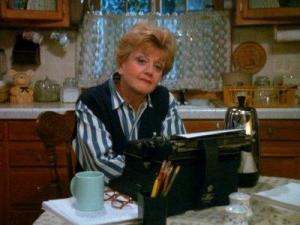
I have fond memories of Sunday nights at my grandparents’ house, sitting on their orange, floral couch in my mother-made flannel nightgown with rags tied in my straight hair to make it look curly the next morning like my sisters’. I happily ate popcorn from a green tupperware bowl while my grandparents and I watched television. I couldn’t wait for the second hand on 60 Minutes‘s endlessly ticking stopwatch to reach the number 12 so that I could finally live another vicarious hour of adventure through Jessica Fletcher in Murder, She Wrote.

Oh, how I loved to watch Mrs. Fletcher solve mysteries! Imagine being a professional writer, taking train rides to New York to meet with a publisher, drinking coffee and tea in fancy hotels, and interacting with such glamorous, interesting people, all the while figuring out it was the son of the Broadway star “who done it.”

Thanks to Netflix, I’ve reunited with Mrs. Fletcher once again. As we’ve been visiting, I’ve discovered that my youthful vision missed a few key facts about my favorite, classy sleuth. For one, in the memorable opening credits sequence in which she is typing away at another mystery, Mrs. Fletcher is wearing a wedding ring. I hadn’t remembered that she was a widow.

The biggest surprise for me, though, came in Episode 4 of Season 1. One afternoon, a mysterious stranger sits at Mrs. Fletcher’s table in Cabot Cove, Maine and asks her a simple question: “You have children?”

Mrs. Fletcher answers, “Oh, no, no. Frank and I were never blessed that way.”

I definitely hadn’t remembered that Jessica Fletcher was barren and a gift-language-wielding barren woman at that!

Thank you, Mrs. Fletcher. You get even better with age.

Her Hands Are Full

Snake’s alive! This world sure is a Debbie Downer when it comes to kids.
I have a friend who is expecting Baby # __ (insert any numeric value over the culturally acceptable number of two), and almost anyone and everyone I tell about Baby’s pending birth says of my friend: “Wow. She has her hands full!”

Not, “Congratulations!” or “Wonderful!” or “How exciting!” or “Praise God for His good gift!” but a pair of raised eyebrows and strained words of judgment.

Is it really such a strange thing to us in the Church that a married couple should welcome more than two children into their family as gifts from God? For, you see, that is what children are to us. They are gifts. We know this to be true, because that is what God tells us in His Word. Children are a heritage from Him, and the couple who has them is blessed. (Psalm 127)

Sure, children may be work. They may require us to give up our annual trek to Sonoma or to forgo buying a new dress every Easter or to miss sleeping for an entire year, but that does not change the truth in God’s Word that children are a sign of His favor. And God’s Word doesn’t differentiate. Baby #8 is just as much of a blessing and a gift as Baby #1. We are so selfish when we think that it is our love and desire that make a child valuable, as if our own wanting or not wanting should determine the goodness of God’s gifts. It is God’s love that gives any of us value, including the children He wants to give to us.

So, whenever someone gives me a “Wow, she has her hands full!” in response to my friend’s blessed state, I usually have to manhandle my eyeballs to keep them from rolling and squeeze my lips shut to keep a sigh of exasperation from escaping. Once my body parts are properly submissive, I try to smile brightly and confess boldly, “Yes, her hands are full of blessings from God!”

Either children are a blessing, or they aren’t. Either God’s Word is true, or it isn’t. Which one is it?

If you don’t know, ask a barren woman.

Celebration

I have this friend. She is crazy talented and super smart. She teaches world music, composes trombone octets, circular breathes into her flute, and, when she’s not busy traipsing around the globe to play international recitals, she hangs out with lowly, Lupron-riddled me.

She asked me about a month ago, “Hey, aren’t you nearing the end of your shots? When’s your last one?”

I blubbered something about it being the last Friday morning in June.

She looked my needle-weary self in the eye and said, “I’m coming with you.”

And, she did. This morning, my busy friend braved the Dallas traffic to meet me at the hospital at 8:00 o’clock sharp. She walked me into the exam room, cheered me through an inconvenient hot flash, winced in sympathy at the giant needle, hugged me through an emotional wave of relief in the parking lot, and, when it was all over, sat on a balcony with me at my favorite restaurant to share a cup of coffee and a chocolate muffin.

Do you want to know the best part? On our way out the door, I got a quick peek at my friend’s day schedule. The whole morning had been blocked out with the words, “Celebration with Katie.”

I don’t know if I could have felt more loved or better understood than I did in that moment.

So, if you are wondering what to do to help a barren friend through a difficult time, take a cue from Lisa: add a little more celebration to her life.