Miscarriage

Aftermath

You told me one night.

Though Easter had come and gone, I saw the fast of Lent alive in your eyes. Yes, even now you keep a pious vigil, twenty years of Tenebrae, still afraid of the strepitus.

You all but cover your ears.

“I had a miscarriage in between the boys. They told me the baby was dead, so I went in for a D&C.”

It happened a generation ago, but you still can’t look at me. You shake your head.

“I couldn’t sleep for weeks. I was afraid. What if I had- ”

You stop. You are a grandma, a happy grandma, but your second child’s Good Friday still haunts you. It is not finished for you. Not yet.

“I went to the hospital and made them show me the records.”

I suck in my breath. This is not grief over death as I had thought. This is something different. This is fear. Over murder.

“I had to know that the baby was really dead before, you know…”

I did know, though I had never considered it. Of course. It is the same procedure, the same legal procedure whether dead or alive.

“The records said she was dead before the D&C.”

I feel relief. Then sudden guilt. Then relief again. She miscarried not murdered.

Wait.

I catch myself in the considering, and my anger is immediate. Burning hot.

This is the sick world in which we live: A mother cannot merely grieve the death of her miscarried child. She cannot simply undergo a procedure and trust that it is reserved for mothers who want their babies but have lost them. She now has to question, has to fear the hostile world that willingly, profitably D&Cs babies to death, and wonder whether or not her procedure of healing medicine was really healing or not.

This is a cruel cruelty.

Cherry Blossoms

Let Us Care for You!

A Middle Eastern woman with her daughter-in-lawI know one of the reasons you won’t confide in people about your barrenness. There are those who insist on fixing you. You know, the people who slip you a piece of paper with the name of a health book they think will cure your barrenness, or the people who tell you to relax or – my personal favorite – start the adoption process in order to get pregnant.

But not everyone wants to fix you. Some people just want to care for you. Leah Houghton, a mother and part-time social worker, is one of those people, and she has something she wants to say to you:

The journey to parenthood has certainly been very trying for my family. Just of few of these trials include a partial-miscarriage of my first pregnancy where I miscarried one of the twins with which I was pregnant. During a standard sonogram, our second child was diagnosed with a cleft lip and palate. We were told by doctors that he would be blind, deaf, and mentally delayed. We were also told he would have heart and lung problems and would be “grossly disfigured.” We would have to wait until his delivery to discover that none of these things were true about our son. Yet, we still faced (and are still facing) numerous surgeries, doctor’s visits, clinic appointments, speech therapy evaluations, etc.   

Just a little over a year after our son’s diagnosis, we experienced the miscarriage of our third pregnancy. I have also experienced moderate postpartum depression after the birth of my second child. Then, after I stopped nursing my daughter, I began experiencing severe anxiety and panic attacks (related to hormonal changes) that nearly incapacitated me for months. However, throughout all of these trials, the Lord has provided our daily bread and given us such grace and comfort. All these gifts truly surpass our understanding.

Sisters, I know from the outside that the woman who has a handful of young and energetic children may seem like the last person on earth to be able to provide you with any comfort when you are struggling with barrenness, and it is true that I cannot imagine the grief that an empty womb and an empty home must be. Yet, I encourage you to please tell your sisters in Christ your struggles. Let us care for you. Let us be a quiet ear to listen, a shoulder to cry on, and a comforting hand to hold. No, I don’t know what it is like to walk by empty nurseries that have been prayed over night after night with hopes that God would choose to fill that nursery in some way. No, I don’t know what it is like to have empty arms that so long to hold a child near. But, I do know what it is like to carry a child when you don’t know if you will ever get to bring that child home from the hospital; I know what it is like to grieve the loss of a child that you will never see on this earth; and I also know the strength and peace that can come from waiting on the Lord. And, sisters, I want to encourage you and carry that burden with you in prayer and love.

Please let us care for you!  Let us pray with and for each other and bear with one another in love!

Leah Houghton
An Agonizing Absence

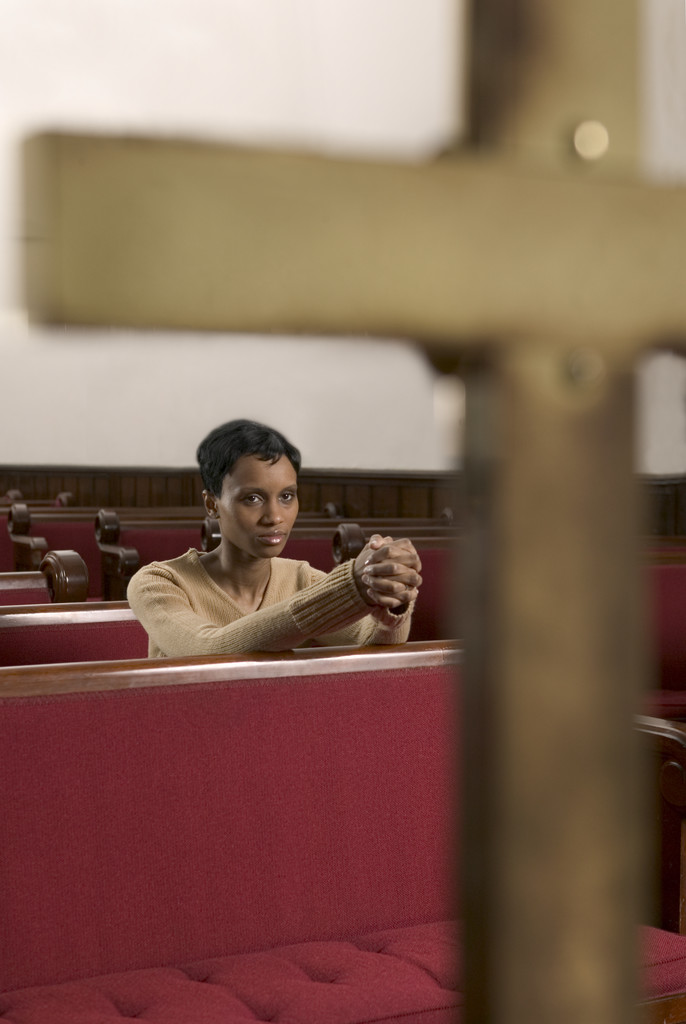
Woman Praying in ChurchA barren friend recently confided to me, “I broke down crying the other day. I don’t really know why. I mean, I thought I would be over this by now.”

I don’t think we ever get over this barrenness thing, because no matter how comfortable we become, no matter how content we grow in our childlessness, it is still not the way things are supposed to be. God commanded us via Adam and Eve in the garden to be fruitful and multiply, and we know that it is God’s good will for us to have the blessing of children in marriage.

Yet, we don’t.

Our barren wombs are a reminder, a manifestation even, of the brokenness of this Sin-sick world, and, even though we are blessed and fruitful beyond measure today in Christ, the wrongness of our childless marriage still stings. And so we grieve.

Rev. Gregory Schulz describes it this way in The Problem of Suffering: A Father’s Hope:

[G]rief is love. This means that grief is a kind of care…Grief as care is an obsession, an attention – not to “mortality” or to “the human condition” – but to a person who is at the same time dearly loved and agonizingly absent. (Schulz, 102-3)

We cry, because our dearly loved children are agonizingly absent.


A Season to Share

Christmas Picture of Mother and DaughterRachel Pollock reminds us in her reflection on “My Suffering Is a Blessing” that we all endure suffering and enjoy blessings throughout the year, and we in the body of Christ can be there to share in all of them.

I had to update addresses before I could send Christmas cards this year. There were joyous updates. I added names of friends that got married, had babies, or finalized adoptions. It seemed there were more sad updates. Some of the names I had to remove because:

  • they had divorced or died. The worst was when an entire entry had to be removed because both spouses had died.
  • a father had committed suicide, and this affects his wife/children/grandchildren daily.
  • a child had lost the battle with leukemia.
  • A spouse had died when he seemed way too young to die.
  • they have dementia, and a letter would confuse them.

When I wrote the addresses on the envelopes I reflected on some of the suffering:  

  • those who are single and would like to be married.
  • many couples that are barren or have not been blessed with a sibling for their only child.
  • many families that have experienced a miscarriage.
  • those who the doctor recommends no more pregnancies for the mother’s health.
  • those families that have so many children that being pregnant one more time feels like a burden for them.
  • those with cancer or Parkinson’s or depression. 
  • those that are unemployed or not in a job they really want.
  • families that live very far from extended family.
  • a family with a seriously ill child.

It is even more difficult to write a Christmas letter with updates about our family. What a downer it would be to put in the letter that we have had six miscarriages. I would love to add in our letter that our youngest is actually younger than our four-year-old.

There are some obvious blessings to reflect on as I update the addresses:

  • a mother that is counting the days that she is still pregnant after many miscarriages, and it seems that she will get to rock and hold a little girl in a few months.
  • families that are healing after the death of a loved one or a divorce.
  • families that were able to adopt a child.
  • a family that rejoices because their child is healthy after major surgery.

Our family has many blessings, too. We have many friends and family all over the world to whom we send Christmas cards. My husband is healthy after a major surgery two years ago. We have three healthy sons. Both sets of our parents are alive and still married to each other. We added a brother-in-law to our family last year. We were able to move closer to one side of the family and able to buy a house beyond what we expected. My husband has a good job. We are part of a wonderful church family.

Yet, there are more blessings, still. Each day I thank and praise God that He safely brought me to another day to live out my baptismal life in Christ. We should not despair even when thinking of all the suffering of our family and friends. Whatever happens in our lives, we are God’s children and God will work it for our eternal good. God will provide and care for our every need. My address list will always have suffering on it because we live in a sinful world. Jesus has conquered sin, death, and the devil. We press on towards the goal of eternal life in heaven. Because of all the suffering on earth, we long for heaven even more.

“Be near me, Lord Jesus: I ask Thee to stay

Close by me forever and love me, I pray.

Bless all the dear children in Thy tender care,

And take us to heaven to live with Thee there.”

LSB 364:3


Rachel Pollock

“My Suffering Is a Blessing” Contest Winner

Crucifix on a Wall

Blessed Epiphany!

Thank you for taking the time to reflect on “My Suffering Is a Blessing” with us this holy season. It is a privilege to be on the receiving end of your thoughtful words (so much so that we are tempted to host more writing contests throughout the year), and we greatly appreciate your participation in such ventures. It truly is an honor to read your submissions.

We’d like to share five posts with you this week, starting today with a post written by our contest winner, Heidi Dawn Sias. Congratulations, Heidi, on winning a free copy of He Remembers the Barren, and thank you for allowing us to share your words of wisdom and encouragement below.

Grateful,

Your HRTB Hosts

It’s that time of year again: a time for gifts, a time for family gatherings, a time for Christmas cookies, a time for singing carols, a time for New Year’s parties, and a time for children, as they have “visions of sugar-plums” dancing in their heads…whatever that means. It’s the most wonderful time of the year, right? It’s so much fun to watch children’s eyes light up when they see the lighted Christmas tree with gifts strewn beneath it, and welcome another New Year with hearts full of hopes and dreams. But what about families struggling to make ends meet; what about families who can’t be together; what about families who have lost someone this past year; what about the twenty families in Connecticut who will look at the gifts they bought for their children this year with tears streaming down their face; what about the family in our community here who eagerly awaited their newborn daughter to arrive around Christmas but attended her funeral instead; what about our friend’s extended family member with six-month-old twins, who lost one twin to SIDS just four days before Christmas; what about my sister-in-law whose one-year-old son died one month after Christmas last year after spending his entire life in the hospital; what about me….entering my final child-bearing years and still without a child of my own to hold? These things hurt deeply and we ask, “why?” We might begin to look at the New Year with anxiety wondering what will happen next. Sometimes this time of year reminds us even more of the suffering we’ve endured instead of being the most wonderful time of the year.

But Christmas is about Jesus. It’s not about sugar-plums. Jesus became flesh and dwelt among us. That’s Christmas. That’s what we celebrate. That little baby came to take on my burdens and to die on a cross. That little baby is my comfort in suffering. My suffering draws me back again and again to the foot of the cross, weary and weeping. Jesus lifts up my head and points me back to His manger, back to His cross, and says, “I did that for you.” He calls me to himself and says, “Come to me, all who labor and are heavy laden, and I will give you rest.” (Matt. 11:28) I can rejoice in my suffering “knowing that suffering produces endurance, and endurance produces character, and character produces hope, and hope does not put us to shame, because God’s love has been poured into our hearts through the Holy Spirit who has been given to us.” (Rom. 5:3–5) It’s a perplexing phrase: “rejoice in my sufferings.” But I can, because in the end suffering gives me hope. Hope in Christ, the only Hope. Of course, I cry in my sufferings too, but I can still rejoice in knowing God’s love has been poured into my heart. He has made promises that I can count on. He weeps with me, wipes away my tears, and says, “come to me so I can comfort you.” I receive Him in faith, I rest in Him, and I cling to the promises He gives me in His Word; promises of forgiveness, life, and salvation. Hope for a future with Him. Jesus came for me. Jesus came for you. That’s worth celebrating no matter what sufferings we endure. It’s worth celebrating at Christmas, and it’s worth celebrating all year round. My suffering is a blessing because it points me to Christ, and He is all I really need.

Heidi Dawn Sias

An Awkward Christmas Gift

I know, I know.

He Remembers the Barren is not exactly the kind of gift you want to wrap up and put under the tree for your loved one. Who wants to open a package and find this inside instead of something from Williams-Sonoma?

HRTB.Proof 1

I mean, did you see the cover? Talk about awkward when everyone else around the tree stops and asks your loved one, “Ooo, what did you get?”

And, let’s be honest, the book doesn’t exactly make a great stocking stuffer, either. It would go over like a detonated grenade amongst the dark chocolate, fuzzy socks, and iTunes gift cards.

Yet, I still think He Remembers the Barren  is a good gift worthy of giving, because the holidays can be one of the most difficult times of the year for a barren woman. She can’t escape her grief when she is surrounded by children’s Christmas programs at church, family dinners galore, and greeting cards introducing everybody else’s newest editions to their families; she has to endure renditions of Connie Francis’s “Baby’s First Christmas” over the sound system whenever she goes shopping; she has to maintain her game face for an entire month’s worth of watching other people’s children enjoy the festivities and holiday traditions. It can be rough.

So, please consider giving your loved one He Remembers the Barren this season of Advent, but use some of your James Bond-esque stealth in the giving. Here are some suggested tactics (Q and M approved, of course):

  • Read the book yourself, so that you know what your loved one is going through and can better love her through her grief and suffering.
  • Give the book to your loved one’s parents, siblings, pastor, etc. for the same reasons.
  • Write a note to go with the book (i.e. “This book is not a label or a judgment. It is a great big hug from me to you. I read it, and it helped me know that God remembers me even when I suffer. I thought it might help you, too. I love you.”)
  • Give her the book in private and at a time when she does not need to be around people for awhile. You can mail it to her home, or you can hand it to her wrapped and tell her to wait until she is alone to open it.
  • If you two already have a history of openly discussing her barrenness, then give it to her in person when it is just the two of you. And tell her what she means to you.
  • Once you give it to her, don’t bring it up. Wait for her to talk about it or not talk about it.
  • Don’t be offended if she doesn’t read it for awhile. Depending on what phase of the grief cycle she is currently experiencing, she may want nothing to do with it at first. She might even be embarrassed or offended. Still, won’t it be nice that the book will be there for her when she is ready for it?

Thank you for caring enough for your loved one to do what is hard. She is blessed to have you in her life.

Second Annual Writing Contest

Christmas lightsDear Women, Men, Married, Single, Barren, and Blessed:

We’ve got another writing contest brewing.

Last year, we asked you to reflect on the topic “Advent and Barrenness.” This year, we would like you to submit posts on the topic “My Suffering Is a Blessing.” The winning post, chosen by our panel of hosts, will receive a free copy of He Remembers the Barren as well as a surprise. (That’s right. A surprise.) The top three finalists will also see their posts featured on our website.

Simply compose your post of 600 words or less in an email and send it to katie@katieschuermann.com by December 25th. The winner will be announced on Epiphany (January 6th).

Please be sure to include your name and shipping address in the email.

Sincerely,

Your HRTB Hosts

Words of Grief and Hope

cross markerSpecial thanks to the Rev. Todd A. Peperkorn for granting permission to reprint this post from his website “Lutheran Logomaniac.” Pastor Peperkorn is a husband, a father, and a pastor. He shares his grief and his confidence in the promise of the resurrection on the Last Day.

“Nadia After Eight”

Each year the day after Thanksgiving begins a period for me where a whole bunch of anniversaries begin. The first is the death of our unborn daughter, Nadia. After that comes the death of our unborn son, Emmanuel. Then it is the death of my mother. Finally is the time when I went on disability for clinical depression.

In many ways my grief is less raw than it once was. It is less primal and fear inducing. My grief now has taken on another character. That character is grief as guilt.

I remember when Nadia died eight years ago. No one knows what to do with a miscarriage. Is it a big deal or not? How do people react to such a thing? And because no one knows what to do, that generally means that most people do nothing. We had a lot of family staying with us when Nadia died, and sure enough, they really did nothing.

I remember being angry at them, so very angry. WE LOST A BABY! Why don’t you care?

Eight years later, I can see that my anger at them was really not directed so much at them as it was at God. They were simply an easier target. When someone dies, above all you want someone to DO SOMETHING ABOUT IT. Fix it, somehow. The least you can do is die with them. But it doesn’t work that way. Someone dies, and everything else just lingers on. Eventually things return to normal, whatever that means. But that smoldering anger remains.

The fact is that God did do something about Nadia’s death. He sent His Son into another womb, helpless and in complete and utter need. And He lived that life of no consequence, just like everyone else’s life. You wouldn’t know Him by looking at Him. And so it is that He died. He died for all of the Nadias out there. He died for all the children born and unborn who are enslaved by this grip of death. He died for the grieving and lingering. He died for them and for me. And you.

I’m not angry at God anymore. Not about that, at least. Ok, not as much. But the grief remains. I cling to this grief, believing that by holding onto this grief (and anger) I can somehow maintain the rightness of my cause. Surely God will do something about this. Surely He will call her from the dead. Surely we will feast together at the Last Day. Surely God will dry our tears. Surely…

Zion hears the watchmen singing,

And all her heart with joy is springing;

She wakes, she rises from her gloom.

For her Lord comes down all-glorious,

The strong in grace, in truth victorious;

Her star is ris’n, her light is come.

Now come, Thou Blessèd One,

Lord Jesus, God’s own Son,

Hail! Hosanna!

We enter all

The wedding hall

To eat the Supper at Thy call.

(LSB 516:2)